Address
Zhengzhou, Henan, China
Work Hours
Monday to Friday: 7AM - 7PM
Weekend: 10AM - 5PM
Address
Zhengzhou, Henan, China
Work Hours
Monday to Friday: 7AM - 7PM
Weekend: 10AM - 5PM

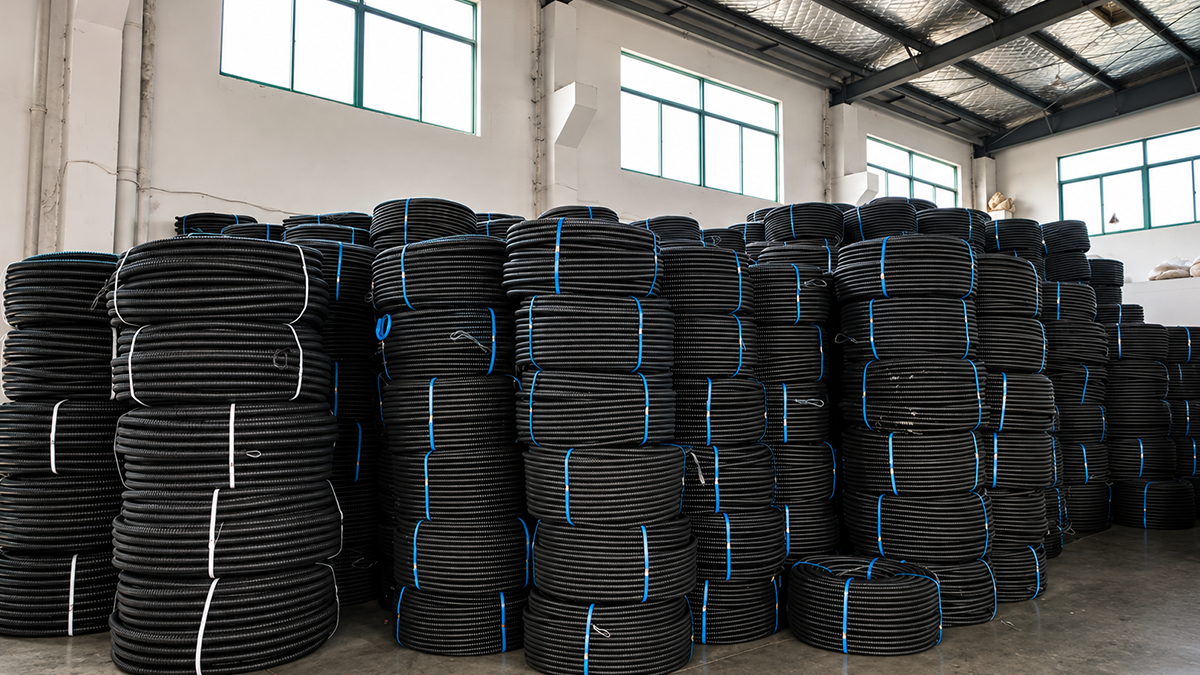
This guide helps global buyers evaluate HDPE single wall corrugated pipe suppliers from China, covering specifications, wholesale pricing, MOQ, OEM customization, quality standards, and supplier vetting—so you can source reliably and reduce procurement risk.
High-Density Polyethylene (HDPE) single-wall corrugated pipe serves as a highly flexible, lightweight conduit and drainage solution, easily recognizable by its ribbed profile inside and out. Produced via continuous extrusion, this specific piping is purpose-built for shallow, gravity-fed (non-pressure) applications. It strikes an excellent balance for projects demanding tight bending radii alongside strict material budgets.
Procurement teams frequently weigh single-wall against double-wall configurations. Thanks to its unmatched flexibility, single-wall corrugated pipe easily snakes around underground obstacles. This makes it a go-to choice for agricultural drainage and cable protection, typically offering a solid 10- to 25-year service life. Double Wall Corrugated (DWC) pipe, on the other hand, pairs a ribbed outer shell with a completely smooth inner bore. That smooth interior dramatically boosts hydraulic efficiency—hitting a Manning’s n value between 0.009 and 0.011—while the dual-layer structure achieves higher load-bearing ratings (SN4 to SN8). Consequently, DWC pipes often surpass the 50-year mark, making them the standard for heavy-duty municipal infrastructure.
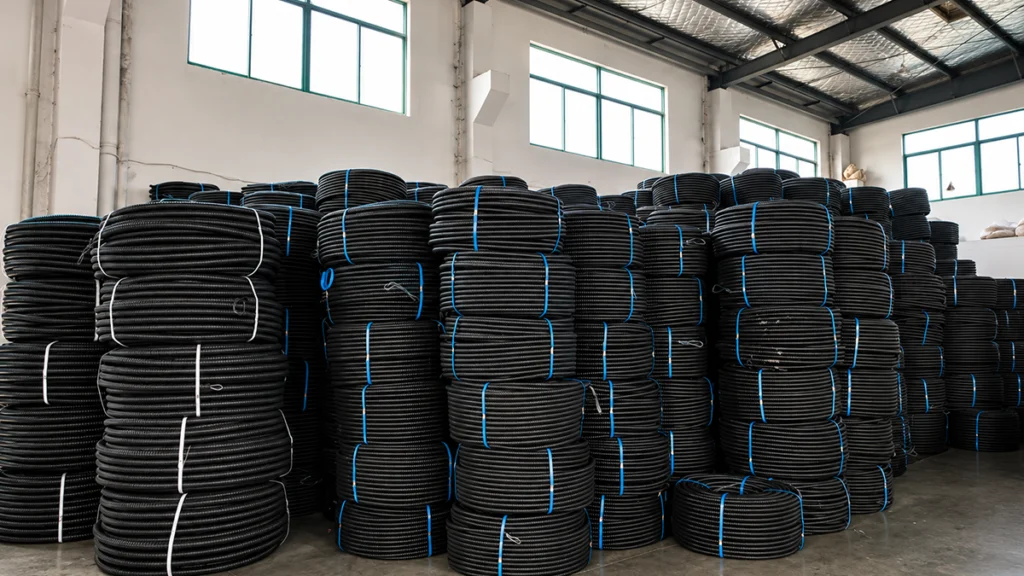
Cost Advantage and Labor Efficiency
Sourcing HDPE corrugated pipes from Chinese manufacturers unlocks substantial economic perks for massive infrastructure builds. Because these plastics weigh roughly 30% to 50% less per linear meter than traditional reinforced concrete, project managers routinely slash their transportation, heavy machinery, and installation labor expenses by an impressive 20% to 35%.
Massive Manufacturing Capacity
As the undisputed heavyweight champion of plastic pipe production globally, China delivers unmatched economies of scale. Top-tier manufacturing hubs span hundreds of acres, churning out annual yields well above 100,000 tons. This sheer volume guarantees a rock-solid supply chain and lightning-fast fulfillment for massive wholesale or OEM runs—even right in the middle of peak global construction seasons.
Stringent International Standards
The country’s premier suppliers don’t just build to local specs; they strictly adhere to global engineering benchmarks like ASTM, AASHTO, and ISO. Leveraging state-of-the-art extrusion lines paired with aggressive quality control frameworks, these facilities reliably push out piping that satisfies the intense technical demands of cross-border infrastructure initiatives.
Mature Export Experience
Veteran Chinese factories maintain critical global credentials, including ISO 9001 for quality, ISO 14001 for environmental management, alongside CE and SGS certifications. Decades of heavy export volume translate into friction-free customs clearance, masterfully optimized container loading, and strict adherence to regional compliance laws.
Industry professionals primarily categorize single-wall corrugated pipes by material grade, ring stiffness, and structural design (solid versus perforated). Standard manufacturing relies on virgin PE80 or PE100 resins. Depending on the target load-bearing capacity, wall thicknesses scale anywhere from SDR9 up to SDR27.
Below is a technical reference breakdown for standard HDPE single-wall profiles:
| Nominal Diameter (DN) | Material Grade | Ring Stiffness (SN) | Standard Length | Pipe Type | Typical Application |
|---|---|---|---|---|---|
| DN16 – DN50 | PE80 / PE100 | SN2 / SN4 | 50m / 100m Coils | Solid | Telecommunications, Fiber Optic Conduit |
| DN50 – DN110 | PE80 / PE100 | SN4 | 50m Coils | Solid / Perforated | Electrical Cable Protection, Foundation Drains |
| DN110 – DN200 | PE100 | SN4 / SN8 | 5.8m / 11.8m Straight | Perforated | Agricultural Subsurface Drainage, French Drains |
| DN200 – DN375 | PE100 | SN8 | 5.8m / 11.8m Straight | Solid / Perforated | Highway Edge Drains, Stormwater Runoff |
*Note: While standard single-wall profiles generally cap out around DN375 (15 inches), the broader spectrum of HDPE pipe manufacturing scales all the way up to DN3000 to accommodate massive municipal demands.*
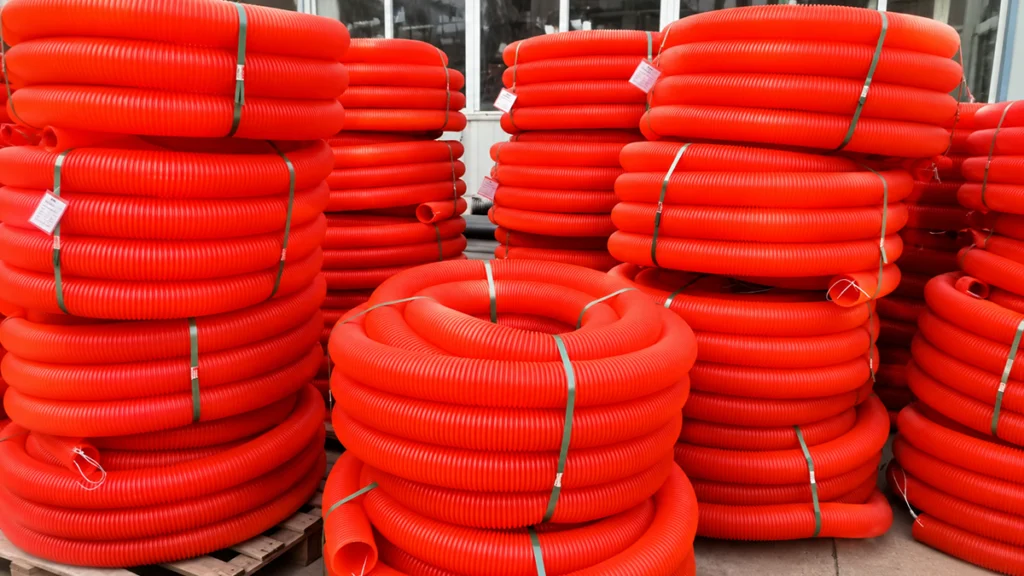
Agricultural Subsurface Drainage
Farm operators rely heavily on perforated single-wall pipes to manage agricultural tile drainage. Tractor-pulled plowing equipment trenches these lines directly into the earth, where they actively collect and siphon away excess moisture from crop root zones. Effectively implemented subsurface drainage prevents waterlogging and soil salinization, a strategy proven to bump crop yields by roughly 15% to 25% per acre.
Cable and Telecommunications Protection
Thanks to its pliable nature, single-wall corrugated conduit remains the undisputed standard for shielding underground power grids and fiber optic networks. The ribbed profile lets the conduit weave around buried obstacles without kinking or buckling. Simultaneously, the tough HDPE polymer delivers outstanding dielectric strength and shrugs off corrosive soil chemicals.
Residential and Commercial Drainage
In the commercial and residential construction sectors, these pipes are foundational for managing surface runoff and subsurface water. Contractors routinely deploy them to divert downspout water away from concrete foundations, build window well drains, and lay out French drains that stop basement flooding and curb soil erosion.
Highway Edge Drains
Major roadway projects depend on perforated corrugated pipes, typically sleeved in geotextile fabric, to control stormwater along highway shoulders. These critical edge drains capture subsurface water before it has a chance to saturate and compromise the highway subgrade, ultimately preserving the pavement’s structural integrity and extending its lifecycle.
Wholesale Pricing Dynamics
On average, wholesale pricing for HDPE single-wall corrugated pipe sits between $0.50 and $8.50 per linear meter. This wide spectrum is driven by the pipe’s nominal diameter (DN), the specified wall thickness, and the resin’s purity (100% virgin PE100 commands a premium over recycled blends).
Cost Breakdown Drivers:
Minimum Order Quantity (MOQ)
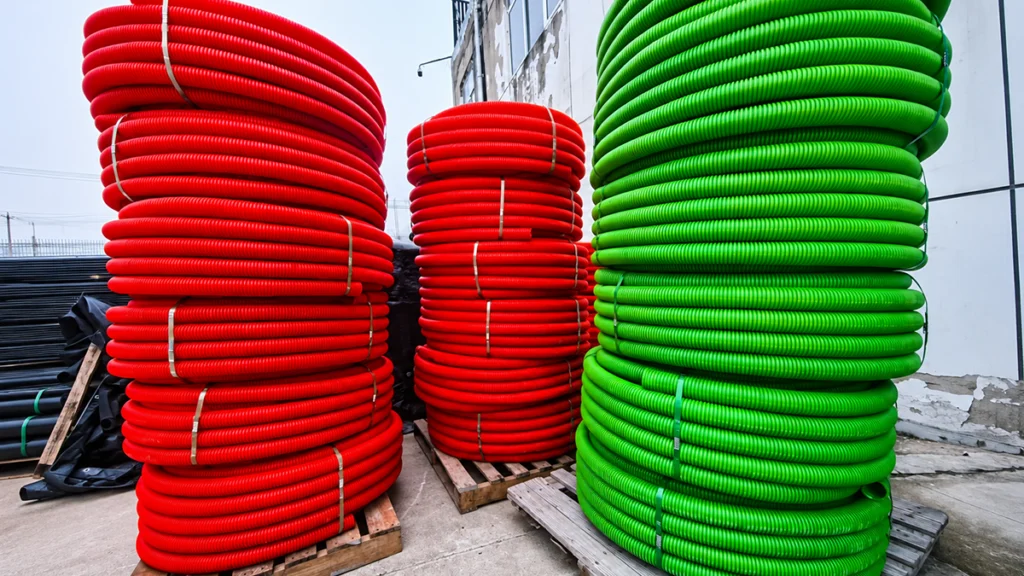
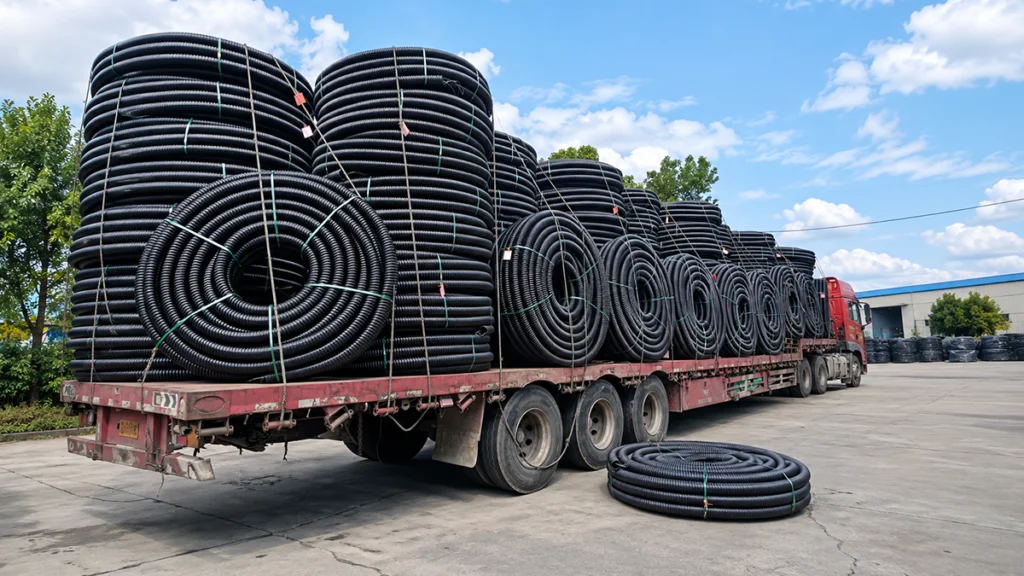
For off-the-shelf sizes in standard carbon black, MOQs generally kick off at a manageable 300 meters. However, international OEM orders change the math. To make trans-oceanic shipping economically viable, factories usually base MOQs on container volume—requiring buyers to fill at least one 20-foot or 40-foot High Cube (HQ) container.
Production Lead Time
Expect standard production runs to take anywhere from 15 to 45 days. This window shifts dynamically based on total meterage, the factory’s seasonal backlog, and the intricacy of OEM requests—like proprietary slotting patterns or custom-colored runs.
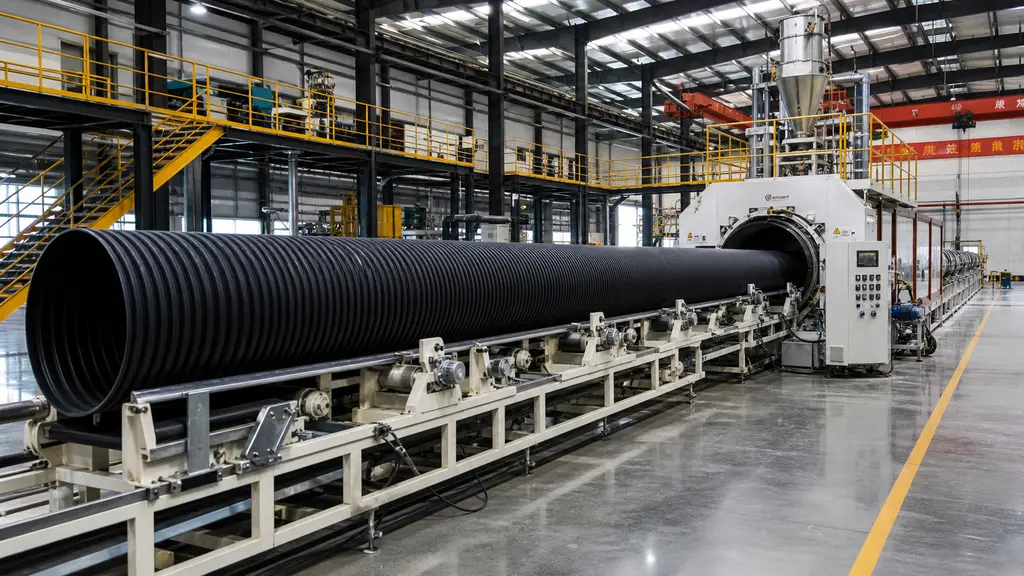
Teaming up with a direct factory empowers procurement managers to tap into deep OEM customization, perfectly aligning the product with hyper-specific project specs.
OEM Customization Checklist:
Selecting a dependable manufacturing partner requires diligent vetting to ensure product quality and supply chain stability.
Trader vs. Factory-Direct Comparison
The most vital first step in sourcing is separating the actual manufacturers from the middlemen (trading companies). A legitimate direct factory usually boasts registered paid-in capital well over $300,000 and maintains a dedicated payroll of 50 or more employees. In China, authentic manufacturers issue value-added tax (VAT) invoices at a 17% rate, whereas small-time traders generally operate on a 3% rate. More importantly, a true factory’s business license will explicitly list “production” or “manufacturing” within its approved business scope, rather than just “sales.”
Supplier Vetting Checklist:
1. Risk: Hiring a Trading Company Instead of a Factory
2. Risk: Use of Excessive Recycled Resin
3. Risk: Specifying the Wrong Ring Stiffness (SN)
4. Risk: Deformation During Transit
Mastering the procurement workflow guarantees your technical specs are nailed and your delivery deadlines are met without a hitch.
1. RFQ and Specification Confirmation: Fire off a highly detailed Request for Quotation. Spell out your exact Nominal Diameter (DN), required Ring Stiffness (SN), polymer grade (PE80 or PE100), and the specific international standard (ASTM, ISO, etc.) you need them to hit.
2. Sample Evaluation: Always ask for physical cut samples. You’ll typically just pay a nominal fee (around $0.10 per meter) plus the DHL/FedEx courier charge. Use this sample to physically test the wall thickness, flexibility, and corrugation uniformity.
3. Supplier Audit: Bring in a reputable third-party inspection crew, or at the very least, conduct an exhaustive live video audit of the factory floor.
4. Contract and Deposit: Execute a comprehensive Proforma Invoice (PI) loaded with your technical specs and clear penalty clauses for delays or defects. The industry standard to kick off production is a 30% T/T (Telegraphic Transfer) deposit.
5. Production and Internal QC: Once the extrusion lines fire up, request a first-piece inspection report. This confirms they dialed in the dimensional accuracy before running the whole batch.
6. Pre-Shipment Inspection: Before a single coil gets loaded into a container, dispatch an independent agency (like TÜV or SGS) to verify the finished batch matches the PI to the letter.
7. Balance and Shipping: Wire the remaining 70% balance upon receiving the copy of the Bill of Lading (B/L). From there, loop in your customs broker and freight forwarder to handle the import logistics.
Building a bulletproof supply chain for commercial plastics means looking way past the initial unit price. You need to assess the supplier’s overall reliability and true manufacturing muscle.
Single-wall variants feature corrugation on both the interior and exterior. This design renders them incredibly lightweight and flexible, perfect for shallow, non-pressure jobs like routing telecom cables. Double Wall Corrugated (DWC) pipes keep the ribbed outer shell but introduce a completely smooth inner wall. That smooth bore supercharges water flow (hydraulics) and drastically increases structural ring stiffness (SN4/SN8), making DWC the heavy-duty choice for municipal storm drains.
You can generally expect wholesale pricing to land between $0.50 and $8.50 per meter. The final number swings based on wall thickness (SDR), nominal diameter (DN), and whether you are paying for 100% virgin PE100 resin or settling for a recycled blend. Keep an eye on global petrochemical indices, as shifts in raw resin costs will cause slight price ripples.
If you just need standard black single-wall pipe, factories usually set a low bar of around 300 meters. But if you’re shipping internationally or requesting OEM tweaks (like custom perforation or specific colors), it’s a different story. To make the ocean freight math work, suppliers will require an order volume large enough to max out at least one 20-foot or 40-foot High Cube container.
Absolutely. The top-tier factories operate cutting-edge extrusion lines built to hit exact international metrics. A solid manufacturing partner can easily calibrate their equipment to satisfy ISO 8772, EN 12201, AASHTO M252, or ASTM F667. Just be sure to boldly state your required standard during the RFQ stage so they select the correct dies and testing protocols.
A standard factory run usually takes 15 to 45 days. That window depends heavily on your total volume, the facility’s current backlog, and how complex your OEM requests are (geotextile wrapping, custom colors, etc.). Once it leaves the dock, factor in an additional 15 to 40 days for ocean freight, depending on your final port of call.
Yes, it is practically tailor-made for it. Single-wall corrugated conduit is the industry standard for telecom and electrical runs. Its extreme flexibility lets installation crews easily route it around buried rocks and roots without buckling. Add in HDPE’s natural moisture resistance, stellar dielectric properties, and immunity to corrosive soils, and you have a perfect shield for buried power and fiber optics.
Start with the business license. Look for a registered capital of at least $300,000 and ensure the permitted business scope specifically lists words like “manufacturing” or “production.” Authentic factories also issue VAT invoices at a 17% rate, while trading companies typically sit at 3%. For ultimate peace of mind, demand a live video tour of the actual extrusion floor.
At a bare minimum, they need active ISO 14001 (Environmental) and ISO 9001 (Quality) certificates. On the product side, they should gladly hand over recent third-party lab reports from heavy hitters like TÜV, CE, or SGS. These reports objectively verify critical performance metrics like impact resistance and ring stiffness.
Tapping into China’s massive manufacturing ecosystem for HDPE single-wall corrugated pipe yields undeniable perks in customization, scale, and bottom-line cost efficiency. However, succeeding in cross-border procurement requires precision. You have to perfectly align your material grades (PE80/PE100), ring stiffness (SN), and diameters with the realities of your drainage or telecom project. By aggressively vetting suppliers to weed out middlemen, locking in virgin material requirements, and executing strict third-party pre-shipment inspections, buyers can drastically cut import risks. Ultimately, partnering with a high-capacity factory that lives and breathes global standards like ASTM and ISO is the surest way to guarantee a resilient supply chain and flawless project execution.