Address
Zhengzhou, Henan, China
Work Hours
Monday to Friday: 7AM - 7PM
Weekend: 10AM - 5PM
Address
Zhengzhou, Henan, China
Work Hours
Monday to Friday: 7AM - 7PM
Weekend: 10AM - 5PM

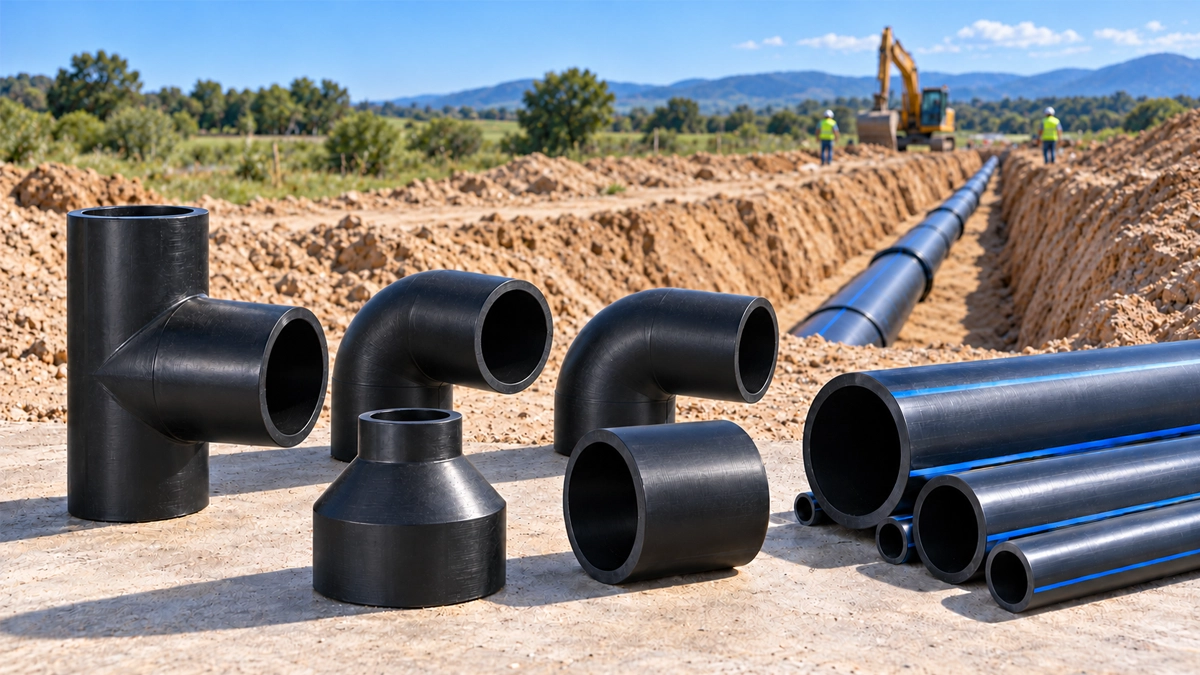
HDPE pipe fittings for water projects are selected by pressure rating, joint method, standards, and site conditions. This guide helps engineers choose compliant fittings, avoid installation risks, and compare suppliers with confidence.
Think of High-Density Polyethylene (HDPE) pipe fittings as the connective tissue of modern municipal water networks. Whether routing flow around obstacles, bridging material transitions, or simply joining long straightaways, these components do heavy lifting. Buried deep underground, they face intense internal surge pressures and crushing soil loads. To maintain a zero-leak network, the HDPE fittings have to be just as tough as the pipelines they connect.
Plastic piping dominates today’s infrastructure, and HDPE commands a massive 72.3% of global market revenues in that space. The HDPE fittings alone make up 27.7% of the market, growing at a brisk 7.1% compound annual growth rate. What’s driving this surge? Municipal water supply and wastewater management account for nearly 46% of the demand. The math for engineers is simple: HDPE systems typically slash total installed costs by 20% to 35% compared to legacy ductile iron or steel. Take an open-cut installation for a 300mm municipal water main, for example.
HDPE averages $80 to $130 per linear meter. Ductile iron? That runs between $110 and $180. Beyond the upfront savings, HDPE creates monolithic, fully restrained joints. This eliminates the need to pour concrete thrust blocks and practically wipes out long-term maintenance expenditures.
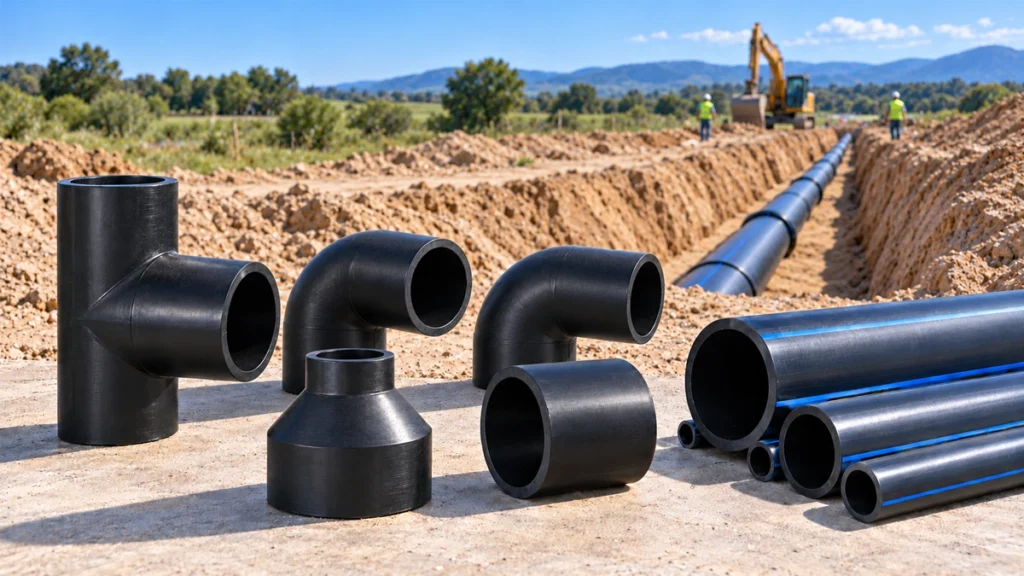
You can’t just grab any fitting off the shelf. Your choice hinges entirely on the pipeline diameter, the reality of your trench conditions, and the specific jointing method the project requires.
| Fitting Type | Primary Application | Jointing Method | Key Engineering Advantage |
|---|---|---|---|
| Butt Fusion | Transmission mains (up to DN2200) | Heat and pressure | Lowest cost, monolithic joint, zero maintenance |
| Electrofusion | Distribution lines, tight trenches | Electrical resistance | Ideal for repairs and confined spaces |
| Mechanical | Mixed-material transitions | Flange/Compression | Requires no heat, works in wet conditions |
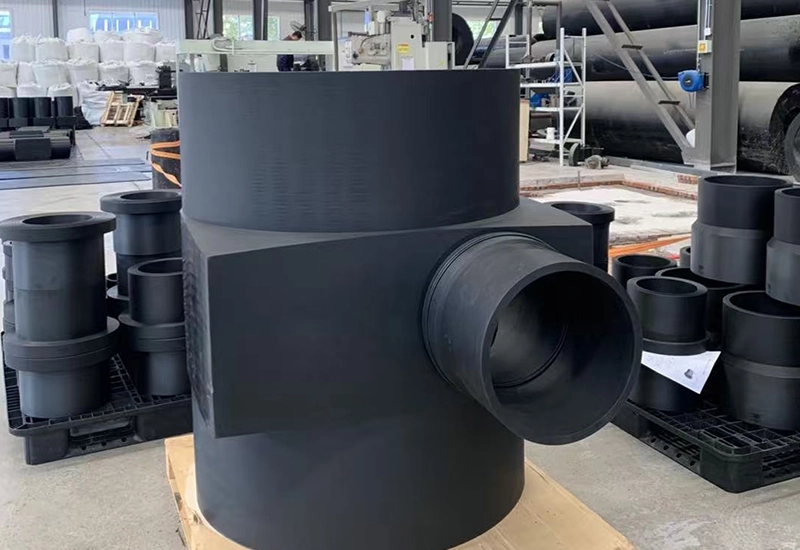
| Fabricated | Custom angles and large tees | Mitered butt fusion | Highly customizable (requires derating) |
Getting the specs right is non-negotiable. Specifying HDPE pipe and fittings for municipal pipelines requires precise alignment across material grades, pressure classes, and dimensional ratios to guarantee network integrity. While manufacturers like JINQUAN produce HDPE pipes and fittings designed to handle full municipal scale, engineers still need to verify the baseline parameters below.
| Parameter | Specification Range | Application Notes |
|---|---|---|
| Diameter Range (OD) | DN16 to DN3000 mm | Covers small service lines to massive transmission mains. |
| Material Grades | PE80, PE100 | PE100 is the modern standard, offering tensile strength ≥ 25 MPa. |
| Pressure Ratings (PN) | PN4, PN6, PN8, PN10, PN16, PN20, PN25 | PE100 handles up to 20 bar (PN20) continuous duty at 20°C. |
| Standard Dimension Ratio (SDR) | SDR 9, 11, 13.5, 17, 21, 26, 32.5 | ~20% wall thickness variance between steps. Lower SDR = higher pressure. |
| Temperature Range | -40°C to 60°C | Operating temperatures above 20°C require standard pressure derating. |
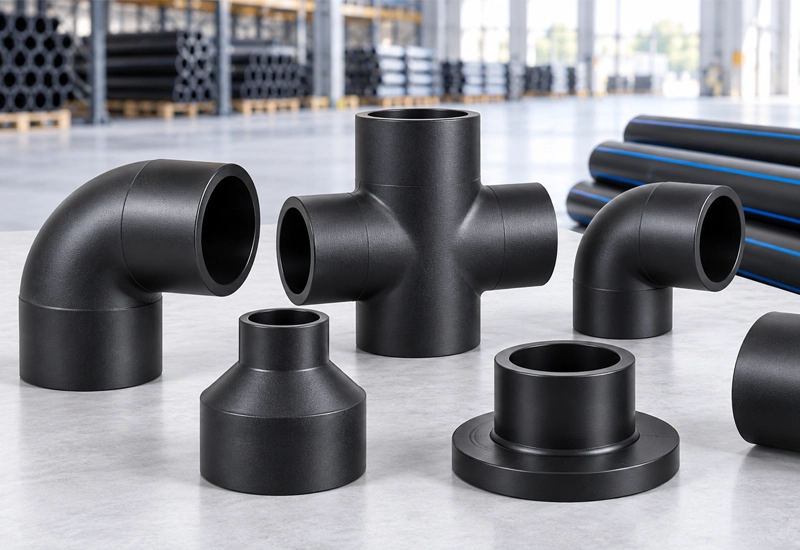
Municipal drinking water networks demand absolute adherence to international safety standards. Public health and structural longevity are on the line, so procurement teams must collect specific documentation to prove compliance before breaking ground.
Picking the right fitting means matching the component directly to the installation environment and the unique operational demands of the network.
Transmission Mains
For long, high-capacity water transmission lines, butt fusion fittings are the undisputed standard. They fuse together to form a fully restrained, monolithic pipeline that demands zero operational expenditure (OpEx) over its entire lifecycle.
Distribution Networks
Urban distribution grids are highly dynamic, frequently requiring new service hookups. Electrofusion saddle fittings and tees shine in these scenarios. They allow field crews to tap directly into live mains without forcing a disruptive shutdown of the municipal network.
Trenchless Installation (HDD)
If your project utilizes Horizontal Directional Drilling (HDD), you must use butt fusion HDPE pipe fittings. HDPE electrofusion fittings sit slightly above the pipe’s outer surface. During the aggressive HDD pullback process, those raised edges create a massive risk of snagging or shearing off against the compacted soil.
Mixed-Material Transitions
Municipal upgrades rarely happen on a blank slate; you are usually tying new HDPE into decades-old infrastructure. When transitioning from HDPE to legacy PVC or ductile iron systems, engineers must specify mechanical flange adapters backed by ductile iron rings to ensure a secure, leak-free bridge.
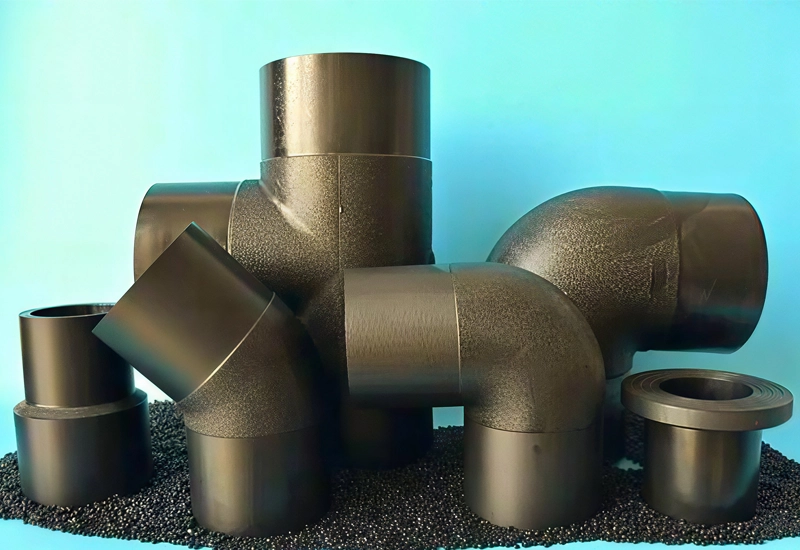
Even the best HDPE pipe and fittings will fail if installed poorly. Proper field execution is the single biggest factor in unlocking the 50- to 100-year design life of municipal HDPE water systems.
Step-by-Step Butt Fusion Execution (ASTM F2620):
1. Surface Preparation: Face the pipe ends until they are perfectly parallel. They must be spotlessly clean and completely free of oxidation.
2. Heating: Apply the heating plate. Crews must strictly maintain the temperature between 400°F and 450°F (204°C–232°C).
3. Heat Soak: Patience is key. Allow at least 4.5 minutes of heat soak time for every inch of pipe wall thickness.
4. Fusion: Remove the heating plate swiftly and apply an interfacial pressure of 60 to 90 psi to bring the ends together.
5. Cooling: Hold the joint under steady pressure until it drops to ambient temperature. Never rush the cooling process.
*Engineering Note on European Standards:* The DVS 2207-1 standard takes a different approach, utilizing a low-pressure method that requires an interfacial fusion pressure of exactly 0.15 N/mm² (±0.01). Field contractors must never mix ASTM high-pressure and DVS low-pressure methodologies on the same site.
When fused correctly using machinery that complies with ISO 12176, the joint reaches a maximum apparent tensile strength of roughly 2,700 psi. In fact, during destructive testing, the parent pipe wall will literally blow out before a properly executed weld gives way.
Premium materials won’t save a project from poor design choices or sloppy handling. Several specific errors frequently compromise municipal water networks.
Securing a dependable HDPE fittings supplier requires looking past the unit price. Procurement teams need to evaluate raw manufacturing capacity alongside rigorous quality control documentation to ensure the project stays on schedule and on budget.
Supplier Evaluation Checklist for Procurement:
To lock in long-term reliability and strict compliance for municipal water systems, run through this final verification checklist during the specification phase:
What HDPE fitting type is best for municipal water distribution lines?
HDPE electrofusion fittings are generally the top choice for municipal distribution lines. They allow contractors to install tapping tees and saddle fittings for new service connections without shutting down the active water network. They also excel in tight, congested urban trenches where dragging in heavy butt fusion machinery just isn’t practical.
How do I choose between butt fusion and electrofusion fittings?
Go with butt fusion for long, straight, large-diameter transmission mains where you need a monolithic joint and the lowest possible component cost. Pivot to electrofusion for smaller diameters, complex distribution grids, live repairs, or whenever you need to connect pipes with slightly different wall thicknesses where butt fusion would fail.
Which standards should HDPE pipe fittings for potable water meet?
Internationally, HDPE pipe fittings for potable water must meet ISO 4427 or EN 12201. In North America, AWWA C906 is the standard. Most importantly, the HDPE pipe fittings must pass mandatory migration testing to prove zero leaching of heavy metals or chemicals, ensuring the network is 100% safe for drinking water.
What pressure rating should I specify for a water project?
Your pressure rating specification should account for the maximum operating pressure plus any potential surge pressures. Standard municipal ratings sit at PN10 (10 bar) or PN16 (16 bar). PE100 pipe fittings can comfortably handle up to 20 bar (PN20) at 20°C. Just remember to apply pressure derating if the water temperature climbs above 20°C.
Can HDPE fittings connect to ductile iron, steel, or PVC pipes?
Absolutely. HDPE networks can tie into legacy materials seamlessly using mechanical flange adapters and backing rings. These transition fittings create a rugged, leak-proof mechanical joint without the need for heat fusion, making them the perfect solution for upgrading older ductile iron or PVC municipal systems.
What are the most common installation mistakes with HDPE water pipe fittings?
Field errors usually boil down to a few culprits: trying to butt fuse pipes with mismatched SDRs (different wall thicknesses), failing to thoroughly clean and dry the pipe ends before fusion, rushing the heat soak times, and forgetting to up-specify the pressure rating (EDR) when deploying fabricated mitered fittings.
How do I evaluate an HDPE fitting supplier for a municipal project?
Look hard at their production capacity (can they handle 100,000+ tons a year?) and verify their ISO 9001/14001 certifications. Demand third-party migration test reports for potable water safety. Finally, ensure they stamp permanent traceability markings on their products and can reliably hit tight delivery windows of 7 to 15 days.
Municipal water infrastructure lives and dies by the quality of its connections. The long-term integrity of these networks relies entirely on the precise specification and flawless installation of HDPE pipe fittings. By understanding exactly when to deploy butt fusion, electrofusion, or mechanical transitions, engineers can design robust systems that eliminate leaks and slash maintenance costs. True success in the field requires strict adherence to international standards like ISO 4427, careful alignment of SDR and pressure ratings, and uncompromising execution of fusion temperatures and pressures. When paired with a heavily vetted manufacturing partner that provides total product traceability and proven potable water compliance, HDPE fittings easily deliver a reliable, maintenance-free design life of up to a century.