Address
Zhengzhou, Henan, China
Work Hours
Monday to Friday: 7AM - 7PM
Weekend: 10AM - 5PM
Address
Zhengzhou, Henan, China
Work Hours
Monday to Friday: 7AM - 7PM
Weekend: 10AM - 5PM

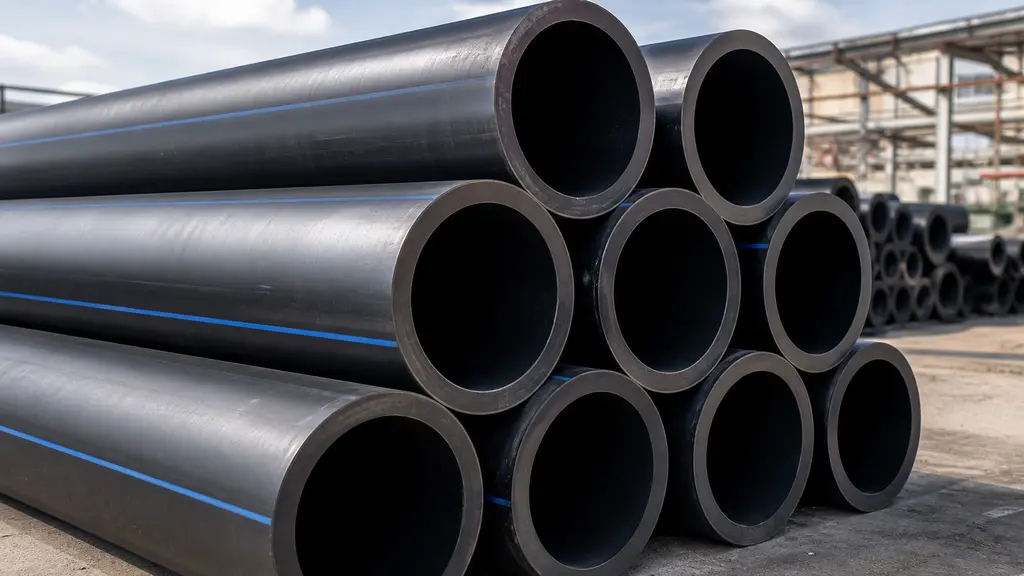
HDPE pipe is engineered for a 50–100 year service life, but actual lifespan depends on resin grade, pressure rating, installation quality, operating environment, and maintenance. This guide explains the standards behind HDPE pipe longevity, the key factors that shorten or extend it, and practical tips B2B buyers and operators can use to maximize ROI.
Under typical operating conditions, the standard design life for an HDPE pipe spans between 50 and 100 years. In fact, the Plastics Pipe Institute (PPI) notes that high-density polyethylene networks deployed in municipal drinking water systems regularly push past the century mark.
Reaching that maximum lifespan isn’t automatic, though. It relies heavily on strict adherence to environmental and operational guidelines. To guarantee long-term durability, operators must focus on a few non-negotiable conditions:
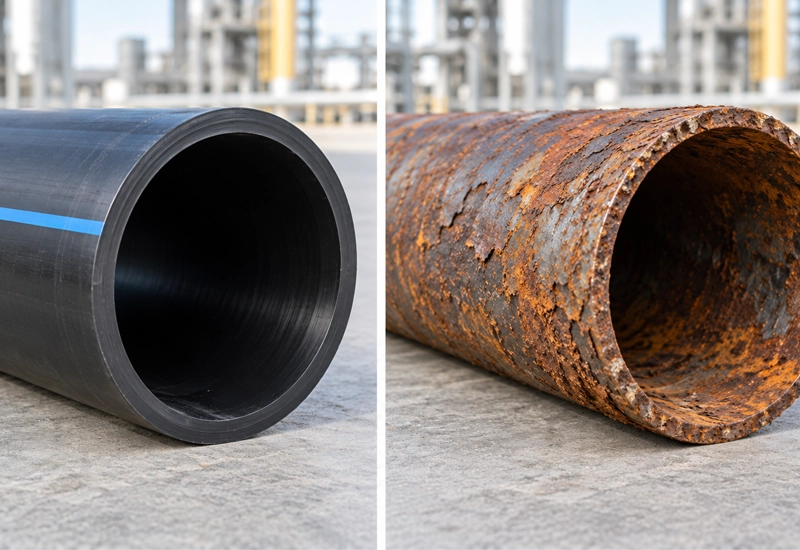
High-Density Polyethylene (HDPE) serves as a flexible, heavily corrosion-resistant thermoplastic polymer. It boasts an impressive strength-to-density ratio and remains completely immune to rust. Traditional metallic piping often falls victim to galvanic corrosion, tuberculation, and biological degradation over time. HDPE bypasses these issues entirely, securing its spot as a foundational material for today’s underground infrastructure.
Engineers look closely at specific resin grades to gauge durability:
JINQUAN manufactures both PE80 and PE100 grades. Their production covers a massive diameter range—from standard DN16 lines up to massive DN3000 configurations. This versatility ensures that specific project durability demands are met worldwide.
Engineers don’t just guess the long-term performance of an HDPE pipe. Instead, they mathematically extrapolate its longevity through brutal, standardized testing. These frameworks guarantee that the materials will hit their 50-year or 100-year design targets without experiencing catastrophic failure.
| Standard | Certification Scope | Relevance to Service Life |
|---|---|---|
| ISO 9080 | Long-term hydrostatic strength of thermoplastic materials. | Extrapolates failure data across multiple temperatures to guarantee a minimum 50-year design life. |
| ASTM F714 / D3035 | Dimensions, wall thickness (SDR), and pressure ratings. | Dictates the exact geometric tolerances required to safely handle continuous internal pressure. |
| AWWA C906 | PE pressure pipe and fittings (4-inch to 65-inch) for water distribution. | Ensures municipal water infrastructure meets stringent safety, pressure, and longevity benchmarks. |
| PPI TR-4 | Recommended Hydrostatic Design Basis (HDB) and MRS ratings. | Validates the specific resin capabilities against long-term operational stress. |
JINQUAN maintains full compliance with these international benchmarks. The company manufactures under ISO 4427, ISO 14586, and DIN 8077/8078 standards, fully backed by CE, ISO 9001, SGS, and ISO 14001 certifications.
The base polymer offers exceptional resilience. However, real-world deployments introduce a host of variables that ultimately dictate actual longevity. Engineering teams have to factor these parameters into the equation during the specification phase.
| Key Factor | Impact on Service Life | Recommended Best Practice / Value |
|---|---|---|
| Temperature | High temperatures soften the polymer, reducing pressure capacity. | Standard pressure ratings (PN/SDR) apply at 68°F (20°C). Safe operation ranges from -220°F to 140°F (-140°C to 60°C). Derate pressure for higher temps. |
| Pressure (SDR/PN) | Exceeding the pressure class causes hoop stress failure and ballooning. | Match wall thickness to operational limits. Common ratings include PN10, PN16, PN20, and PN25. |
| UV Resistance | Unprotected polyethylene degrades and becomes brittle under direct sunlight. | Ensure the pipe contains a minimum of 2-3% well-dispersed carbon black for 10+ years of UV protection above ground. |
| Chemical Resistance | Aggressive soils can degrade inferior materials, leading to external leaks. | HDPE is highly resistant to both acidic and alkaline soils (pH 1 to 14), eliminating external corrosion risks. |
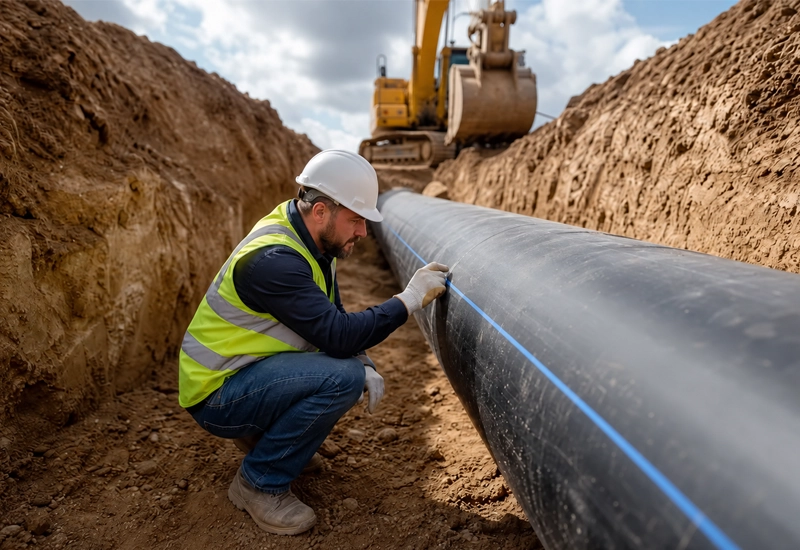
Thanks to its inherent flexibility, an HDPE pipe functions as a composite system alongside the surrounding earth. It actively shares the physical load with the soil. This means the actual execution of the installation matters just as much as the pipe’s chemical properties.
Bedding and Backfill Procedures:
1. Trench Preparation: The trench bottom needs to remain completely stable. Clear out any sharp rocks or debris that might trigger point-loading.
2. Embedment Soil: Always utilize Class I or Class II soils for the embedment zone.
3. Haunching: This represents the most critical zone in the trench. The soil situated in the haunch area (the lower half of the pipe) requires substantial compactive effort. If you skip this, you risk pipe ovality and deflection.
4. Compaction: Surrounding soil must hit a minimum of 70% relative density to create true structural synergy.
Fusion Joint Quality Control Checklist:
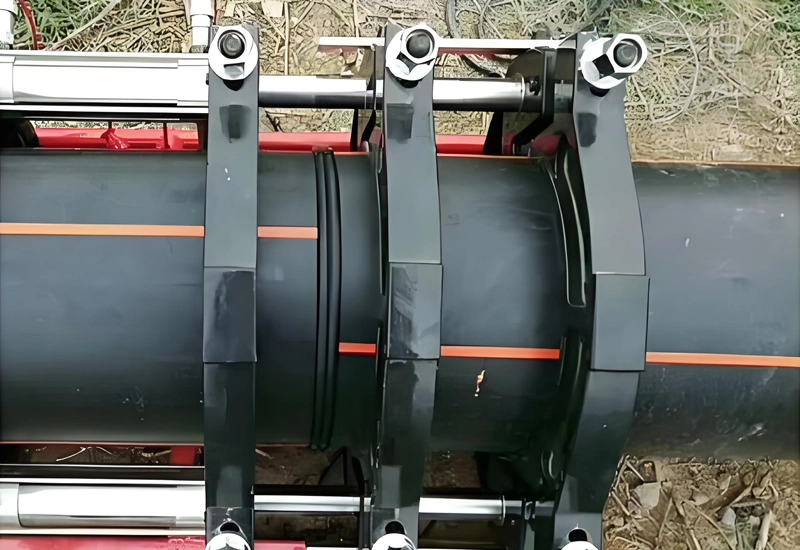
A HDPE pipeline will only ever be as strong as its weakest joint. To achieve seamless, leak-free integration:
JINQUAN provides proprietary pipe welding machines alongside a comprehensive catalog of HDPE fittings. From butt fusion and electrofusion to socket fusion options, they supply the hardware needed to ensure joint integrity perfectly matches the pipe’s expected lifespan.
Evaluating the total cost of ownership (TCO) for major infrastructure projects requires a hard look at material lifespans and their respective failure modes.
| Material | Expected Lifespan | Corrosion Resistance | Jointing Method | Relative TCO |
|---|---|---|---|---|
| HDPE Pipe | 50–100+ years | Absolute (Zero rust/scale) | Heat fused (Seamless, leak-free) | Lowest (Minimal maintenance, no coatings) |
| PVC Pipe | 50–100 years | High | Mechanical/Gasketed (Prone to leaks) | Low/Medium (Lower upfront, higher leak risk) |
| Ductile Iron | 50–100 years | Poor (Requires lining/poly-wrap) | Mechanical/Gasketed | High (Heavy installation, corrosion mitigation) |
| Steel Pipe | 30–50 years | Very Poor (Highly vulnerable) | Welded / Flanged | Highest (Requires cathodic protection, frequent recoating) |
HDPE consistently stands out. It brings an impressive yield strength of roughly 1,600 psi to the table, alongside unmatched flexibility for earthquake resistance. Best of all, it completely eliminates gasketed joints—the undisputed leading cause of municipal water loss.
The specific operational environment plays a massive role in dictating how long an HDPE pipe will survive, whether buried underground or exposed on the surface.
Municipal Water Supply (100+ Years)
When buried in stable environments with carefully regulated pressure, HDPE simply outlasts almost everything else on the market.
*Mini Case Example:* Consider a mid-sized municipal utility that needed to replace failing, 60-year-old cast iron water mains. They opted for PE100 HDPE. By deploying horizontal directional drilling (HDD), the crews entirely bypassed the mess of open-cut trenching. Operating at a steady 60 PSI with groundwater temperatures hovering around 55°F (12°C), the engineered design life of this new system easily exceeds a century. Zero corrosion maintenance is anticipated.
Natural Gas Distribution (50–100 Years)
In highly regulated, low-pressure gas networks, utilizing PE100 and PE4710 resins completely removes the threat of catastrophic brittle failure. The result? Decades of safe, leak-proof transit.
Mining & Slurry Transport (20–50 Years)
Mining pipelines face the brutal task of moving highly abrasive materials, such as rock slurry. While HDPE offers abrasion resistance that drastically outperforms steel, constant internal friction inevitably wears down the wall thickness. This naturally condenses the service life to a 20-to-50-year window, heavily dependent on particulate size and slurry velocity.
Manufacturers often market these systems as “maintenance-free.” However, proactive monitoring remains the best way to ensure an HDPE piping network actually hits its maximum design life.
1. Visual Inspections (Bi-Annual): For above-ground setups, run regular visual sweeps. Look for physical deformation, UV discoloration, or deep gouging. As a general industry rule, any scratch penetrating more than 10% of the pipe’s wall thickness warrants rejection.
2. Hydrostatic Pressure Testing (As Needed): You should conduct fresh pressure tests following major ground shifts, nearby heavy construction, or seismic events. This verifies that your fusion joints haven’t been compromised.
3. Leak Detection (Ongoing): For buried lines, lean on acoustic leak detection technology or tracer wires (which should be installed during the initial trenching phase). These tools allow teams to quickly isolate and identify accidental third-party damage.
By understanding exactly why HDPE pipelines fail ahead of schedule, engineers can specify better materials and enforce stricter installation protocols.
| Failure Mode | Cause | Prevention Strategy |
|---|---|---|
| Slow Crack Growth (SCG) | Brittle cracks propagating from continuous point loads (e.g., pipe resting on a sharp rock). | Utilize PE100-RC (Resistant to Crack) resins and enforce strict sand bedding protocols. |
| Rapid Crack Propagation (RCP) | Fast-moving longitudinal cracks triggered by sudden pressure surges at low temperatures. | Specify modern PE100 or PE4710 grades, which possess exceptionally high RCP resistance. |
| Oxidation | Chemical degradation over decades, heavily accelerated by high fluid temperatures and excessive chlorine levels. | Monitor water chemistry and temperature; ensure resin includes high-quality anti-oxidant packages. |
| Poor Fusion Joints | Operator error during welding, such as surface contamination or rushing the mandatory cooling times. | Mandate the use of automated, data-logging fusion machines to remove human error. |
| Third-Party Damage | Unintended excavation strikes by heavy machinery. | Install warning tape and tracer wires above the pipe; utilize GIS mapping for buried assets. |
Sourcing premium materials is step one if you want a pipeline to last a century. B2B buyers have to evaluate potential manufacturers based on rigid material sourcing and quality control criteria.
Procurement Evaluation Checklist:
The JINQUAN Advantage:
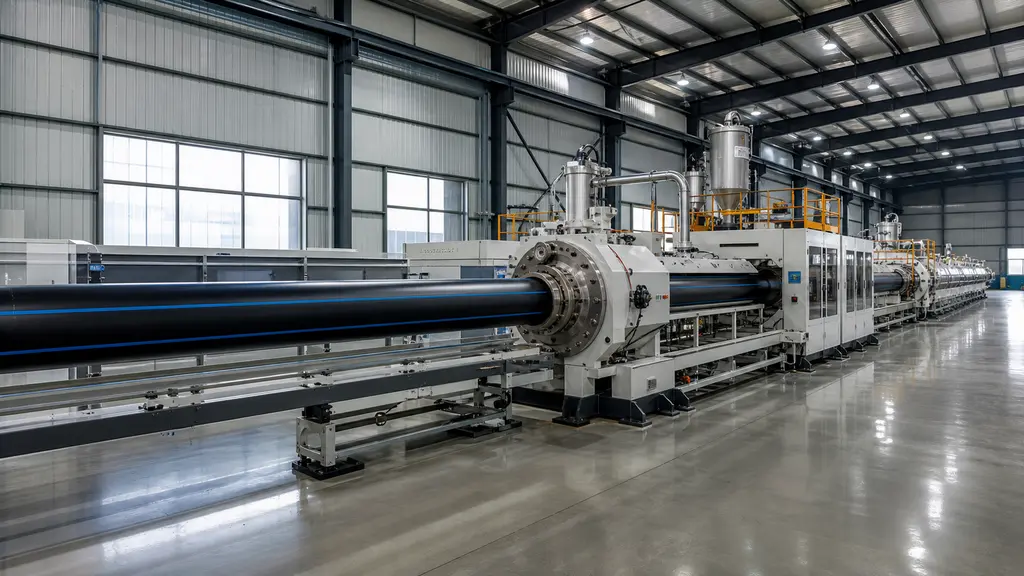
Operating out of a massive 200-acre facility equipped with over 40 high-speed extrusion lines, JINQUAN produces more than 100,000 tons of product annually. For global buyers, this kind of scale translates to factory-direct pricing, fast 7-to-15-day delivery windows, and deep OEM/ODM customization capabilities. It’s all backed by over 15 years of dedicated export expertise.
Q1: Can HDPE pipe really last 100 years?
Absolutely, provided the conditions are right. The Plastics Pipe Institute (PPI) and countless engineering studies confirm a simple truth: when an HDPE pipe is extruded from virgin PE4710 or PE100 resin, placed in a properly bedded trench, and operated within its designated temperature and pressure limits, it easily surpasses the 100-year mark. This is especially true for municipal water applications.
Q2: What is the average lifespan of HDPE pipe underground?
Buried HDPE pipe typically lasts anywhere from 50 to 100 years. Underground environments are highly beneficial because they shield the polymer from extreme temperature swings, physical impacts, and UV radiation. As long as the surrounding earth is properly compacted and clear of sharp point-loads, the structural integrity of the pipe will hold strong for decades.
Q3: Does sunlight (UV) reduce HDPE pipe service life?
Yes, leaving raw polyethylene exposed to direct sunlight for extended periods will degrade it. To combat this, reputable manufacturers blend a minimum of 2% to 3% well-dispersed carbon black into the resin during the extrusion process. This additive serves as a powerful UV shield, allowing the pipe to sit above ground for 10 to 20 years without experiencing major structural degradation.
Q4: Which lasts longer: HDPE or PVC pipe?
While both boast a theoretical design life of 50 to 100 years, HDPE generally outlasts PVC out in the real world. PVC has a tendency to become brittle over time, making it highly vulnerable to cracking during seismic events or normal ground shifts. Additionally, PVC relies on gasketed mechanical joints that inevitably degrade and leak. HDPE, on the other hand, uses seamless, leak-free heat fusion joints.
Q5: What are the main causes of HDPE pipe failure?
The number one cause of premature failure in the field is third-party damage—usually an accidental strike from an excavator. Secondary culprits include poor fusion joint execution (like incorrect temperatures or contamination during welding), point-loading caused by sloppy trench bedding (which leads to Slow Crack Growth), and pushing the system past its rated temperature or pressure limits.
Q6: How often should HDPE pipelines be inspected?
For above-ground pipelines, conduct visual inspections twice a year to look for UV bleaching, deep gouges, or physical warping. Buried pipelines don’t require frequent physical unearthing. Instead, they should be continuously monitored via acoustic leak detection systems and periodic pressure testing—especially after heavy nearby construction or seismic activity.
Q7: Does HDPE pipe rust or corrode over time?
No. An HDPE pipe will never rust. Because it is a thermoplastic polymer rather than a metal, it remains entirely immune to oxidation, tuberculation, and galvanic corrosion. It safely handles highly alkaline and acidic soils (ranging from pH 1 to 14) without requiring the costly poly-wraps, cathodic protection, or protective coatings that ductile iron and steel demand.
Q8: What temperature range can HDPE pipe handle without shortening its life?
HDPE pipe performs best—and achieves its absolute maximum lifespan—at standard ambient temperatures of around 68°F (20°C). It can safely operate across a wide spectrum, from -220°F to 140°F (-140°C to 60°C). That said, if you plan to operate continuously at elevated temperatures (above 68°F), you must derate the allowable internal pressure to avoid premature structural failure.
The impressive longevity of an HDPE piping network doesn’t happen by accident. It is the direct result of disciplined installation, precise manufacturing, and advanced material science. Offering a proven service life that stretches from 50 to well over 100 years, these systems deliver unparalleled resistance to seismic activity, soil settlement, and corrosion. To maximize this lifespan, project managers must specify the correct resin grades (like PE100 or PE4710), stick rigidly to temperature and pressure tolerances, execute flawless heat fusion joints, and enforce strict backfill standards. By merging these core engineering principles with a reputable, certified manufacturing partner, your infrastructure projects can easily achieve a century of reliable, leak-free performance—all while locking in the lowest possible total cost of ownership.