Address
Zhengzhou, Henan, China
Work Hours
Monday to Friday: 7AM - 7PM
Weekend: 10AM - 5PM
Address
Zhengzhou, Henan, China
Work Hours
Monday to Friday: 7AM - 7PM
Weekend: 10AM - 5PM

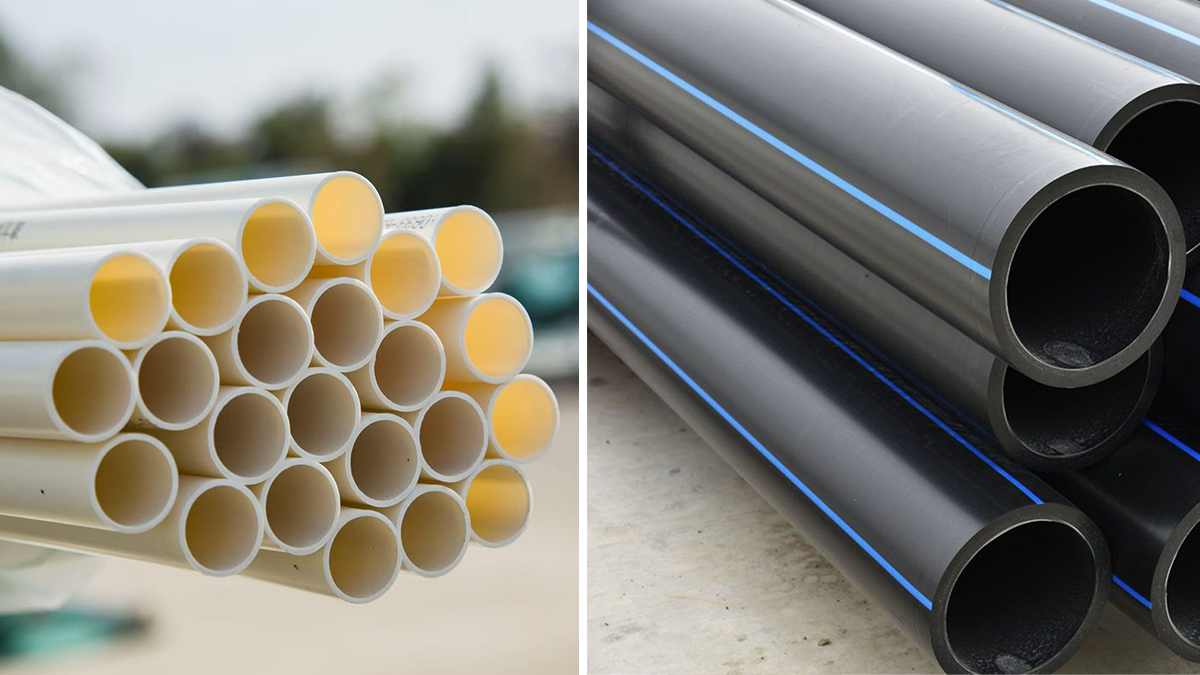
HDPE Pipe vs PVC Pipe compared across pressure rating, lifespan, chemical resistance, installation, and total cost — with clear B2B selection guidance for water supply, drainage, and underground projects, plus a supplier evaluation checklist to reduce sourcing risk.
When you need to push high-pressure water through shifting soils or bore beneath a busy highway, high-density polyethylene (HDPE) pipe takes the lead. Its massive flexibility and ability to absorb brutal water hammer events make it the undisputed heavyweight for complex underground jobs. On the flip side, polyvinyl chloride (PVC) shines when budgets are tight and the layout is simple. If you are laying straight, rigid lines for standard gravity drainage or low-pressure residential plumbing, PVC does the job perfectly without breaking the bank.
Project engineers constantly weigh these two materials against each other. The ultimate decision boils down to balancing that initial upfront material cost against decades of lifecycle performance.
Selection Summary Table
| Feature | HDPE Pipe (High-Density Polyethylene) | PVC Pipe (Polyvinyl Chloride) |
|---|---|---|
| Material Base | Petroleum-based thermoplastic | Vinyl polymer |
| Flexibility | High (can bend without breaking) | Rigid / Low |
| Jointing Method | Heat fusion (butt/electrofusion) | Solvent welding / mechanical |
| Initial Cost | Moderate to High | Low |
| Surge Pressure Tolerance | Up to 200 psi above rating | Up to 100 psi above rating |
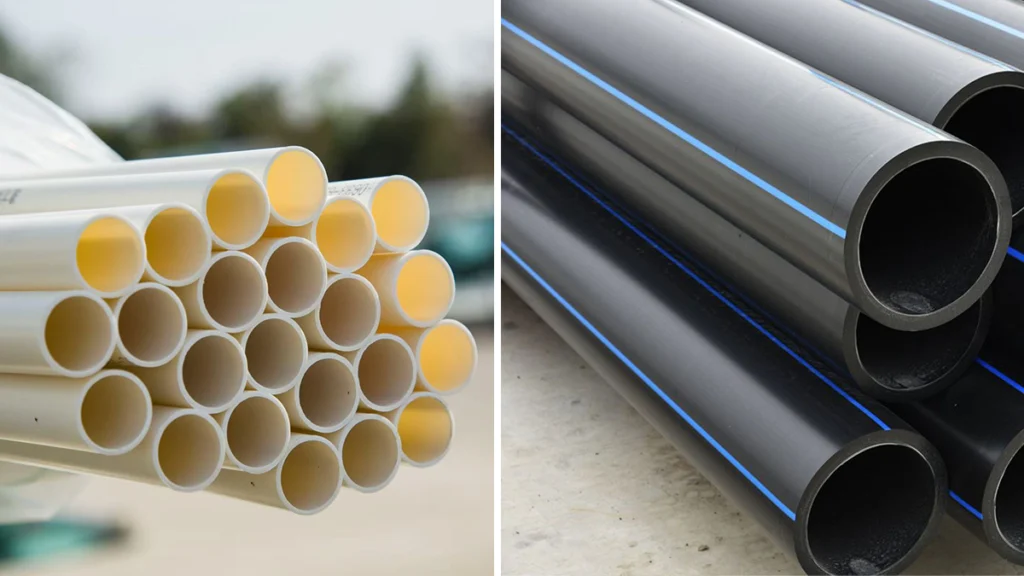
Let’s break down the chemistry and engineering behind both options.
HDPE is a petroleum-based thermoplastic built to take a beating. Manufacturers engineer this flexible piping for high-stress fluid transport, strictly following global benchmarks like ISO 4427, ASTM F714, and AWWA C906. The pipe relies on heavy-duty material grades—think PE80, PE100, and PE4710. Packing a density between 0.94 and 0.96 g/cm³, HDPE delivers an incredibly rare mix of brute toughness and chemical resistance. That specific combination is exactly why it dominates modern municipal infrastructure.
PVC pipe, meanwhile, is a high-strength vinyl polymer. It is stiff, rigid, and sits at the core of general construction and plumbing worldwide. Most rigid piping utilizes uPVC (Unplasticized Polyvinyl Chloride), regulated by standards like ISO 1452 and ASTM D1785. Because it holds its shape so well, uPVC requires far less structural support above ground. Keep it in static, low-stress environments, and its chemical makeup will fend off degradation for decades.
You cannot truly understand the specification differences until you look at how these materials react under heavy mechanical and environmental strain.
Core Specification Comparison
| Performance Metric | HDPE Pipe (PE100) | PVC Pipe (uPVC) |
|---|---|---|
| Tensile Strength & Rigidity | Lower tensile strength; highly tough | Higher tensile strength; stiff and rigid |
| Elongation at Break | Massive elongation; bends easily | Low elongation; brittle under bending |
| Impact Resistance | Superior, especially in cold weather | Poor; prone to shattering upon impact |
| Surge / Water Hammer | Withstands surges 200 psi over rating | Withstands surges 100 psi over rating |
| Temperature Range | Operates safely up to 80°C (176°F) | Operates safely up to 60°C (140°F) |
| UV Resistance | 10+ years outdoors (with carbon black) | Degrades and becomes brittle under UV |
| SDR / Wall Thickness | Requires thicker walls for same PN rating | Thinner walls achieve high PN ratings |
Let’s talk about pressure ratings, specifically regarding surge tolerance. This is a massive dividing line between the two materials. HDPE acts like a shock absorber. It eats kinetic energy, safely handling water hammer spikes up to 200 psi above its baseline pressure class. PVC cannot do this. Its rigid nature restricts its surge tolerance to just 100 psi over the rating. Put PVC in a system with aggressive, frequent pump cycling, and you significantly increase the risk of a blowout.
Because PVC boasts higher inherent tensile strength, HDPE needs thicker walls to hit the exact same pressure rating (PN). Historically, engineers applied a 1.6 safety factor for PE4710 to compensate. But HDPE trades that wall thickness for incredible stretching power. This massive elongation capacity makes it the only logical choice in seismic zones. Where ground shifts would snap a stiff PVC line in half, HDPE simply bends and keeps flowing.
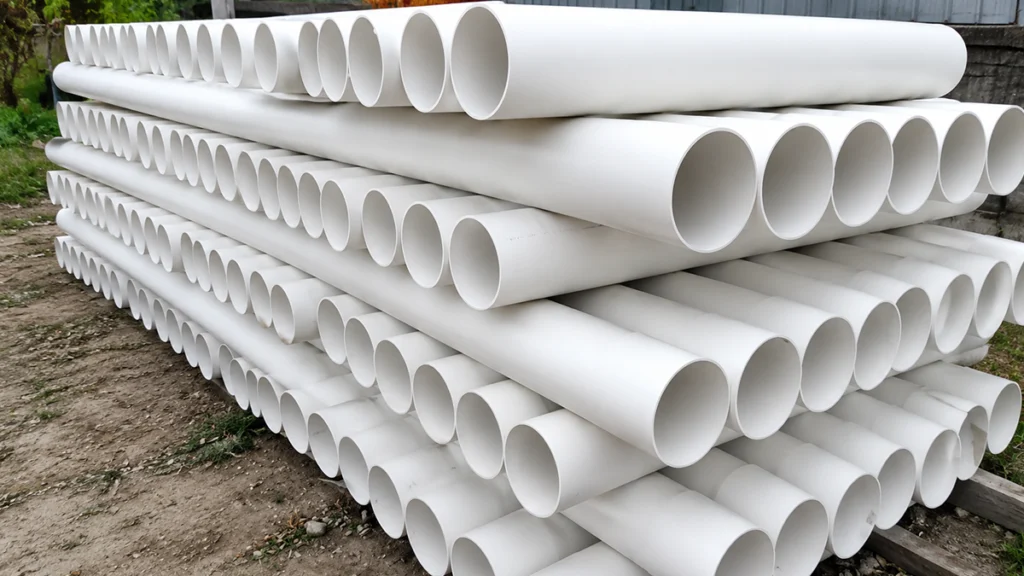
Structural integrity over the long haul dictates the true value of your pipeline. HDPE routinely delivers an operational lifespan stretching from 50 to well over 100 years. PVC generally taps out between 50 and 70 years, heavily dependent on how well it was installed and the environmental stressors it faces.
HDPE Failure Modes:
PVC Failure Modes:
From a maintenance perspective, HDPE drastically undercuts PVC. Fusing HDPE creates a monolithic system. There are no gaskets to fail or glued joints to pop, completely eliminating the leak points that plague older PVC grids. Plus, you do not need mechanical thrust blocks or restrainers with HDPE, which wipes out a massive chunk of future underground maintenance.
The environment dictates the material. Pushing the wrong pipe into the wrong scenario guarantees system failure and wrecked budgets.
*Field Example:* Consider a recent water utility upgrade in Southeast Asia. The municipality needed to replace a critical transmission main plagued by failing gaskets and constant joint leaks. They ditched their old rigid pipes and installed an HDPE PN16 DN400 system. The new pipeline easily absorbs the region’s frequent seismic ground shifts, completely solving their leakage crisis.
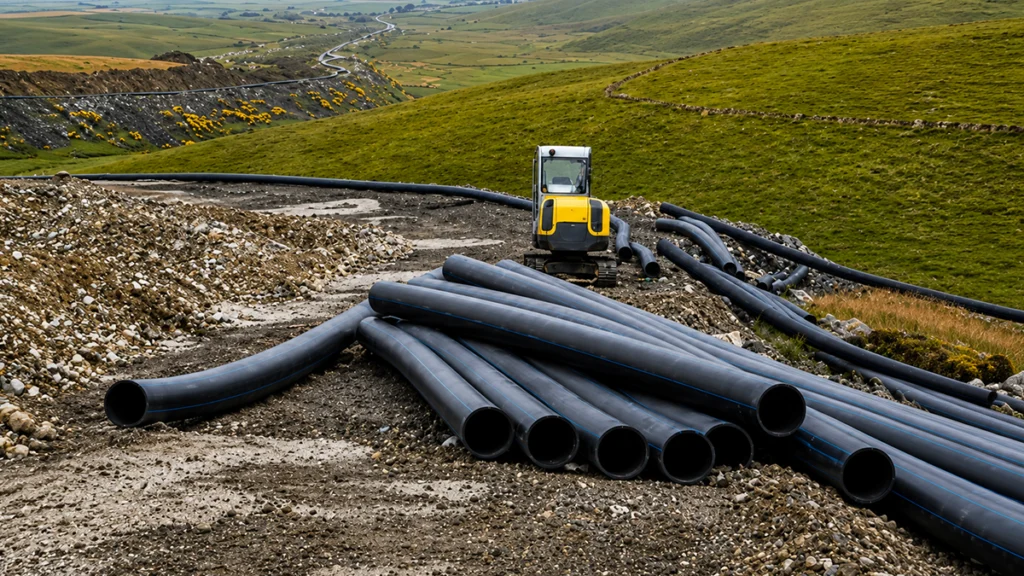
Jointing technology drives the installation cost gap between these two materials. They require entirely different skill sets and toolkits.
HDPE Jointing (Butt Fusion):
Butt fusion literally melts the pe pipe ends together, creating a continuous line that is actually stronger than the pe pipe wall itself.
1. Trimming: Shaving the pe pipe ends to strip away oxidation and guarantee a perfectly flush alignment.
2. Heating: Pressing the trimmed ends against a precision-controlled hot plate.
3. Fusing: Driving the molten ends together under exact hydraulic pressure.
4. Cooling: Maintaining that pressure while the thermoplastic fully solidifies.
PVC Jointing (Solvent Welding):
Solvent welding relies on a chemical reaction to melt and bind the plastic. Crews swab on a chemical primer, apply a layer of cement, and firmly push the pe pipe into its fitting.
Labor and Equipment Impact:
HDPE demands capital. You need specialized thermofusion machines and certified operators, which heavily spikes the initial setup cost. PVC is cheap and fast to install. A crew often needs nothing more than a saw, primer, and cement. For short runs or tightly budgeted jobs, PVC’s labor and equipment savings are hard to beat.
Procurement is a balancing act. You have to weigh the upfront price per meter against the Total Cost of Ownership (TCO). PVC wins the initial purchase phase with a noticeably lower cost per meter. If you are developing a short-term, budget-capped project, PVC looks incredibly appealing. HDPE hits your budget harder upfront due to material and installation costs. However, it easily wins the TCO battle. Zero maintenance and zero leaks over a century-long lifespan pay for that initial premium many times over.
Indicative Commercial Data
| Parameter | HDPE Pipe (PE100) | PVC Pipe (uPVC) |
|---|---|---|
| Initial Purchase Price | Moderate to High | Low |
| Total Cost of Ownership | Very Low (Zero maintenance) | Moderate (Joint repairs expected) |
| Standard MOQ | 1x20ft or 1x40ft HQ Container | 1x20ft or 1x40ft HQ Container |
| Factory Lead Time | 25 to 35 Days | 25 to 35 Days |
| Customization | OEM sizing, SDR adjustments | Standardized dimensions |
JINQUAN provides direct factory pricing alongside comprehensive OEM capabilities. Whether you need standard dimensions or customized SDR adjustments for specific project demands, production maintains a tight 25-35 day lead time for international container shipping.
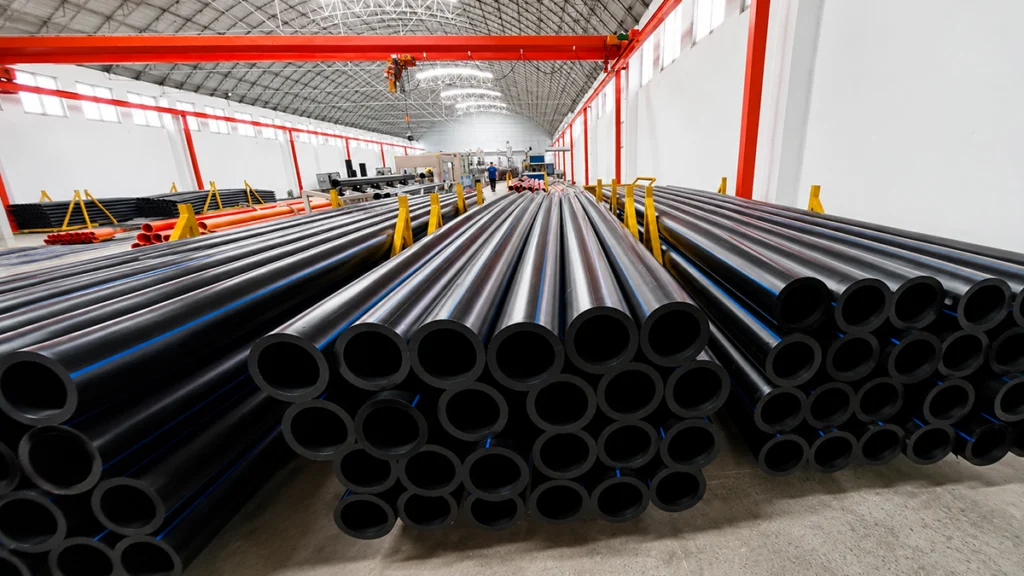
Sourcing piping from overseas carries inherent risks. Bad manufacturing leads to disastrous, expensive underground blowouts. Vet your suppliers hard using this pre-shipment checklist.
1. Resin Verification: Do not take their word for it. Demand lab test certificates proving they exclusively use 100% virgin PE100 or PE4710 resin.
2. The Recycled Pipe Trap: Flat-out reject any HDPE pipe made from regrind or recycled plastics. These compromised lines will easily survive a quick factory hydrostatic test. But once buried, depleted antioxidants and terrible slow-crack-growth (SCG) resistance will cause them to fail fast.
3. Dimensional Tolerances: Grab a pair of digital calipers before they load the container. Verify that the Outside Diameter (OD) and wall thickness align perfectly with your specified SDR rating.
4. Certifications: The factory must hold active, verifiable ISO 9001 and ISO 14001 certificates. Look for CE marking and strict compliance with standards like ISO 4427 or DIN 8077/8078.
1. Specifying “HDPE” without stating the resin grade.
2. Using PVC in systems with frequent pump cycling.
3. Ignoring installation equipment costs when budgeting for HDPE.
4. Installing PVC in freezing climates without deep burial.
Nailing down the right specification means taking a hard look at your site, your wallet, and your crew. Run through this checklist before you sign off on a material:
1. Budget Strategy: Are you forced to optimize purely for the cheapest initial purchase? Go with PVC. Are you prioritizing a 50-year horizon with zero underground maintenance? HDPE is the answer.
2. Environmental Conditions: Are you dealing with rocky trenches, seismic activity, unstable soil, or hard freezes? You need HDPE.
3. Installation Methodology: Will you use trenchless Horizontal Directional Drilling (HDD) to shoot under a river or highway? HDPE is mandatory.
4. Contractor Capability: Does your local crew actually have access to butt-fusion machines and the certified training to use them? If the answer is no, PVC might be your only practical option.
Is HDPE pipe stronger than PVC pipe?
They are strong in entirely different ways. PVC boasts higher tensile strength, which makes it stiff and great at supporting its own weight on above-ground racks. HDPE dominates in toughness, impact resistance, and elongation. It can take a brutal pressure surge and bend heavily without snapping, while a hard impact will easily shatter rigid PVC.
Which lasts longer, HDPE or PVC pipe?
HDPE takes the crown in dynamic underground environments, easily pushing past a 50 to 100-year lifespan. PVC typically taps out around the 50 to 70-year mark. Because HDPE uses fused joints and resists fatigue cracking, it offers incredible longevity. PVC struggles over the decades as environmental stress degrades its joints and makes the material brittle.
Can HDPE pipe be used for drinking water?
Absolutely. Virgin HDPE (PE80/PE100) blocks biological growth, refuses to leach toxic chemicals, and maintains total water purity. It is globally certified for potable water, making it the backbone of modern municipal drinking water networks.
Why is HDPE preferred over PVC for underground installation?
HDPE bends. That flexibility lets it absorb heavy surface traffic, soil settlement, and seismic shifts without cracking. Add in the fact that continuous heat-fused joints completely eliminate underground leaks, and it becomes the clear favorite. Plus, it is the only viable option if you are doing trenchless directional drilling.
Is PVC pipe cheaper than HDPE pipe?
On day one? Yes. PVC costs less to buy and less to install, making it a favorite for tight budgets. But over the total lifecycle, HDPE is vastly more cost-effective. You pay more upfront for the resin and the fusion equipment, but you recover that money by never having to dig up and fix a leak for the next century.
What is the maximum pressure rating of HDPE vs PVC pipe?
Engineers can spec both materials to handle extreme pressures, like PN16 or PN20. PVC hits those high ratings with thinner walls thanks to its tensile strength. HDPE requires thicker walls (a lower SDR) to match that exact rating. But here is the kicker: HDPE can absorb surge pressures up to 200 psi above its rating, completely outclassing PVC during water hammer events.
Can HDPE and PVC pipes be connected together?
Yes, but you have to use mechanical transition fittings, flanged connections, or specialized couplings. Because you are dealing with two totally different plastics—a thermoplastic and a vinyl polymer—you cannot glue them together with cement, and you definitely cannot melt them together with a fusion machine.
Which pipe is more resistant to chemicals and corrosion?
Both easily outlast metal when it comes to corrosion. However, HDPE handles a much wider, more aggressive spectrum of industrial acids, bases, and harsh chemicals. It also shrugs off highly aggressive soils. PVC can break down when exposed to certain solvents and needs a protective coating if it is going to sit in direct sunlight.
Choosing between HDPE and PVC pipe ultimately demands aligning the material’s physical limits with your specific job site realities. HDPE remains the heavy-duty heavyweight. It is the undisputed premium solution for high-pressure mains, trenchless drilling, and dynamic, shifting environments, delivering a leak-free century of performance. PVC, however, still commands immense respect as a highly efficient, budget-friendly option for static gravity drainage and low-pressure distribution where rigid lines make sense. By running a hard analysis on your soil stability, surge pressure risks, and total lifecycle budget, your engineering team can confidently lock in a piping system that guarantees long-term reliability.