Address
Zhengzhou, Henan, China
Work Hours
Monday to Friday: 7AM - 7PM
Weekend: 10AM - 5PM
Address
Zhengzhou, Henan, China
Work Hours
Monday to Friday: 7AM - 7PM
Weekend: 10AM - 5PM


This HDPE Pipe Size Chart guide explains OD, wall thickness, SDR, and PN pressure ratings under ISO 4427 and ASTM standards, with full size tables from DN20 to DN1600. Use it to specify, compare, and procure the right HDPE pipe for water, gas, mining, and industrial projects.
An HDPE pipe size chart usually lists nominal diameter (DN), outside diameter (OD), SDR, wall thickness, and pressure rating. HDPE pipe is normally OD-controlled, which means the outside diameter stays fixed while the wall thickness changes according to SDR and pressure class.
A lower SDR means a thicker pipe wall and higher pressure capacity, while a higher SDR means a thinner pipe wall and lower pressure capacity. Before ordering HDPE pipe, always confirm the project standard, pipe material grade, SDR, PN rating, and application requirements.
A standard HDPE pipe size chart acts as an essential engineering blueprint. It maps out critical dimensions for High-Density Polyethylene pipes, including Nominal Diameter (DN), Outside Diameter (OD), Wall Thickness, Standard Dimension Ratio (SDR), and Nominal Pressure (PN). Since HDPE pipes are strictly OD-controlled, their outside dimension remains fixed. A 110mm pipe, for instance, will always measure exactly 110mm across its exterior, no matter its pressure rating. When you need a pipe to handle higher pressures, the wall thickness expands inward. This internal growth naturally reduces the internal diameter (ID).
Relying on an accurate size chart prevents disastrous system failures across both municipal and industrial setups. Proper sizing guarantees your pipeline safely withstands maximum operating demands—like a 16-bar surge in a main water pipeline—while still delivering the exact fluid volume your project requires.

Large-scale infrastructure projects depend heavily on strict manufacturing standards to guarantee pipeline safety and seamless interoperability. Any reliable HDPE pipe size chart aligns directly with major international or regional frameworks. Pinpointing the exact standard that governs your specific jurisdiction is the vital first step before specifying any pipe dimensions.
| Standard Specification | Region / Adoption | Scope and Application | Pipe Series Sizing |
|---|---|---|---|
| ISO 4427 | International | Specifies PE pipes for water supply up to 60°C. Covers PE80 and PE100 material grades. | Metric (DN16 to DN2000+) |
| ASTM F714 | United States | Specifies polyethylene pipe based on outside diameter for industrial and municipal use. | IPS (3 to 65 inches) & DIPS (4 to 65 inches) |
| DIN 8074 / 8075 | Germany / Europe | DIN 8074 defines dimensions; DIN 8075 defines general quality requirements and testing. | Metric |
| GB/T 13663 | China | National standard for PE water pipes. Highly harmonized with ISO 4427 performance metrics. | Metric (DN16 to DN2000+) |
For projects requiring DN1000, DN1200, or larger pipe sizes, you can also check our large diameter HDPE pipe solutions for municipal drainage, marine outfall, mining, and infrastructure applications.
Table 1: Metric ODs (ISO 4427 / GB/T 13663)
Engineers across Europe, Asia, Africa, and South America universally rely on standard metric sizing. *Note: JINQUAN routinely manufactures custom large-diameter piping reaching up to DN3000.*
| Nominal Diameter (DN) / OD | Equivalent in Inches (Approx) | Standard Size Class |
|---|---|---|
| 20 mm | 0.79" | Small Diameter / Coils |
| 25 mm | 0.98" | Small Diameter / Coils |
| 32 mm | 1.26" | Small Diameter / Coils |
| 40 mm | 1.57" | Small Diameter / Coils |
| 50 mm | 1.97" | Small Diameter / Coils |
| 63 mm | 2.48" | Small Diameter / Coils |
| 75 mm | 2.95" | Medium Diameter |
| 90 mm | 3.54" | Medium Diameter |
| 110 mm | 4.33" | Medium Diameter |
| 160 mm | 6.30" | Medium Diameter |
| 200 mm | 7.87" | Medium Diameter |
| 250 mm | 9.84" | Medium Diameter |
| 315 mm | 12.40" | Large Diameter |
| 400 mm | 15.75" | Large Diameter |
| 500 mm | 19.69" | Large Diameter |
| 630 mm | 24.80" | Large Diameter |
| 800 mm | 31.50" | Mega Diameter |
| 1000 mm | 39.37" | Mega Diameter |
| 1200 mm | 47.24" | Mega Diameter |
Table 2: IPS Sizes (ASTM)
Iron Pipe Size serves as the standard measurement system for a vast majority of North American industrial applications.
| IPS Nominal Size | Actual Outside Diameter (OD) | Metric Equivalent |
|---|---|---|
| 2" IPS | 2.375 inches | 60.3 mm |
| 4" IPS | 4.500 inches | 114.3 mm |
| 6" IPS | 6.625 inches | 168.3 mm |
| 8" IPS | 8.625 inches | 219.1 mm |
Table 3: DIPS Sizes (ASTM)
Contractors frequently use Ductile Iron Pipe Size when tying new HDPE lines into legacy municipal water grids throughout North America.
| DIPS Nominal Size | Actual Outside Diameter (OD) | Metric Equivalent |
|---|---|---|
| 4" DIPS | 4.800 inches | 121.9 mm |
| 6" DIPS | 6.900 inches | 175.3 mm |
| 8" DIPS | 9.050 inches | 229.9 mm |
*(Conversion Rule: To manually convert inches into millimeters, simply multiply the inch value by 25.4).*

Grasping the Standard Dimension Ratio (SDR) is absolutely fundamental when deciphering any HDPE pipe size chart. This metric defines the geometric relationship between a pipe’s outside diameter and its wall thickness.
> The SDR Formula:
> SDR = Outside Diameter (OD) / Minimum Wall Thickness
SDR operates on a strict inverse relationship. A lower SDR value means the pipe has a thicker wall, which translates to a higher pressure capacity. On the flip side, a higher SDR number points to a thinner wall and a correspondingly lower pressure rating.
The real beauty of the SDR system lies in the “Constant Pressure Rule.” This engineering principle guarantees that pipes of vastly different diameters—provided they share the same SDR and material grade—will handle the exact same pressure. A 63mm SDR 11 pipe and a massive 315mm SDR 11 pipe made from PE100 pipe resin will both safely carry a PN16 (16 bar) load.
Common SDR Values in Pipeline Engineering:
Nominal Pressure (PN) dictates the maximum allowable operating pressure (measured in bars) at 20°C, calculated for a 50-year design lifespan (where 1 bar ≈ 14.5 psi and 10 bar = 1.0 MPa). Finding the correct PN on a sizing chart requires buyers to cross-reference the SDR against the specific grade of the raw material.
Manufacturers primarily extrude modern HDPE pipelines from two distinct resin grades:
PE100 Pressure Ratings at 20°C
| Standard Dimension Ratio (SDR) | Nominal Pressure (PN) | Pressure in MPa |
|---|---|---|
| SDR 11 | PN 16 | 1.6 MPa |
| SDR 13.6 | PN 12.5 | 1.25 MPa |
| SDR 17 | PN 10 | 1.0 MPa |
| SDR 21 | PN 8 | 0.8 MPa |
| SDR 26 | PN 6 | 0.6 MPa |
PE80 Pressure Ratings at 20°C
| Standard Dimension Ratio (SDR) | Nominal Pressure (PN) | Pressure in MPa |
|---|---|---|
| SDR 11 | PN 12.5 | 1.25 MPa |
| SDR 13.6 | PN 10 | 1.0 MPa |
| SDR 17 | PN 8 | 0.8 MPa |
| SDR 21 | PN 6 | 0.6 MPa |
Important Note on Temperature Derating: PN ratings are strictly calibrated for a baseline water temperature of 20°C. If your system’s operating temperature creeps above 20°C (up to a hard limit of 60°C), you must reduce the pipe’s pressure rating using a standardized derating factor. Take a PE100 PN16 pipe, for instance. If the fluid running through it hits 40°C, the pipe’s safe operating capacity drops to roughly 11.8 bar.
![[HDPE pipe dimensions and weight per meter logistics]](https://jq-pipe.com/wp-content/uploads/2026/06/image-2.webp)
Analyzing wall thickness and weight per meter goes far beyond pressure tolerance. These metrics dictate your logistics strategy, heavily influence freight costs, and determine the heavy machinery required for installation.
The parameter table below compares the physical weight and wall thickness of two standard metric sizes (110mm and 315mm) across varying SDR classes, assuming a standard PE100 material grade.
| Outside Diameter (OD) | SDR Class (PE100) | Wall Thickness (mm) | Approximate Weight (kg/m) |
|---|---|---|---|
| 110 mm | SDR 11 (PN16) | 10.0 mm | 3.14 kg/m |
| 110 mm | SDR 17 (PN10) | 6.6 mm | 2.15 kg/m |
| 315 mm | SDR 11 (PN16) | 28.6 mm | 25.7 kg/m |
| 315 mm | SDR 17 (PN10) | 18.7 mm | 17.4 kg/m |
Logistics Impact: Calculating weight per meter is a non-negotiable step for international freight planning. Standard 40ft High Cube shipping containers have rigid weight limits, usually capping out around 26 to 28 tons of payload. Thicker-walled pipes (like SDR 11) eat up that weight allowance much faster than thinner SDR 21 pipes. Ultimately, you will fit fewer linear meters of SDR 11 pipe into a single container before maxing out the legal weight limit. This dynamic directly drives up your shipping cost per meter.
Pulling the correct specifications from a standard chart demands a rigorous, methodical engineering approach. Use this step-by-step workflow to guarantee optimal performance for your pipeline system.
1. Determine Flow Rate & ID: Calculate the exact internal diameter (ID) you need based on target fluid volumes and velocity demands. The ID dictates the system’s overall hydraulic efficiency.
2. Identify Pressure & Temperature: Pinpoint the maximum operating pressure alongside the expected fluid temperature. Leverage these metrics to choose the appropriate PE grade (PE100 remains the gold standard for high-pressure networks) and the correct SDR class.
3. Calculate OD: Take your required wall thickness (determined by your SDR) and add it to your calculated ID. This gives you the standard Outside Diameter (OD).
4. Verify Sizing System: Cross-check that your selected OD matches the sizing system (Metric, IPS, or DIPS) of the existing infrastructure and HDPE pipe fittings. This helps ensure compatibility with flange adapters, reducers, elbows, tees, and transition connections before installation.
Supplier Inputs Checklist:
Before locking in a final specification, procurement teams should gather the following data points for the manufacturer:
Manufacturers produce specific diameters and SDR classes to serve highly distinct industrial sectors. The mapping table below outlines typical field applications across the entire sizing spectrum.
| Size Range (OD) | Recommended SDR / Grade | Typical Industrial Applications |
|---|---|---|
| DN20 – DN63 | SDR 11 / SDR 9 (PE100) | Residential water service lines, agricultural irrigation systems, telecom conduit. Typically supplied in 50m, 100m, or 200m flexible coils. |
| DN75 – DN250 | SDR 11 / SDR 17 (PE100) | Municipal water distribution networks, gas distribution, industrial chemical transfer, and mining slurries. |
| DN315 – DN630 | SDR 17 / SDR 21 (PE100) | Main water transmission lines, municipal sewer force mains, and industrial process water. |
| DN710 – DN3000 | SDR 21 / SDR 26 (PE100) | Large-scale stormwater drainage, marine outfalls, cooling water intakes for power plants. |
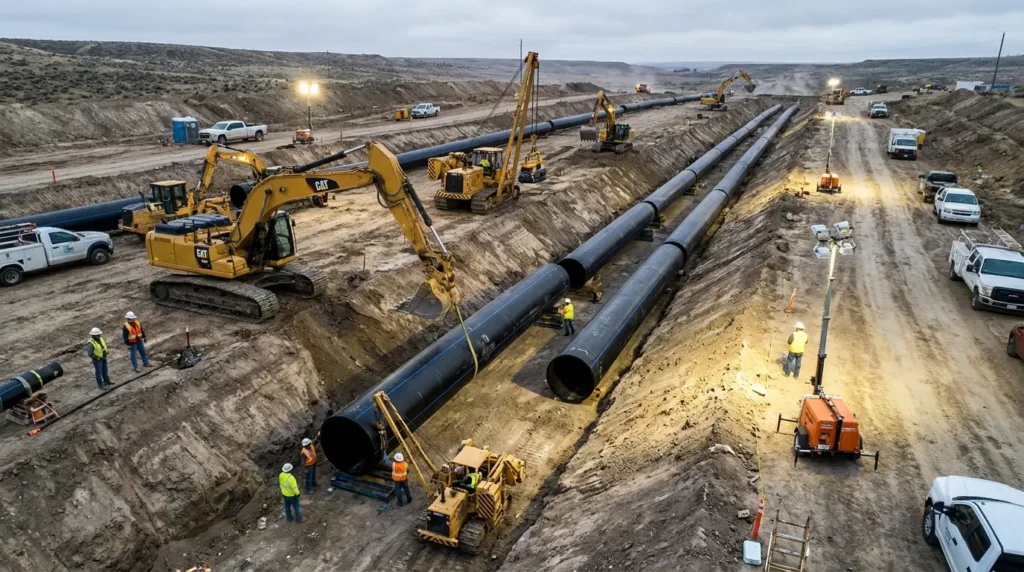
Misreading dimensional data triggers a cascade of site issues—from incompatible fittings to catastrophic pipe bursts and blown project deadlines. Steer clear of these frequent specification errors:
Sourcing industrial volumes of polyethylene pipe means that interpreting the sizing chart is only half the battle. You also have to evaluate a manufacturer’s production capacity, quality control rigor, and logistics expertise to keep your project viable.
JINQUAN operates a sprawling 200-acre manufacturing facility boasting an annual production capacity that exceeds 100,000 tons. Equipped with over 40 high-speed pipe extrusion lines, this massive scale guarantees a stable, uninterrupted supply chain for global mega-projects.
Procurement Metrics to Consider:
Supplier Evaluation Checklist:
1. Do they process 100% virgin resin? (Using recycled materials is strictly prohibited for pressure-rated pipes).
2. Do they maintain in-house hydrostatic pressure testing laboratories?
3. Do they enforce rigorous dimensional tolerance checks for both OD and wall thickness?
4. Do they bring export packaging expertise to the table? (For example, container nesting—sliding smaller pipes inside larger ones—saves buyers a fortune on international freight).

What size does HDPE pipe come in?
HDPE pipe is available in a wide range of metric sizes depending on the production standard and application. Common metric sizes start from DN16 or DN20 for small service lines and can extend to DN1200 for municipal water supply, drainage, mining, and infrastructure projects. For large-diameter projects, HDPE pipes can also be manufactured up to DN3000 depending on factory capability, wall thickness, and project requirements.
How do I read an HDPE pipe SDR rating?
SDR stands for Standard Dimension Ratio. It is calculated by dividing the pipe outside diameter by the minimum wall thickness. A lower SDR means a thicker pipe wall and higher pressure capacity, while a higher SDR means a thinner wall and lower pressure capacity.
What is the pressure rating of SDR 11 HDPE pipe?
The pressure rating of SDR 11 HDPE pipe depends on the material grade. For PE100 material, SDR 11 is commonly rated PN16, which equals 16 bar or 1.6 MPa at 20°C. For PE80 material, SDR 11 is commonly rated PN12.5, which equals 12.5 bar or 1.25 MPa.
Is HDPE pipe size measured by OD or ID?
HDPE pipe is normally specified by outside diameter, also called OD. The outside diameter is the main reference size for each pipe, while the internal diameter changes according to wall thickness, SDR, and pressure rating.
What is the difference between PE100 and PE80 in pressure rating?
PE100 boasts a Minimum Required Strength (MRS) of 10.0 MPa, whereas PE80 tops out at an MRS of 8.0 MPa. Because PE100 utilizes a stronger, higher-density resin architecture, it achieves superior pressure ratings compared to PE80, even when both pipes share the exact same wall thickness and SDR class.
What is the largest diameter HDPE pipe available?
HDPE pipe size charts commonly list standard metric sizes up to DN1000 or DN1200. For large infrastructure, marine outfall, drainage, and industrial pipeline projects, some manufacturers can produce large-diameter HDPE pipes up to DN3000, depending on production equipment, wall thickness, pressure rating, and project specification.
How do I convert HDPE pipe size from mm to inches?
To convert HDPE pipe size from millimeters to inches, divide the millimeter value by 25.4. For example, 110 mm is about 4.33 inches. However, metric HDPE pipe sizes are not always directly interchangeable with IPS or DIPS inch-based pipe systems, so pipe fittings, flange adapters, and transition connections should be checked before ordering.
Which HDPE pipe size is best for water supply mains?
Common HDPE pipe sizes for water supply mains include DN110, DN160, DN200, DN250, and DN315, depending on flow demand, operating pressure, installation distance, and project design. PE100 SDR 11 and SDR 17 are commonly used for water supply projects, but the final selection should follow the required pressure rating, local standard, installation conditions, and engineering design.
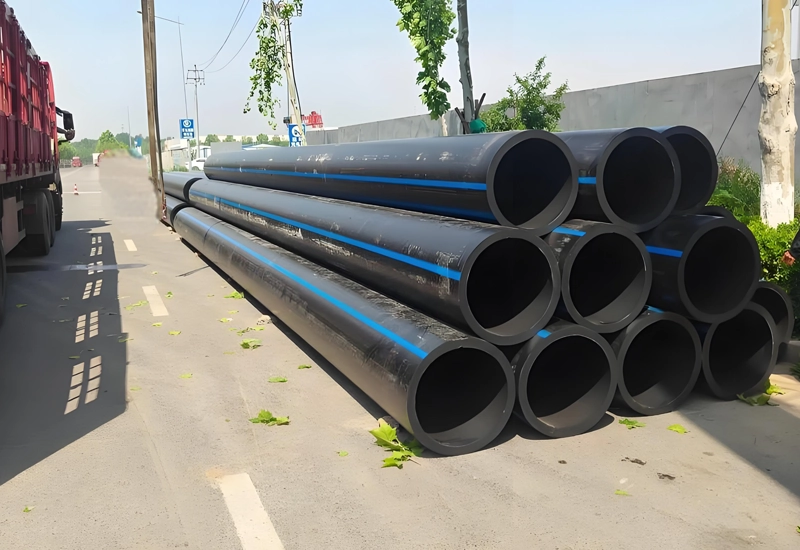
An HDPE pipe size chart helps engineers, contractors, and procurement teams compare DN, OD, SDR, wall thickness, and pressure ratings before selecting pipe specifications. Because HDPE pipe is normally OD-controlled, the outside diameter remains the main reference size, while the internal diameter changes according to SDR and wall thickness.
When choosing HDPE pipe for water supply, gas distribution, mining, drainage, irrigation, or industrial projects, buyers should confirm the pipe standard, material grade, SDR, PN rating, wall thickness, application, and required fittings. This helps reduce sizing errors, improve system compatibility, and support safer pipeline installation.
For project procurement, it is also important to confirm lead time, certification requirements, packaging, shipping method, and factory production capability before placing bulk orders. If you need help confirming pipe dimensions, SDR, PN rating, wall thickness, or project specifications, Contact JQ PIPE for technical support and a factory-direct quotation.