Address
Zhengzhou, Henan, China
Work Hours
Monday to Friday: 7AM - 7PM
Weekend: 10AM - 5PM
Address
Zhengzhou, Henan, China
Work Hours
Monday to Friday: 7AM - 7PM
Weekend: 10AM - 5PM

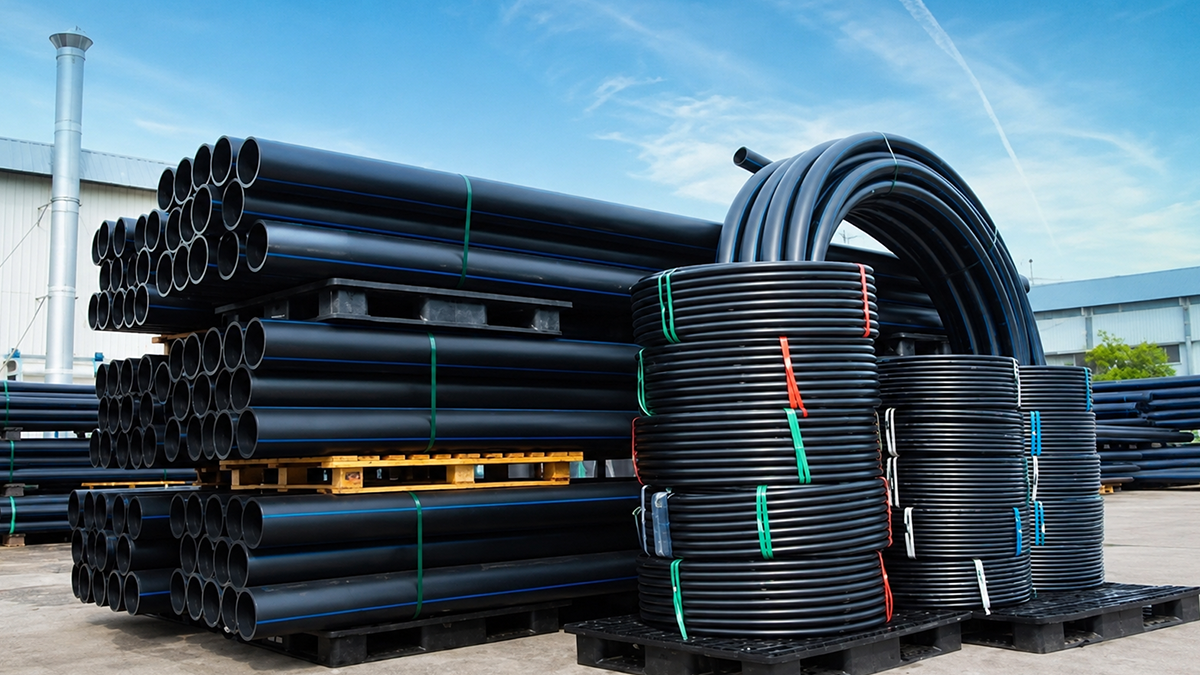
This PE100 Pipe Supplier guide helps B2B buyers verify standards (ISO 4427, EN 12201), assess quality control, compare SDR specifications, evaluate factory capability, and negotiate bulk-order pricing, MOQ, and lead time — so you can shortlist reliable manufacturers and avoid costly sourcing mistakes.
A PE100 pipe supplier delivers high-density polyethylene pipelines crafted from a specific material classification outlined by ISO 12162. This designation guarantees a Minimum Required Strength (MRS) of 10.0 MPa. For B2B procurement managers, partnering with the right vendor is a high-stakes decision. It ultimately determines whether municipal, industrial, or infrastructure pipelines will survive their intended 50-year lifespan. Vetting these partners means learning how to tell true manufacturers—those directly controlling raw material extrusion—apart from middlemen who simply aggregate products.
Grasping the nuances between these vendor types serves as the foundation of a smart procurement strategy. It paves the way for factory-direct pricing and ensures you receive products with rigorous dimensional tolerances.
| Supplier Type | Production & Quality Control | Pricing & Customization | Best Suited For |
|---|---|---|---|
| Direct Manufacturer (e.g., JINQUAN) | Operates extrusion lines directly. Full on-site QA lab. Controls virgin resin input. | Factory-direct pricing. Custom SDRs available. Massive capacity (100,000+ tons/year). | Large-scale infrastructure, international bulk orders, custom specifications. |
| Trader / Sourcing Agent | No direct control over quality testing. Sources from multiple factories. | Adds 10%-20% markup. Risk of mixed batches and inconsistent SDR tolerances. | Buyers needing consolidated shipments of unrelated building materials. |
| Local Distributor | Relies on manufacturer warranties. Holds local inventory. | Highest price per meter. Low MOQ but highly limited customization. | Small, urgent local orders requiring immediate dispatch. |
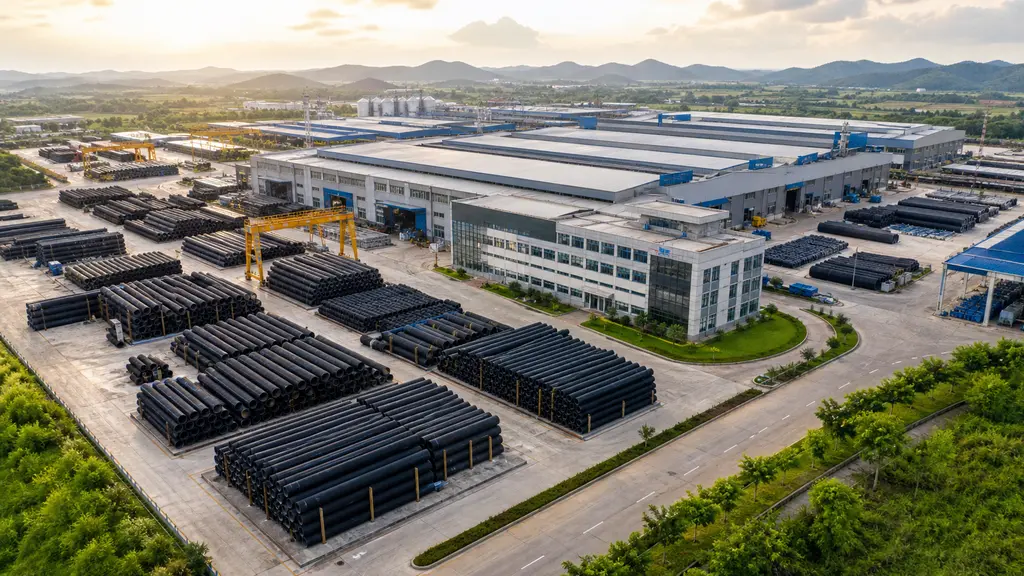
To compete on a global scale, a PE100 pipe supplier has to produce materials that meet strict international testing and dimensional frameworks. These guidelines govern everything from hydrostatic strength to a HDPE pipe’s safety for carrying drinking water or natural gas. When you source from a manufacturer holding active ISO 4427 certification, you ensure your pipeline infrastructure will easily pass local regulatory inspections and hold up reliably under constant pressure.
Global Standards Mapping for PE100 Pipes:
| Standard Code | Region / Scope | Primary Application |
|---|---|---|
| ISO 4427-1/2/3 | Global | PE pipes and fittings for water supply |
| EN 12201-2 | Europe | Water supply, drainage, and sewerage under pressure |
| AS/NZS 4130 | Australia / New Zealand | PE pressure pipes for general applications |
| ASTM F714 / D3035 | North America | Outside diameter-controlled PE pipes |
| GB/T 13663 | China | National standard for PE water supply pipes |
| ISO 4437 / EN 1555 | Global / Europe | Specific requirements for natural gas supply |
| ISO 9080 | Global | Long-term hydrostatic testing (50-year lifespan validation) |
Verification Steps for B2B Buyers:
The technical backbone of any PE100 pipe specification rests on two factors: the Standard Dimension Ratio (SDR) and its corresponding Nominal Pressure (PN) rating. SDR simply describes the ratio of the HDPE pipe’s nominal outside diameter (OD) to its nominal wall thickness. A lower SDR translates to a thicker wall, which inherently handles higher pressure. When weighing a PE100 vs PE80 pipe supplier, buyers quickly realize that PE100 materials can achieve superior pressure ratings using thinner walls. This dynamic drastically improves hydraulic capacity while cutting down on raw material costs.
SDR 11 PE100 pipe specifications and supplier requirements:
| SDR Value | Typical PN Rating | Typical Applications | Selection Notes |
|---|---|---|---|
| SDR 26 | PN 6.3 (0.63 MPa) | Low-pressure water conveyance and irrigation | Suitable where lower pressure capacity and reduced pipe weight are acceptable |
| SDR 21 | PN 8 (0.8 MPa) | Water distribution and irrigation systems | Confirm surge pressure and installation conditions |
| SDR 17 | PN 10 (1.0 MPa) | Municipal water distribution and industrial water systems | Commonly selected for medium-pressure water applications |
| SDR 13.6 | PN 12.5 (1.25 MPa) | Pumped water, sewage, and industrial pipelines | Check temperature, surge pressure, and transported-medium factors |
| SDR 11 | PN 16 (1.6 MPa) | Higher-pressure water mains and selected industrial systems | Gas applications require the applicable gas standard and a different design basis |
| SDR 9 | PN 20 (2.0 MPa) | High-pressure water and demanding industrial applications | Confirm project pressure, operating temperature, and surge conditions |
Typical PN ratings shown above are based on PE100 water pipe at 20°C and an applicable water-service design basis. Available diameters vary by manufacturer, production capability, product standard, and required SDR.
Elite quality control isn’t just a nice-to-have feature; it’s an absolute necessity for preventing catastrophic pipeline failures. A trustworthy manufacturer runs a documented, uncompromising testing protocol spanning from the raw resin silo all the way to the finished extrusion line. Every single batch requires full traceability and validation against core ISO parameters.
Step-by-Step Quality Control Protocol:
1. Raw Material Verification: Technicians perform Melt Flow Rate (MFR) testing (ISO 1133) to verify the virgin resin’s flow consistency before it ever hits the extrusion hopper. The results must align perfectly with the resin manufacturer’s technical data sheet.
2. Antioxidant Testing: The Oxidation Induction Time (OIT) test (ISO 11357-6) is critical. Samples have to endure at least 20 minutes at 200°C. Passing this test guarantees the chemical stability necessary for a half-century design life.
3. Pressure Resistance Validation: Through the Hydrostatic Pressure Test (ISO 1167), finished pipes face intense internal pressure at 20°C for 100 hours, and at 80°C for anywhere between 165 and 1000 hours. Weeping or bursting results in an immediate failure.
4. UV Protection Analysis: Measuring Carbon Black Content (ISO 6964) ensures the HDPE pipe can survive outdoor exposure. For maximum UV resistance, carbon black dispersion must fall strictly between 2.0% and 2.5%.
5. Mechanical Integrity: Tensile strength and elongation at break tests prove the HDPE pipe’s flexibility. The material must stretch more than 350% before breaking, confirming it can withstand shifting ground conditions.
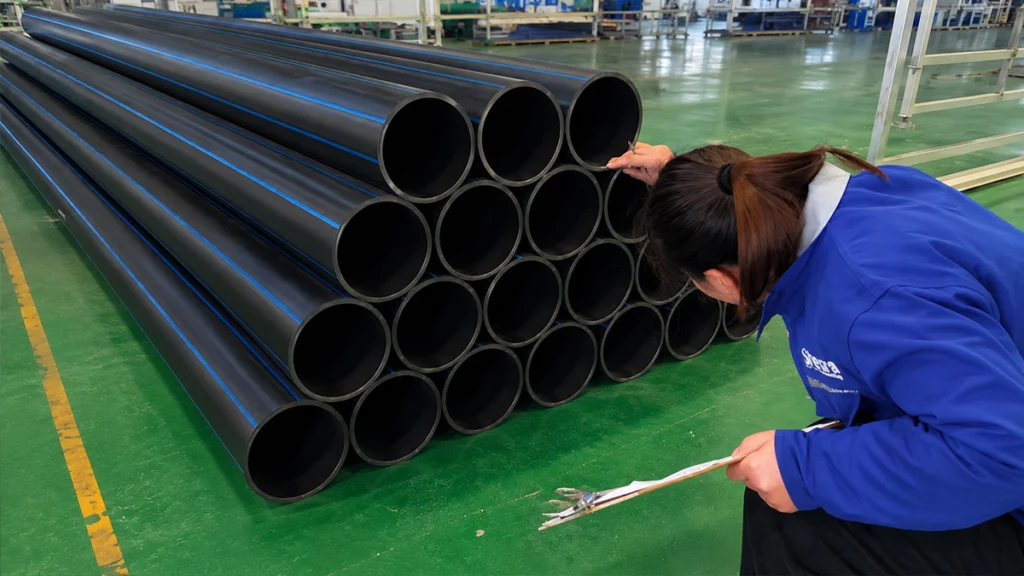
Your pipeline’s end-use establishes the exact visual coding, material grades, and certifications you need to demand from your PE100 pipe supplier. Taking a generic approach to procurement usually ends in compliance failures during strict municipal inspections.
Picking a PE100 pipe supplier in China for international export means conducting a systematic audit. You need to weed out trading companies and subpar manufacturers. A thorough factory audit confirms the vendor actually has the physical infrastructure, quality management systems, and testing capabilities required to deliver massive bulk orders without a hitch.
10-Point PE100 pipe factory audit checklist for B2B buyers:
1. Validate the scope and active status of both ISO 9001 (Quality) and ISO 14001 (Environmental) certificates.
2. Walk the raw material storage area. You want to see branded virgin PE100 resin silos (from names like Sabic or Borouge), not mysterious, unmarked bags of regrind scrap.
3. Examine the extrusion line technology. Specifically, look for automated ultrasonic wall-thickness calibration systems.
4. Audit the in-house laboratory to ensure they operate active, recently calibrated Hydrostatic and OIT testing machines.
5. Test their batch traceability. Have the supplier trace a random finished HDPE pipe directly back to its original resin batch certificate.
6. Evaluate production capacity. Benchmark the facility against industry leaders (for example, JINQUAN operates a 200-acre facility producing 100,000+ tons annually) to ensure they can handle your bulk order.
7. Check the fitting ecosystem. The manufacturer should also produce matching electrofusion and butt fusion fittings for a seamless, integrated pipeline.
8. Review their export packaging protocols alongside their strategies for optimizing container loads.
9. Ask for recent third-party pre-shipment test reports from recognized agencies like Bureau Veritas, CE, or SGS.
10. Read through the commercial warranty terms and verify the availability of after-sales technical support, including the provision of welding machines if needed.
Critical Red Flags: Be wary of any vendor who refuses third-party pre-shipment inspections. Additionally, a strong burnt plastic or chemical smell on the factory floor often points to the heavy use of recycled plastics. An inability to produce virgin resin certificates is an immediate dealbreaker.
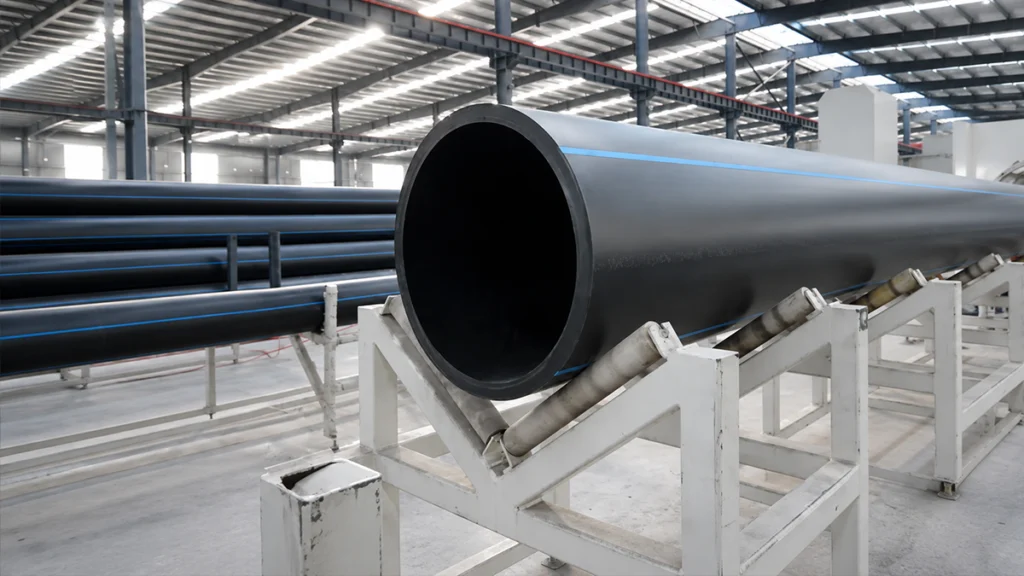
Grasping the logistics timeline and cost structure is vital for accurate project bidding. Wholesale PE100 pipe prices per meter are heavily influenced by global petroleum indices, simply because raw virgin resin makes up the vast majority of the total manufacturing cost.
Standard Cost Breakdown:
Pricing scales exponentially alongside the pipe’s wall thickness and diameter. A DN32 SDR11 pipe, for example, uses a fraction of the material per meter compared to a massive DN315 SDR17 pipe, which drastically changes the unit cost. Most factories quote these products either by the metric ton or by the meter.
PE100 HDPE pipe bulk order MOQ and lead time:
| Diameter Category | Typical MOQ | Standard Lead Time |
|---|---|---|
| Small (DN16 – DN110) | 100 – 500 meters | 7 – 10 days |
| Medium (DN160 – DN400) | 1x20ft Container | 7 – 15 days |
| Large (DN450 – DN3000) | 1x40ft HQ Container | 15 – 21+ days |
*Note: Large-scale integrated manufacturers like JINQUAN can often push standard sizes through production in just 7 to 15 days thanks to their massive annual capacity. Custom SDR requests, however, naturally require longer production windows.*
Managing international procurement means planning your logistics strategically to minimize freight costs and avoid shipping damage. An experienced PE100 pipe supplier knows how to engineer the loading process to maximize every inch of container space, actively driving down your landed cost per meter.
Logistics and Delivery Checklist:
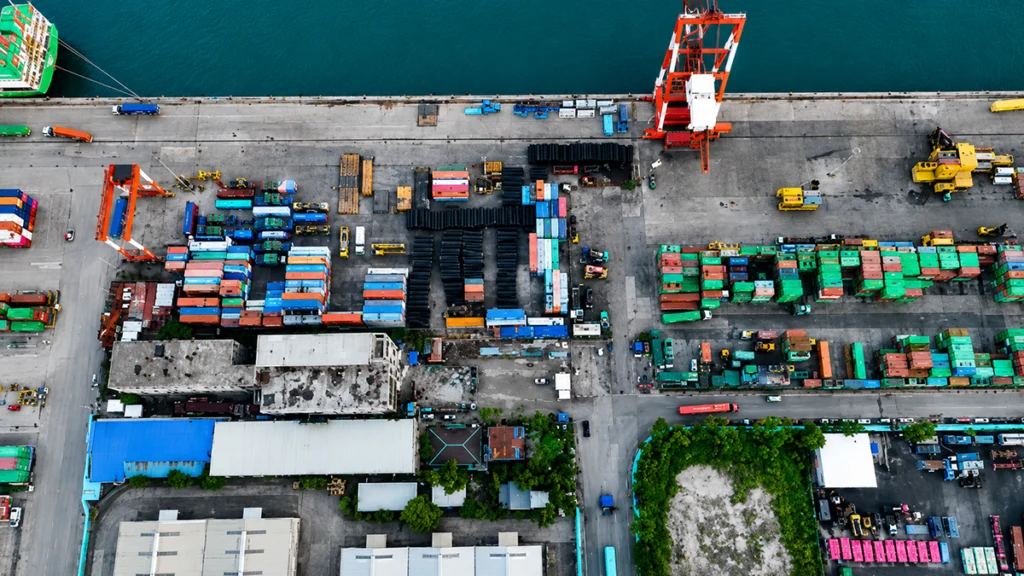
Buying infrastructure materials based on nothing but the lowest price tag is a dangerous game. Shady suppliers frequently cut corners in ways that are completely invisible to the naked eye but disastrous once the system is under hydrostatic pressure. Keep this risk framework handy to protect your capital.
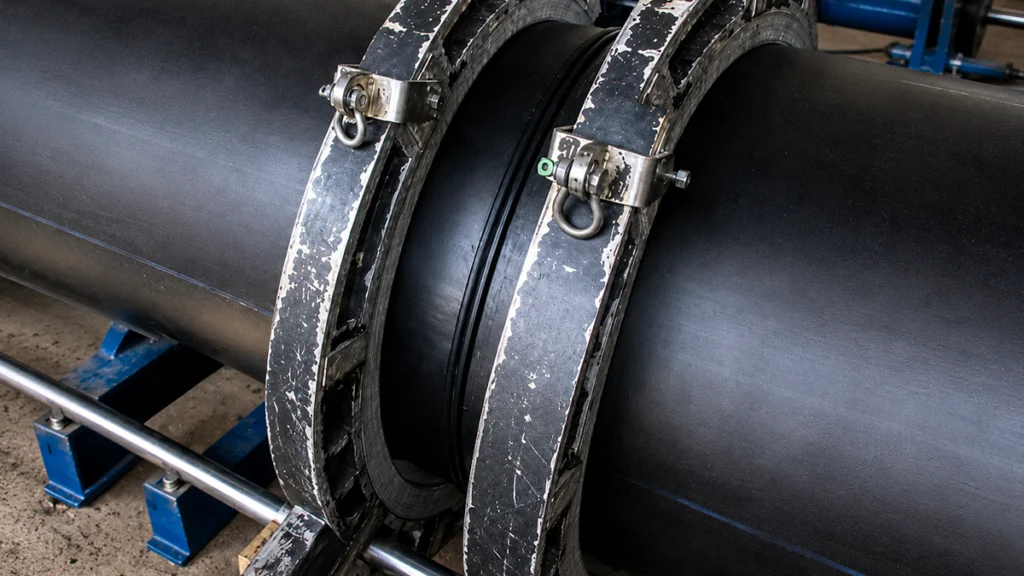
Selecting a reliable PE100 pipe supplier can help reduce procurement risk, control project costs, and improve delivery coordination. Before making a final decision, buyers should evaluate the supplier’s manufacturing capability, product compliance, quality control, technical support, and export experience.
1. Confirm whether the supplier is a direct manufacturer or a trading company, and review its production capacity, extrusion equipment, and project experience.
2. Request documented evidence of compliance with the product standards required by the project, such as ISO 4427, EN 12201, or other applicable local or industry standards.
3. Verify that the supplier uses certified and traceable PE100 compound that meets the required material standard and project specification.
4. Review the supplier’s quality-control capability, including dimensional inspection, melt mass-flow rate testing, oxidation induction time testing, and hydrostatic pressure testing where applicable.
5. Confirm that the supplier can provide compatible PE100 pipes, fittings, welding equipment, technical documents, and project-specific support when a complete pipeline package is required.
6. Ask for a clear quotation showing product specifications, quantities, accessories, testing requirements, packaging, freight terms, and any customization costs.
7. Evaluate the supplier’s export experience, production schedule, packaging method, container-loading plan, delivery coordination, spare-parts support, and after-sales service.
8. Request recent project references, inspection reports, certificates, and sample documentation before placing a large or long-term order.
Check the company’s business license, factory address, production lines, laboratory equipment, and warehouse. A live video tour or factory visit can also help confirm whether certificates, invoices, and export documents match the actual manufacturer.
Buyers should request evidence of compliance with ISO 4427 or the required local standard, together with batch test reports and any potable-water approval required in the destination market. SGS is a testing organization, not a universal drinking-water certification.
MOQ and lead time depend on diameter, SDR, quantity, pipe length, markings, testing, and production schedule. Standard orders may take about 7–15 days when materials and capacity are available, while customized orders may require longer.
Appearance and odor alone are not reliable. Buyers should request resin certificates, batch traceability, and relevant test reports. OIT, MFR, hydrostatic strength, and carbon-black testing can support quality checks, but no single test proves recycled content.
The price depends on diameter, SDR, material grade, length, quantity, testing, packaging, resin cost, and freight. A project-specific quotation is more accurate than a general price range.
PE100-RC is useful for trenchless installation, pipe bursting, rocky ground, and projects with higher slow-crack-growth risk. It is not necessary for every application, so the choice should follow the installation method and project specification.
Typical documents include the invoice, packing list, bill of lading, certificate of origin when required, raw-material certificate, batch inspection report, and product compliance documents. Additional reports may be required by the project.
Properly designed, manufactured, installed, and operated PE100 systems may last 50 years or more. Actual service life depends on material quality, pressure, temperature, installation, fusion quality, and operating conditions.
Selecting a reliable PE100 pipe supplier requires careful review of material traceability, product standards, testing capability, manufacturing capacity, and export experience. Buyers should confirm that the supplier uses certified PE100 compound, follows the applicable pipe standard, and provides batch inspection and test documentation.
Working with an integrated manufacturer that can supply PE100 pipes, compatible fittings, welding equipment, and technical support can simplify procurement and reduce compatibility risks. Clear production planning, suitable packaging, and coordinated logistics also help improve delivery efficiency for municipal, industrial, and infrastructure projects.