Address
Zhengzhou, Henan, China
Work Hours
Monday to Friday: 7AM - 7PM
Weekend: 10AM - 5PM
Address
Zhengzhou, Henan, China
Work Hours
Monday to Friday: 7AM - 7PM
Weekend: 10AM - 5PM

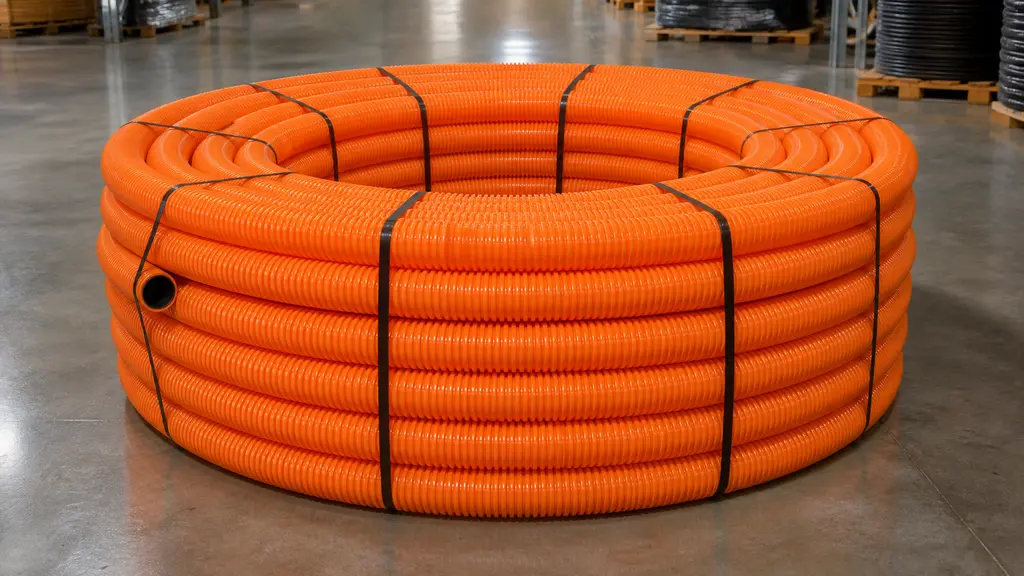
Single Wall Corrugated HDPE Pipe is widely used for underground cable protection because it offers flexible routing, corrosion resistance, fast installation, and practical cost control for utility projects.
Think of single wall corrugated HDPE pipe as a flexible, lightweight armor for underground utilities. Manufactured from High-Density Polyethylene, this conduit features a distinct, uniform corrugated profile on both the inside and outside. It acts as a dedicated, secure pathway, shielding vital electrical, telecommunications, and fiber optic cables from the harsh realities of buried environments.
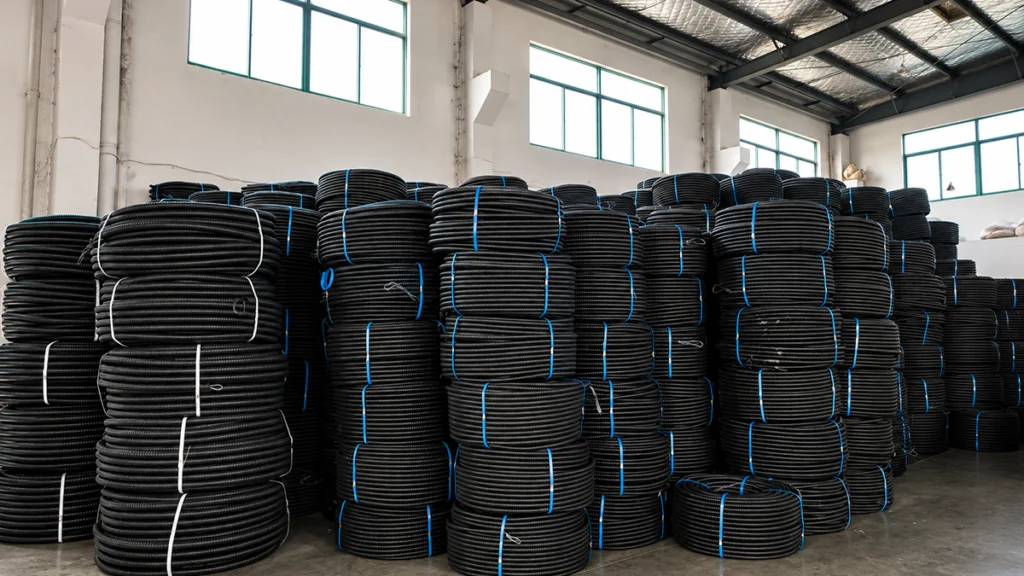
Producers extrude this pipe using premium virgin or carefully selected recycled HDPE resins—usually PE80 or PE100 grades. The resulting structure capitalizes on polyethylene’s natural strengths. Thanks to the single-wall corrugation, the conduit stays incredibly light and highly flexible while easily fending off corrosion, aggressive soil chemicals, and biological decay. Plus, unlike rigid stick pipes that require constant joining, this corrugated conduit ships in massive, continuous coils. That makes adapting to rolling, complex underground topographies surprisingly straightforward.
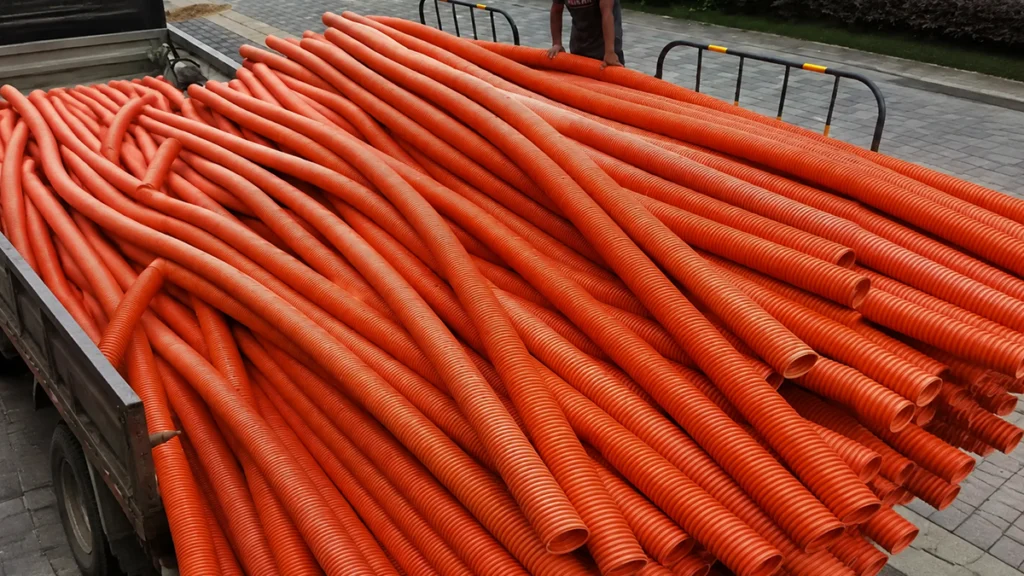
Site engineers and project managers lean heavily on this specific conduit because it tackles the two biggest threats to buried lines head-on: mechanical impact and environmental decay.
Mechanical Protection: That corrugated profile isn’t just for looks. It acts as a structural shock absorber. When soil pressure, heavy impacts, or installation stresses bear down on the HDPE pipe, the corrugations deflect that force away from the fragile utility lines housed inside.
Environmental Barrier: Buried infrastructure constantly fights a losing battle against moisture, shifting groundwater, and corrosive soil chemistry. Because HDPE is naturally inert and impermeable, it forms a watertight seal. This keeps moisture and chemicals completely locked out, protecting the cables for decades.
Continuous Runs: You can order this HDPE pipe in massive coils—anywhere from 100 feet up to lengths exceeding 5,000 feet, depending on the diameter. Longer runs mean drastically fewer joints. When you eliminate joints, you eliminate potential failure points and slash the risk of water creeping in, especially compared to traditional rigid PVC or steel pipes.
Route Flexibility: The single-wall design naturally bends. Installation crews can effortlessly weave the conduit around existing utilities, massive rocks, and awkward geological formations. You rarely need complex angled fittings or time-consuming joint assemblies.
Efficiency and long-term reliability make or break large-scale utility rollouts. For demanding infrastructure sectors, this conduit brings some heavy-hitting benefits to the table.
The actual mechanics of this HDPE pipe come down to a unique partnership between the conduit’s geometry and the dirt packed around it.
Load Distribution: The exterior ridges provide what engineers call “ring stiffness.” When heavy traffic or deep vertical soil loads press down on the HDPE pipe, the corrugations push that pressure outward into the compacted backfill. Essentially, the soil and the polyethylene pipe lock together into a unified structural system to prevent the plastic from crushing.
Ground Movement Absorption: Subsurface environments rarely sit still. Ground shifts happen constantly due to freeze-thaw cycles, torrential rain, or even seismic tremors. While rigid HDPE pipes often crack or shear under these dynamic stresses, HDPE simply yields and flexes. The pipe moves with the earth, keeping the internal void perfectly intact.
Cable Housing and Pulling: Once safely in the ground, the HDPE pipe serves as a continuous, armored duct. Teams can easily pull electrical or telecom lines through the pathway, often using a draw wire pre-installed at the factory. This setup is a massive win for future maintenance, allowing you to upgrade or swap out cables years later without ever touching a backhoe.
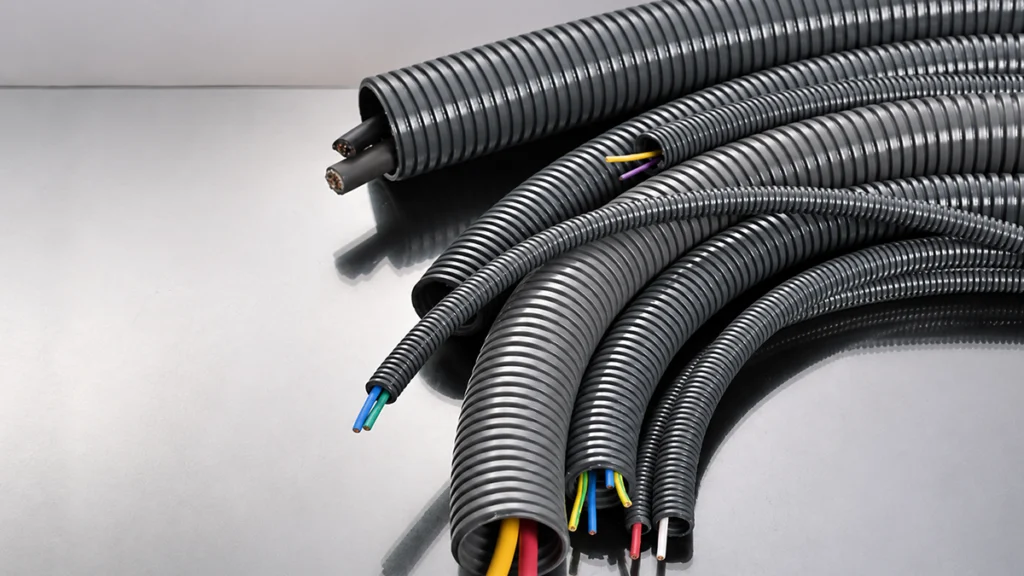
Thanks to its raw versatility, this HDPE pipe has become a standard specification across a wide variety of infrastructure sectors.
Getting the right corrugated HDPE duct means matching the technical specs to exactly what your site demands. Here is a breakdown of the critical parameters every buyer needs to evaluate before pulling the trigger.
| Specification Item | Common Range / Options | Why It Matters & Buyer Notes |
|---|---|---|
| Diameter Range | 1" to 6" (25mm to 150mm) | Cable protection typically uses smaller diameters; ensure enough internal clearance for cable pulling and future heat dissipation. |
| Dimension Ratio (DR) | DR 9 to DR 17 | Defines wall thickness (OD divided by minimum wall thickness). Lower DR means a thicker wall, offering higher crush resistance for deeper burials. |
| Ring Stiffness | SN4 (≥4 kN/m²) or SN8 (≥8 kN/m²) | Indicates resistance to radial deflection under soil/traffic loads. SN8 is recommended for areas with heavy surface traffic. |
| Temperature Tolerance | -20°F to 122°F (-29°C to 50°C) | Ensures the pipe will not become brittle during winter installations or deform during high-heat summer deployments. |
| Material Grade | PE80 or PE100 | PE100 offers superior density, higher pressure ratings, and better resistance to slow crack growth compared to PE80. |
| Industry Standards | ISO 4427, EN 12201, ASTM F2160, ASTM D3350 | Verifies the pipe meets international testing benchmarks for tensile strength, environmental stress crack resistance, and dimensional accuracy. |
Knowing how this material stacks up against the alternatives guarantees you pick the most structurally sound—and cost-effective—option for your specific trench.
| Conduit Type | Key Characteristics | Comparison vs Single Wall Corrugated HDPE |
|---|---|---|
| Single Wall Corrugated HDPE | Corrugated inside and out, highly flexible, continuous coils. | Creates slightly higher friction during cable pulling due to the corrugated interior, but offers unmatched flexibility and lowest cost for standard sweeps. |
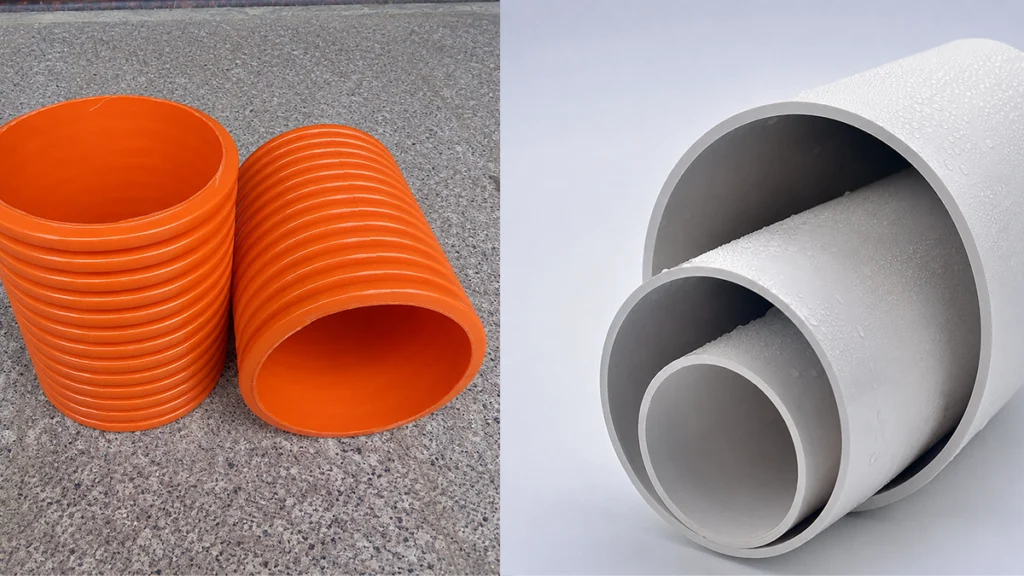
| Double Wall Corrugated (DWC) HDPE | Corrugated exterior, smooth interior wall. | The smooth interior makes cable pulling significantly easier over long distances. Higher ring stiffness for deep burial, but less flexible than single wall. |
| PVC Conduit | Rigid plastic, smooth interior, glued joints. | Requires angled fittings for bends. Can become brittle and prone to cracking in freezing temperatures, whereas HDPE remains impact-resistant in the cold. |
| Steel Conduit | Rigid metal, maximum crush resistance. | Extremely heavy, expensive, and susceptible to rust/corrosion over time. HDPE is 100% corrosion-proof, much lighter, and highly cost-effective. |
| MPP (Modified Polypropylene) Pipe | High tensile strength, extreme heat resistance. | The premium choice for trenchless HDD high-voltage power projects due to heat resistance. HDPE remains more cost-effective for standard open-trench burial. |
Even the highest-quality flexible conduit will fail if you install it poorly. If you don’t support the pipe correctly in the trench, it will deflect and eventually collapse. Stick to this installation checklist for the best results.
Sourcing underground HDPE conduit involves juggling a few moving commercial targets. Pricing isn’t static. It rides the waves of global polyethylene resin costs, which tie directly back to the crude oil market. Beyond raw materials, your project-specific costs will shift based on the HDPE pipe’s diameter, wall thickness (the DR rating), total order volume, and any custom requests like specific color striping or non-standard coil sizes.
When vetting a supplier, industrial buyers need to look hard at manufacturing muscle and quality control. Take JINQUAN as an example: they operate a massive 200-acre facility with an annual output topping 100,000 tons, driven by over 40 high-speed extrusion lines. That kind of scale guarantees a rock-solid supply chain, even for sprawling municipal builds.
For bulk orders, standard lead times generally run between 7 and 15 days. Minimum Order Quantities (MOQ) will vary depending on the diameter and the level of customization you need. Smart buyers verify factory-direct capabilities upfront. Request physical product samples, check for active ISO 9001 and ISO 14001 certifications, and demand proper export packaging so your coils survive the harsh realities of international maritime shipping.
Specifying the wrong conduit—or trying to shave a few dollars off the procurement budget—can trigger catastrophic infrastructure failures down the line. Keep these critical errors off your site.
Using Unrated Drainage Pipe: This is one of the most dangerous shortcuts out there. Swapping utility-grade cable conduit for cheap, agricultural drainage pipe is a recipe for disaster. Drainage pipes are frequently perforated and completely lack the structural ring stiffness needed to shield electrical cables from heavy, crushing soil loads.
Ignoring Thermal Expansion: HDPE moves with the temperature, expanding and contracting quite a bit. If you ignore thermal expansion during the install—especially if the black HDPE pipe sits baking in the sun before you backfill—you’ll end up with severe pipe snaking in the trench or joints pulling entirely apart.
Inadequate Trench Bedding: Dumping the pipe onto sharp trench rocks or failing to compact the side-fill soil compromises the entire system. Without tight lateral support, the flexible wall will slowly ovalize and eventually crush under vertical weight, which can easily sever the vital cables inside.
Exceeding Bend Radius: Bending corrugated pipe into harsh 90-degree angles just to save a little excavation time destroys the wall’s structural integrity. Worse, it creates massive friction choke points that make pulling heavy electrical lines physically impossible.
Buying Solely on Price: Chasing rock-bottom prices usually means you’re buying pipe extruded from highly degraded, low-tier recycled resins. The result? Inconsistent wall thicknesses, brittle plastic, and a massive risk of premature failure once buried. Always demand virgin materials or strictly controlled, high-grade recycled PE80/PE100 resins.
It serves as a rugged underground shield for utility lines. The conduit protects telecommunications, fiber optics, and electrical power cables from blunt impacts, heavy soil pressure, ground moisture, and corrosive chemicals, keeping critical infrastructure safe and stable.
Absolutely. It offers fantastic electrical insulation, blocks moisture, and shrugs off harsh soil chemistry. Utility crews regularly rely on color-coded HDPE (like black pipe with red striping) to safely route and easily identify primary and secondary power lines.
Diameters usually range from 1 inch up to 6 inches (25mm to 150mm), dictated by the size of your cable bundle. A good rule of thumb is to choose a pipe where the cables take up no more than 40% of the interior space. This leaves plenty of room for smooth pulling and proper heat dissipation.
That depends on the pipe’s ring stiffness (like SN4 or SN8) and what’s driving over the surface. Standard utility jobs usually bury the conduit 24 to 36 inches deep. If you’re routing under heavy vehicular traffic, you’ll need deeper trenches, higher ring stiffness, and meticulously compacted backfill.
If you’re doing incredibly long cable pulls, double wall corrugated (DWC) pipe often wins because its smooth interior drastically cuts friction. However, single wall pipe is much more flexible and budget-friendly, making it the superior choice for shorter runs or routes that require a lot of winding directional changes.
When extruded from premium PE80 or PE100 resin and bedded correctly in the trench, this pipe boasts an engineered lifespan of 50 to 100 years. It simply doesn’t rust, rot, or degrade from chemical or biological exposure.
Pricing shifts with the global cost of polyethylene resin, which tracks alongside crude oil markets. On a per-project basis, your final invoice depends on the pipe diameter, wall thickness (DR rating), total order volume, custom color requirements, and the factory’s Minimum Order Quantity (MOQ).
Yes, it’s widely used across fiber optic networks. That said, for massive, continuous pulls, telecom contractors sometimes upgrade to smooth-wall HDPE or Double Wall Corrugated (DWC) pipe to minimize drag and keep delicate fiber strands from stretching under excessive tension.
Choosing the right underground conduit is an important decision that affects the safety, service life, and maintenance requirements of utility infrastructure. Single wall corrugated HDPE pipe provides a flexible and cost-effective solution for cable protection, electrical routing, and telecom applications.
When selecting conduit, buyers should consider pipe diameter, ring stiffness, material grade, installation environment, and project requirements. Double wall corrugated pipe or MPP pipe may be more suitable for certain heavy-duty or trenchless applications, while single wall HDPE pipe remains a practical choice for many standard underground cable protection projects.
For reliable long-term performance, use standards-compliant pipe, follow proper installation practices, and choose a supplier that can provide consistent quality and technical support.