Address
Zhengzhou, Henan, China
Work Hours
Monday to Friday: 7AM - 7PM
Weekend: 10AM - 5PM
Address
Zhengzhou, Henan, China
Work Hours
Monday to Friday: 7AM - 7PM
Weekend: 10AM - 5PM


In Russia, heating and water supply systems are critical components of buildings, and PE-RT pipe have become a popular choice. Influenced by its uniquely harsh climate and vast geographical challenges, heating and water supply systems must withstand extremely low external temperatures and high internal water supply temperatures. This directly drives the urgent demand for high-performance, durable, and highly heat-resistant piping materials. Traditional metal pipes face issues like corrosion, scaling, and high installation costs, while PPR pipe or polybutylene pipes have limitations in handling high temperatures and pressures, as well as long-term reliability.
Therefore, Russian heating and water supply systems urgently require piping materials with exceptional thermal stability and flexibility to better meet heating and water supply demands. PE-RT pipe precisely meets these requirements, offering reliability under both low-temperature installation and high-temperature operation. This guide will specifically analyze why PE-RT pipe should be chosen for Russia’s heating and water supply systems.
Research indicates that demand for PE-RT pipe and fittings in the Russian market is experiencing significant growth, primarily driven by three core factors: large-scale residential modernization projects, government promotion of green building and energy efficiency standards, and sustained infrastructure investment needs. Russia’s harsh winters (with extreme temperatures reaching -40°C) demand piping technology capable of withstanding both low and high temperatures, a requirement perfectly matched by PE-RT pipes’ temperature range of -40°C to 95°C. Approximately 30% of Russia’s municipal pipelines are currently operating beyond their design lifespan, creating substantial demand for large-scale pipeline network renovations. Concurrently, agricultural modernization is unlocking the market for water-saving irrigation pipes, while expanding housing areas and infrastructure investments are driving demand in the construction sector.
In summary, driven by Russia’s harsh climate demanding high-temperature and freeze-resistance from piping materials, the market’s continuous emphasis on energy efficiency, environmental protection, and construction convenience, as well as government policies and industry standards promoting demand for new high-performance piping materials, the demand for PE-RT pipe and fittings in Russia is steadily increasing.
PE-RT pipe, fully known as Polyethylene of Raised Temperature Resistance Pipe, is a high-molecular-weight material pipe manufactured through copolymerization of ethylene and octene. Through specialized molecular design and synthesis processes (typically copolymerization), controlled and uniformly distributed side chains are introduced onto the polyethylene molecular chain, significantly enhancing its long-term heat resistance and creep resistance properties.
The heat resistance of PE-RT is not achieved through cross-linking (as in PEX pipes), but rather through “genetic modification” of the raw material during the polymerization stage. During production, specialized catalysts and copolymerization techniques precisely incorporate another monomer (such as hexene or octene) into the polyethylene molecular chain, forming uniformly distributed short side chains. The material is then extruded into pipe form using standard plastic extrusion equipment, followed by drawing, cutting, printing, and spooling to create the finished product. This entire process ensures precise pipe dimensions, a smooth surface, and stable performance, meeting the requirements for heating and hot water systems.

PE-RT pipe specifications are critical for ensuring long-term reliability in Russian heating and water supply systems.
When selecting PE-RT pipes, determine the required specifications based on the system’s operating temperature and pressure for the specific application scenario.
PE-RT pipe has secured a prominent position in Russian heating and water supply systems due to its unique material properties and outstanding comprehensive performance. PE-RT plumbing not only meets the demands of cold environments but also demonstrates significant advantages in installation efficiency, long-term cost-effectiveness, and environmental sustainability.
PE-RT tubing can be safely used over extended periods within a temperature range of -40°C to +95°C, and can even withstand short-term peak temperatures of up to 110°C. This enables it to easily meet the high-temperature demands of domestic hot water, district heating, and underfloor heating systems.
Under sustained high temperatures and pressure, conventional materials gradually deform (creep). The molecular structure of PE-RT material effectively resists creep, ensuring that pipe wall thickness does not diminish over its decades-long design life. This enables the pipe to continuously withstand system pressure, eliminating the risk of rupture caused by long-term creep.
PE-RT plumbing exhibits outstanding long-term hydrostatic strength and thermal creep resistance. This enables it to sustain high system pressures under elevated operating temperatures, ensuring pipes remain free from rupture or leakage throughout their design lifespan. This significantly enhances the safety of heating and water supply piping systems.
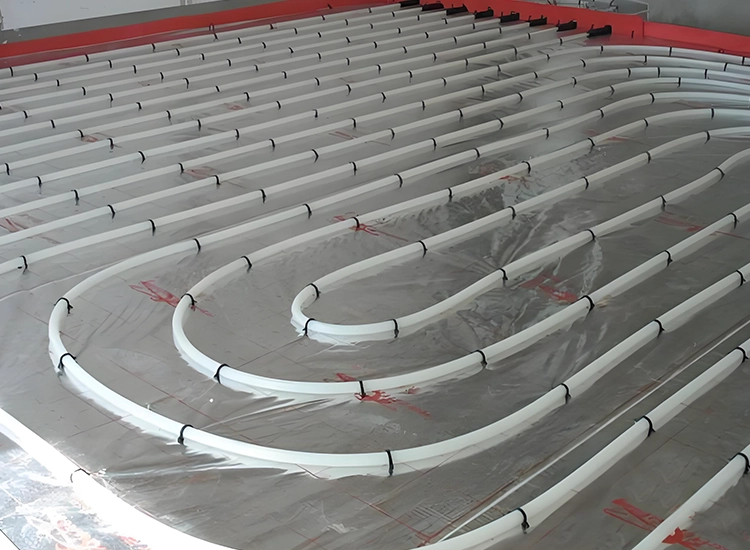
PE-RT pipes offer excellent flexibility, resisting springback during small-radius bends without requiring preheating. This characteristic makes them particularly suitable for installing radiant floor heating loops in complex areas, allowing easy navigation around obstacles.
Due to the exceptional flexibility of PERT pipes, the use of small-diameter PERT pipes during installation reduces the number of joints required, significantly improving construction efficiency while lowering installation time and labor costs.
PE-RT pipes exhibit excellent corrosion resistance against acids, alkalis, salts, and other chemicals, remaining completely unaffected by electrochemical corrosion. They are particularly suitable for corrosive soil environments or water conditions. The pipes feature a smooth inner wall with low friction resistance, making them resistant to scaling.
PE-RT tubing is lighter than metal pipes, making transportation and handling more convenient and economical. Its smooth inner walls reduce energy consumption during fluid conveyance. Waste generated during production and use, along with old pipes, can be recycled. With a long service life, PE-RT tubing offers both economic and environmental benefits overall.
Under design temperature and pressure conditions, PE-RT pipes have an expected service life exceeding 50 years, far surpassing the actual service life of many traditional metal pipes.
PE-RT pipe has become the core choice for heating and water supply systems in Russia’s building infrastructure due to its exceptional resistance to temperature, pressure, corrosion, and flexibility. This is particularly true in environments requiring resilience against severe cold climates and high energy efficiency demands.
From heating systems that ensure warm and comfortable homes, to delivering clean and hygienic drinking water, to ground snow-melting facilities that enhance public safety, PE-RT pipes have become the preferred choice for heating and water supply piping materials in Russia due to their comprehensive performance, reliable quality, and environmental friendliness.
PE-RT pipes and polybutylene (PB) pipes are both flexible plastic piping systems. PB pipes were once widely used in hot and cold water supply systems and heating installations worldwide, favored for their flexibility, high-temperature resistance, and ease of installation. However, their inherent brittleness makes them prone to cracking and leakage, limiting their applicability. PE-RT pipes represent a more modern and reliable solution, gradually replacing PB pipes.
| Items | PE-RT Pipe | Polybutylene Pipe(PB Pipe) |
|---|---|---|
| Material | Polyethylene of Raised Temperature Resistance | Polybutylene |
| Molecular Structure | Non-cross-linked Polyethylene | Linear Semi-crystalline Polymer |
| Temperature Resistance | -40°C to +95°C | -20°C to +110°C |
| Pressure Resistance | excellent | good |
| Connection Methods | Electrofusion, butt fusion, socket fusion | Compression fittings |
| Flexibility | Excellent, good low-temperature flexibility | Excellent, very soft and easy to bend |
| Water Quality Impact | Not affected by chlorine, strong corrosion resistance | Susceptible to chlorine, which may accelerate degradation |
| Recyclability | Recyclable | Generally recyclable, but application is limited |
| Service Life | Over 50 years | 5-15 years |
| Corrosion Resistance | It exhibits excellent corrosion resistance to chlorine and other chemicals in water. | Bad, easily corroded by residual chlorine in water. |
PE-RT (Polyethylene of Raised Temperature Resistance) pipes and PEX (cross-linked polyethylene) pipes are both high-performance plastic piping systems widely used in modern construction, particularly in heating and water supply systems. Both offer excellent temperature resistance, corrosion resistance, and flexibility, but they differ significantly in molecular structure, connection methods, ease of installation, and environmental recyclability. Understanding these distinctions is crucial when selecting piping materials for engineering projects, as it directly impacts long-term reliability, construction efficiency, and cost control.
| Items | PE-RT Pipe | PEX Pipe |
|---|---|---|
| Material | Polyethylene of Raised Temperature Resistance | Cross-linked Polyethylene |
| Molecular Structure | Non-cross-linked PE | Cross-linked PE |
| Production Process | Catalytic Copolymerization | Cross-linking Method |
| Temperature Resistance | -40°C to +95°C | -70°C to +110°C |
| Pressure Resistance | Excellent | Superior |
| Connection Methods | Electrofusion, butt fusion, socket fusion | Mechanical connection |
| Flexibility | Excellent, Low-temperature flexibility is generally better than PEX pipe. | Excellent,Highly malleable |
| Recyclability | Recyclable, as it is a thermoplastic | Non-recyclable due to cross-linked thermoset structure |
| Memory Effect | None. Does not spring back. | Yes. Especially PEX-a, can be difficult to handle. |
In Russia, particularly given its harsh climate and extensive district heating infrastructure, the reliability, energy efficiency, and long-term durability of piping systems are paramount. PE-RT pipes have gained widespread adoption in Russia due to their outstanding comprehensive performance.
As Russian building codes increasingly mandate higher energy efficiency and material longevity, coupled with growing recognition of its performance among installers and end-users, the application scope of PE-RT piping is projected to continue expanding.
PE-RT pipes, as a high-performance piping solution, significantly enhance the overall performance of building heating and water supply systems. Their exceptional temperature resistance and creep resistance ensure more stable heating system operation and precise water temperature control, improving indoor comfort while effectively reducing system energy consumption. The smooth inner surface of the pipes prevents scale buildup, maintaining water purity over time and reducing maintenance needs caused by blockages or corrosion. This substantially lowers long-term operational costs and replacement frequency.
As a recyclable thermoplastic material, PE-RT pipes offer an environmentally friendly and sustainable choice for building piping. Furthermore, their high weld strength and superior sealing eliminate leakage risks. Combined with inherent corrosion resistance and freeze-thaw durability, these pipes guarantee long-term stable operation of heating and water supply systems.
PE-RT pipe and fittings are increasingly becoming a popular choice in Russia’s heating and water supply systems due to their exceptional high-temperature resistance, outstanding flexibility, convenient and efficient installation, and long service life. Whether in residential, commercial buildings, or industrial applications, PE-RT piping systems deliver reliable, safe, and efficient solutions. They demonstrate exceptional reliability in Russia’s harsh winter conditions. As one of China’s trusted PE-RT pipe manufacturers, Jinquan remains committed to providing customers with high-quality PERT pipe that meets international standards. Designed to withstand Russia’s frigid climate, Jinquan PERT pipe delivers outstanding performance in heating and water supply networks. Choosing Jinquan PE-RT pipe means selecting a durable, energy-efficient, and environmentally friendly solution for your heating and water supply systems.
Fill out the form and our team will contact you shortly.