Address
Zhengzhou, Henan, China
Work Hours
Monday to Friday: 7AM - 7PM
Weekend: 10AM - 5PM
Address
Zhengzhou, Henan, China
Work Hours
Monday to Friday: 7AM - 7PM
Weekend: 10AM - 5PM

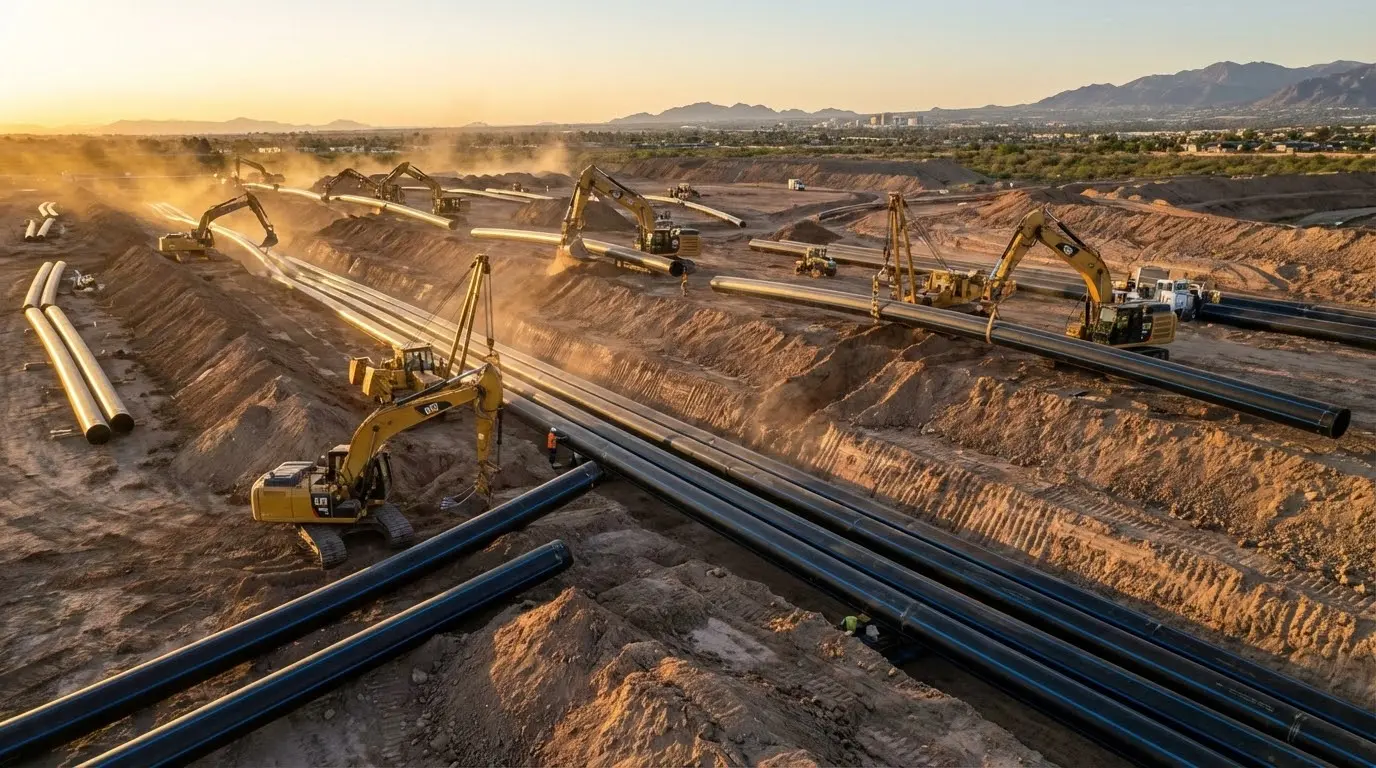
Leaking infrastructure costs global utility companies an estimated $14 billion every year. That statistic alone makes selecting the right HDPE pipe for water supply the single most effective strategy for reducing non-revenue water. Unlike traditional metals that inevitably corrode and crack over time, High-Density Polyethylene (HDPE) provides a fused, monolithic system built to survive aggressive soil conditions for more than half a century.
This engineering guide breaks down the technical nuances between PE80 and PE100 grades, clarifies how to calculate pressure ratings using SDR and PN values, and offers a direct comparison between butt fusion and electrofusion for installation efficiency. We will also look at the total lifecycle costs compared to ductile iron and detail the specific ISO 4427 quality control protocols we use at JINQUAN’s 200-acre manufacturing facility.
By the end of this guide, you will have the knowledge to write a precise procurement specification, evaluate supplier certifications, and confidently size the optimal HDPE pipe for your next municipal or industrial project.
—
For decades, water infrastructure was synonymous with ductile iron, steel, and concrete. That era is ending. HDPE isn’t just an “alternative” anymore; it is the default choice for new installations and rehabilitation projects worldwide. To understand why, we need to look at the material science and engineering leverage that JINQUAN applies in the manufacturing process.
High-Density Polyethylene (HDPE) is a thermoplastic polymer derived from the monomer ethylene. In pressure piping, materials are categorized by their Minimum Required Strength (MRS).
When designing for potable water, priorities are safety, flow rate, and longevity. HDPE hits the mark on all three:
1. Immunity to Corrosion: Unlike ferrous metals, HDPE is chemically inert. It won’t rust, rot, or suffer from galvanic corrosion. It stands up to aggressive, low-pH soils without requiring expensive cathodic protection or plastic sleeving.
2. Fused, Leak-Free Joints: Whether using butt fusion or electrofusion, the resulting joint is stronger than the pipe itself. This creates a continuous system, eliminating the bell-and-spigot joints that are the primary source of leaks in older systems.
3. Superior Flow Coefficient: HDPE boasts an incredibly smooth interior with a Hazen-Williams C-factor of 150. Because scale and biological growth don’t stick to the surface, this flow capacity remains constant over the HDPE pipe’s life, keeping pumping energy costs low.
4. Longevity: Under standard conditions (20°C), these PE100 pipes are engineered for a minimum service life of 50 years. Real-world studies often suggest a lifespan exceeding a century.
To assist with your next tender evaluation, here is how HDPE stacks up against traditional materials across key performance metrics.
| Feature | HDPE (PE100) | Ductile Iron (DI) | PVC (Polyvinyl Chloride) | Steel |
|---|---|---|---|---|
| Corrosion Resistance | Excellent (Native) | Poor (Needs coating/sleeving) | Good | Poor (Needs coating/cathodic protection) |
| Joint Integrity | Welded (Leak-free, monolithic) | Gasketed (Risk of root intrusion) | Gasketed/Solvent Weld | Welded or Flanged |
| Flexibility | High (Bend radius 20-25x OD) | Rigid | Rigid (Brittle in cold) | Moderate |
| Flow Coefficient (C) | 150 (Constant) | 140 (Degrades over time) | 150 | 140 (Degrades significantly) |
| Installation Speed | Fast (Long lengths, fewer joints) | Moderate (Heavy, short lengths) | Moderate | Slow (Welding is labor intensive) |
| Surge/Water Hammer | Excellent Damping | Moderate | Poor (Catastrophic failure risk) | Good |
In water supply, compliance isn’t optional. JINQUAN manufactures HDPE pipes in strict adherence to:
—
Simply asking for “HDPE pipe” isn’t enough. You need to specify the correct parameters to handle your system’s internal pressure and external loads.
Your choice here dictates wall thickness and budget.
The Standard Dimension Ratio (SDR) is the most vital geometric number to understand. It represents the ratio between the HDPE pipe’s size and its wall thickness.
The Formula:
The Rule of Thumb: A lower SDR number indicates a thicker wall and a higher pressure rating. A higher SDR means a thinner wall and lower pressure capacity.
Common SDR to PN Conversions (PE100 at 20°C):
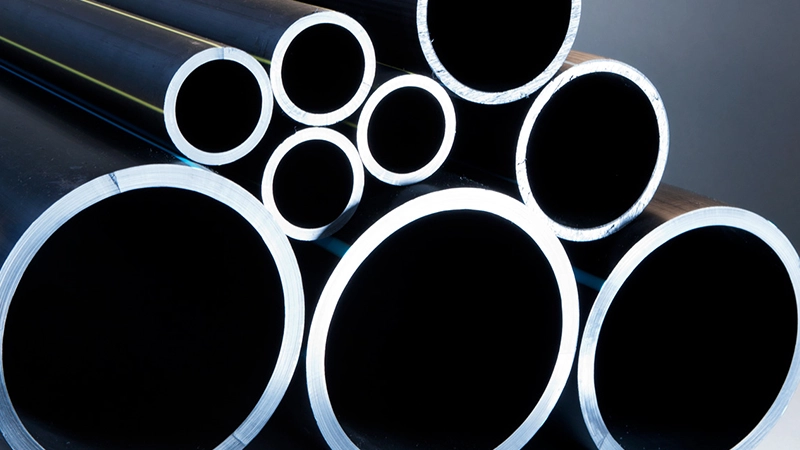
JINQUAN produces HDPE pipes from DN16 mm up to DN3000 mm. In the HDPE world, “DN” refers to the Nominal Outside Diameter (OD).
How can we promise a 50-year life? We calculate it using the Hydrostatic Design Basis (HDB).
The design stress(σ) comes from dividing the MRS by a safety factor (C). For water, the standard safety factor is 1.25.
—
A HDPE pipeline is only as reliable as its weakest joint. HDPE’s fusion capability creates a system where the “joint” is actually as durable as the pipe itself.
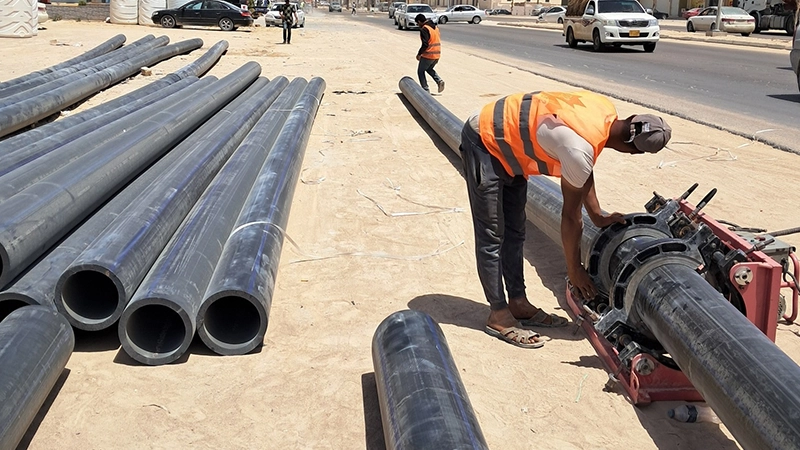
This is the go-to method for PE water pipes larger than DN63.
1. The Process: HDPE pipe ends are planed smooth, heated against a plate until a melt bead forms, and then forced together under hydraulic pressure.
2. Key Variables: Heater plate temperature (typically 200-220°C), soak time, and fusion pressure must be precise.
3. Equipment: JINQUAN provides hydraulic butt fusion machines capable of welding up to 1200mm diameters.
4. Visual Check: A solid joint displays a uniform double roll-back bead. If the bead is misshapen, the joint is suspect.
Electrofusion utilizes fittings with embedded heating coils.
1. The Process: HDPE pipe ends are scraped to remove the outer oxidation layer (a mandatory step), inserted into the coupling, and a machine sends current through the coils to fuse the plastic.
2. Best Use Case: Perfect for tight trenches where bulky butt fusion gear won’t fit, or for tie-ins and repairs.
3. Smart Tech: Modern scanners read the fitting’s barcode to auto-set voltage and time, removing human error from the equation.
Fusion is best, but mechanical connections have their place:
—
B2B buyers often struggle with the trade-off between upfront price and long-term value. While HDPE prices track with oil indices, the lifecycle economics tell a clear story.
When you analyze costs over 50 years, HDPE wins.
—
With over 15 years of experience and an annual output topping 100,000 tons, JINQUAN Plastic Industry Co., Ltd. blends massive scale with laboratory precision.
Quality starts with raw materials. We use 100% Virgin PE100 Granules from top-tier suppliers like Borealis, Sabic, and Sinopec. We never use recycled material for pressure pipes, ensuring consistent MRS performance.
1. Drying & Feeding: Removing moisture from raw material is the first step.
2. Extrusion: We run 40+ high-speed Battenfeld-Cincinnati lines to melt and shape the pipe.
3. Vacuum Sizing & Cooling: HDPE pipes pass through vacuum tanks to fix the OD, followed by spray cooling.
4. Marking: Every meter is stamped with Brand (JQ Pipe), Size, SDR, Material, Standard, and Batch Code for total traceability.
Our in-house CNAS-accredited lab tests per ISO 4427:
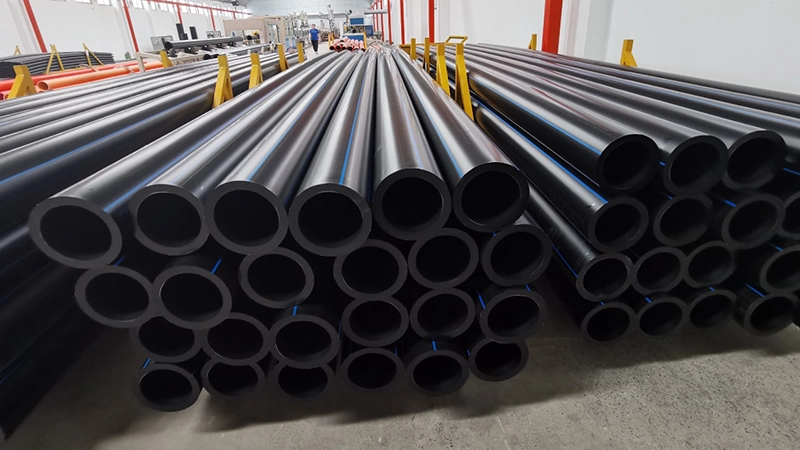
Shipping to 50+ countries requires smart logistics.
—
Use this guide to ensure you get an accurate quote and the right product for your needs.
1. Fluid & Temp: Is it potable water? Is the temp < 40°C? (If >40°C, look at PE-RT).
2. Working Pressure: What is the max system pressure (including surge)? Select a PN rating $\ge$ System Pressure.
3. Select SDR: Use the conversion table (e.g., 10 bar = SDR17 PE100).
4. Choose Diameter: Based on your flow rate requirements.
5. Define Connections: Butt fusion for mainlines, flanged for valves.
Copy and paste this details into your Request for Quotation:
—
Q1: What is the maximum operating temperature for HDPE water pipes?
HDPE pressure ratings are calculated at 20°C. The material can handle spikes up to 60°C, but continuous operation above 40°C requires derating (lowering the pressure limit). For continuous hot water (up to 95°C), you should use PE-RT pipes or PPR pipes, which JINQUAN also manufactures.
Q2: How do I calculate the PN rating if I know the SDR?
For PE100 with a safety factor (C) of 1.25, the formula is:
Simplified for PE100:
Always check the manufacturer’s datasheet, as local standards (like ASTM) may apply different safety factors.
Q3: Can HDPE pipes be used for chlorinated water?
Yes. HDPE is approved for potable water with standard levels of chlorine and chloramine used for disinfection. It is chemically stable and won’t impact water taste or odor. JINQUAN uses food-grade virgin raw materials to ensure full drinking water safety compliance.
Q4: What is the lead time for a 40ft container of DN315, SDR17 PE100?
Thanks to our high-capacity lines, standard specs like DN315 SDR17 are often in stock or produced very quickly. Typically, production takes 7-10 days for a full container load. Shipping time depends on the destination port. Contact our sales team for a real-time schedule.
Q5: Do you offer technical support for welding crews?
Yes. JINQUAN supports partners beyond the sale. We provide digital manuals, video tutorials for fusion, and technical consultation. For major projects, we can coordinate with local partners or guide your team on welding parameters to ensure installation quality.
—
Selecting the right piping system is where engineering precision meets economic foresight. By choosing HDPE pipe for water supply, you are investing in infrastructure that eliminates corrosion, reduces leakage to near zero, and withstands ground movement for decades. The pillars of a successful project—choosing PE100 over PE80, accurately calculating SDR, and using proper fusion methods—are what separate a reliable network from a maintenance nightmare.
As a manufacturer with over 15 years of global experience, JINQUAN Plastic Industry Co., Ltd. is ready to help. We don’t just sell HDPE pipes; we provide certified solutions tailored to your hydraulic and environmental needs.
Ready to secure your water infrastructure?
Contact JINQUAN’s engineering sales team today to request a project-specific quotation, access free sample HDPE pipes for testing, or receive a complete factory certification package. Let’s build a leak-free future together.