Address
Zhengzhou, Henan, China
Work Hours
Monday to Friday: 7AM - 7PM
Weekend: 10AM - 5PM
Address
Zhengzhou, Henan, China
Work Hours
Monday to Friday: 7AM - 7PM
Weekend: 10AM - 5PM

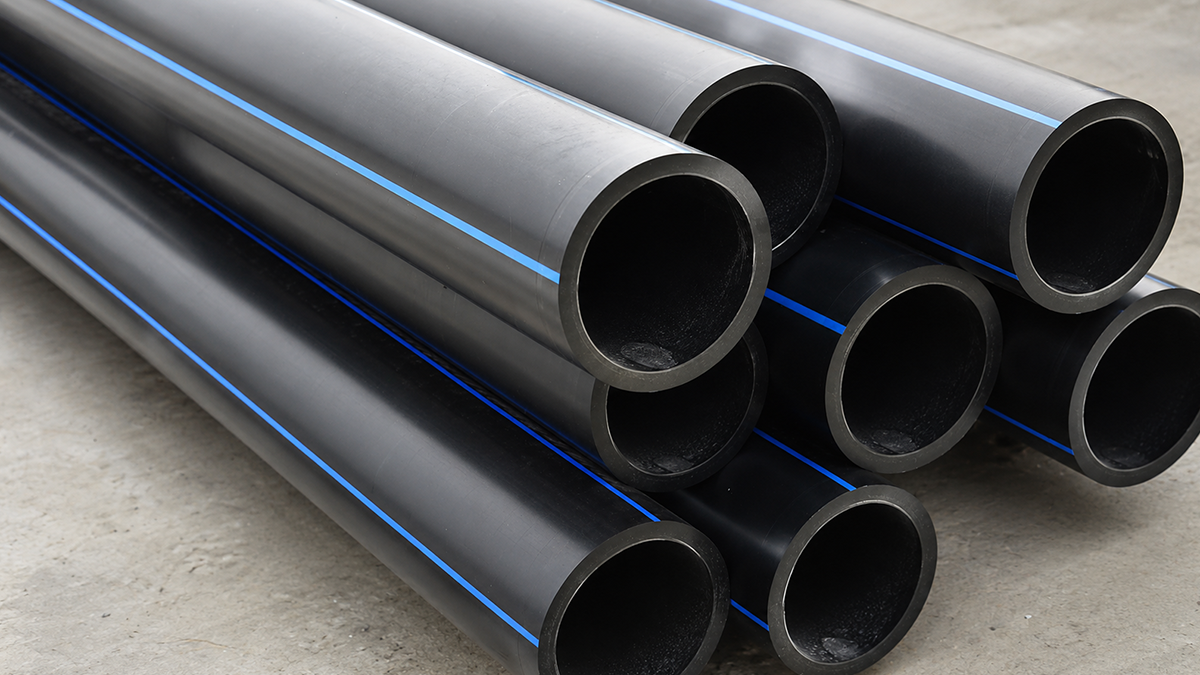
HDPE pipe is widely used for water supply, gas distribution, mining slurry, and drainage systems. This guide explains its key applications, specifications, pressure ratings, and selection criteria to help engineers and B2B buyers choose the right HDPE pipe for any industrial project.
Manufactured through the low-pressure catalytic polymerization of ethylene monomers, High-Density Polyethylene (HDPE) pipe is a rugged, semi-crystalline thermoplastic polymer. Engineers specifically design this piping for high-performance gas and fluid transport. It brings exceptional chemical resistance and extreme flexibility to the table, along with a seamless heat-fused jointing system. Ultimately, buyers and engineers look to HDPE as a leak-free, long-lasting upgrade over conventional concrete and metallic networks.
The material’s core physical and mechanical properties include:
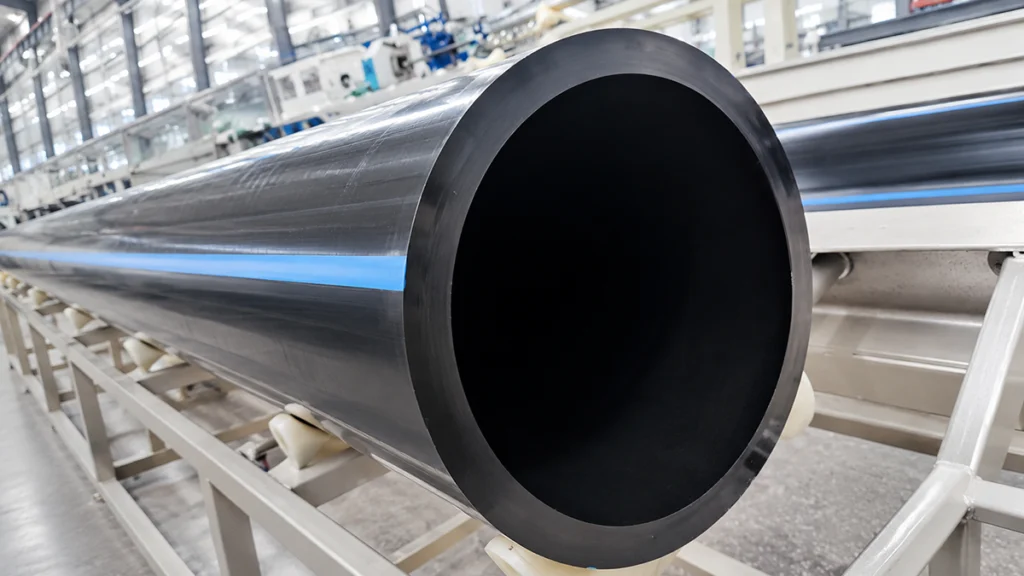
You’ll find this material deployed heavily across agricultural, industrial, and municipal sectors. Why? Because it directly tackles the common failure points associated with legacy piping materials. By wiping out mechanical joint leaks and systemic corrosion, it delivers an incredibly reliable conduit for mission-critical infrastructure.
The standout advantages include:
When utilized for water supply, this HDPE pipe for water pipe offers a scale-resistant, incredibly safe conduit for municipal distribution networks. The polymer refuses to corrode. It won’t leach harmful chemicals either, meaning strict water purity is maintained all the way from the treatment plant to the tap. On top of that, the exceptionally smooth internal bore slashes friction loss, which directly reduces the energy load on municipal pumping stations.
Typical Water Supply HDPE Specifications:
| Parameter | Specification Details |
|---|---|
| Size Range | DN16 to DN3000 |
| Pressure Classes | PN4, PN6, PN8, PN10, PN12.5, PN16, PN20, PN25 |
| Material Grades | PE80 (MRS 8.0 MPa) and PE100 (MRS 10.0 MPa) |
| Global Standards | ISO 4427, AWWA C901/C906, EN 12201, AS/NZS 4130 |
| Health Certifications | NSF-61, WRAS (Ensures zero chemical leaching) |
Is this material actually safe for gas transport? Absolutely. In fact, it serves as the global standard for low and medium-pressure gas distribution. The heat-fused joints completely eradicate the gas leak risks inherent in threaded or mechanical alternatives. What remains is a fracture-resistant, highly flexible network that easily absorbs seismic shifts and soil settlement without breaking open.
HDPE pipe for gas pipe faces strict regulations and requires immediate visual identification. Manufacturers universally color-code it—either as solid yellow or black featuring co-extruded yellow stripes—to denote the transport of propane, methane, or natural gas. Stringent international standards govern both its production and field deployment, with GB 15558 and ISO 4437 (PE Pipes for Gaseous Fuel Supply Systems) leading the charge.
Few environments punish infrastructure quite like a mining operation. These sites are chemically aggressive and incredibly abrasive. Engineers heavily favor HDPE pipe for mining slurry transport because its scouring and wear resistance vastly outperforms standard metallic piping.
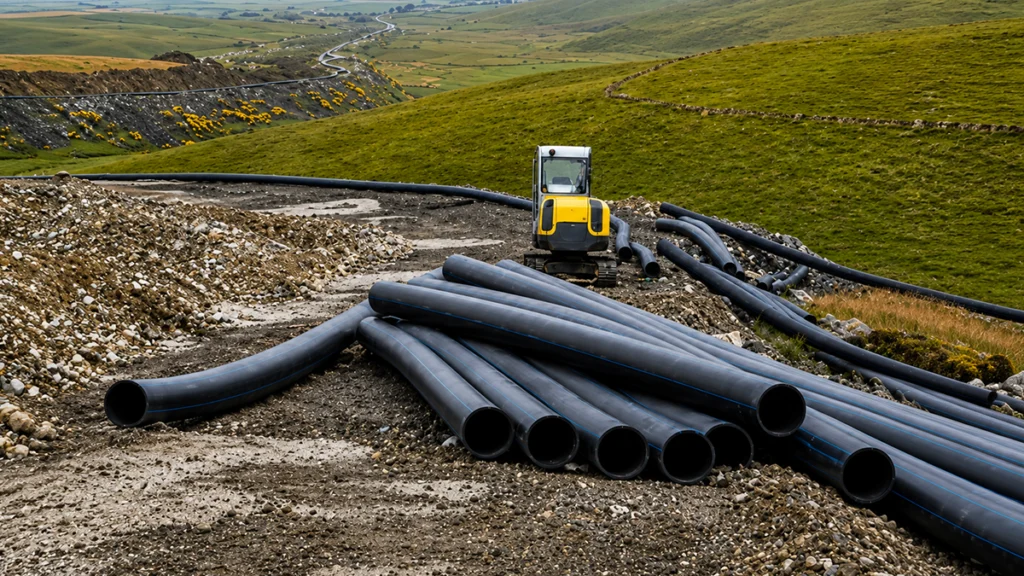
Consider a standard slurry line replacement. Upgrading from carbon steel to a PE100 grade often drives lifecycle cost savings of 20% to 50%. The tough polymer structure shrugs off the chemical leachates and corrosive mine water that eat right through steel. Furthermore, its inherent flexibility lets the line contour seamlessly across rugged terrain and sharp elevation drops. This drastically cuts down the need for expensive corridor grading and heavy mechanical fittings.
When evaluating HDPE pipe for drainage and sewage applications, you’ll generally look at two distinct structural designs. The choice depends entirely on the flow and pressure demands of the specific network. Pressurized sewage force mains demand thick, solid-wall construction. Conversely, gravity-fed stormwater systems get massive benefits from lightweight, highly engineered corrugated profiles.
Solid-Wall vs. Corrugated HDPE Pipe Comparison:
| Feature | Solid-Wall HDPE Pipe | Double-Wall Corrugated (DWC) HDPE Pipe |
|---|---|---|
| Primary Application | Pressurized sewage and force mains | Gravity flow, stormwater, and culverts |
| Structural Design | Solid monolithic wall | Smooth inner wall with a corrugated outer wall |
| Key Metric | SDR and PN (Pressure) ratings | Ring Stiffness (SN4: 4 kN/m², SN8: 8 kN/m²) |
| Weight Profile | Heavier, requires robust handling | Significantly lighter, saving transport and labor costs |
This material’s versatility stretches far beyond basic municipal water and gas lines, reaching into several specialized industrial sectors:
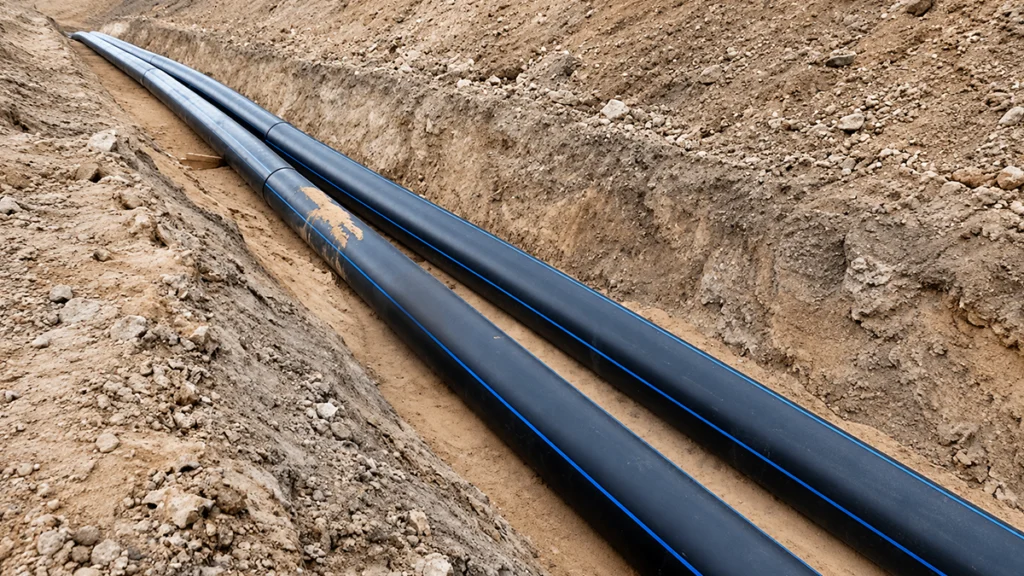
Nailing down the right SDR specifications and pressure ratings is absolutely critical for sound pipeline engineering. SDR, or Standard Dimension Ratio, simply represents the ratio of the polythylene pipe’s outside diameter (OD) to its wall thickness. When you see a lower SDR number, it means the HDPE pipe has a thicker wall and can safely handle a higher internal pressure.
The specific material grade (PE100 versus PE80) plays a massive role in pressure capacity. Modern PE100 resins boast a Minimum Required Strength of 10.0 MPa, a solid step up from the 8.0 MPa of legacy PE80 resins. Because of this, an SDR 11 pipe extruded from PE100 hits a PN16 rating. Take that exact same SDR 11 wall thickness but use PE80, and the rating drops to PN12.5.
HDPE Pipe Pressure Chart (Water @ 20°C):
| Standard Dimension Ratio (SDR) | PE100 Pressure Rating (PN) | PE80 Pressure Rating (PN) |
|---|---|---|
| SDR 17 | PN10 (10 bar / 145 psi) | PN8 (8 bar / 116 psi) |
| SDR 11 | PN16 (16 bar / 232 psi) | PN12.5 (12.5 bar / 181 psi) |
| SDR 9 | PN20 (20 bar / 290 psi) | PN16 (16 bar / 232 psi) |
| SDR 7.4 | PN25 (25 bar / 362 psi) | PN20 (20 bar / 290 psi) |
Specifying the right piping involves a careful balancing act. You have to weigh the strict technical demands of your project against the actual manufacturing capabilities of your chosen supplier. Vetting your manufacturer properly is the only way to guarantee the long-term reliability of the installed infrastructure.
Step-by-Step Selection Checklist:
1. Determine Fluid Characteristics: Pinpoint exactly what is flowing through the line. You need the fluid type, its chemical makeup, and the peak operating temperature.
2. Calculate Flow Requirements: Establish your required flow rate. This dictates the precise internal diameter (ID) you will need.
3. Identify Operating Pressure: Figure out the absolute maximum internal working pressure, making sure to factor in surge allowances. This data drives your SDR and material grade (like PE100) selection.
4. Assess External Loads: Look at the burial depth, overhead traffic loads, and surrounding soil conditions to guarantee the HDPE pipe won’t collapse under external stress.
5. Verify Regulatory Standards: Cross-check the HDPE pipe against relevant international and local frameworks, such as AWWA or ISO 4427.
Supplier Evaluation Criteria for Procurement Managers:
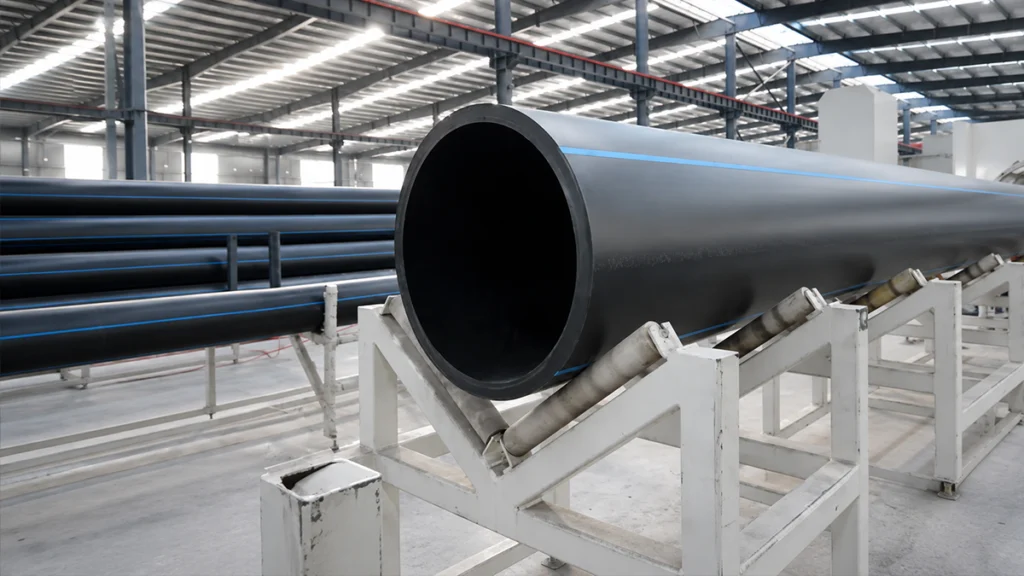
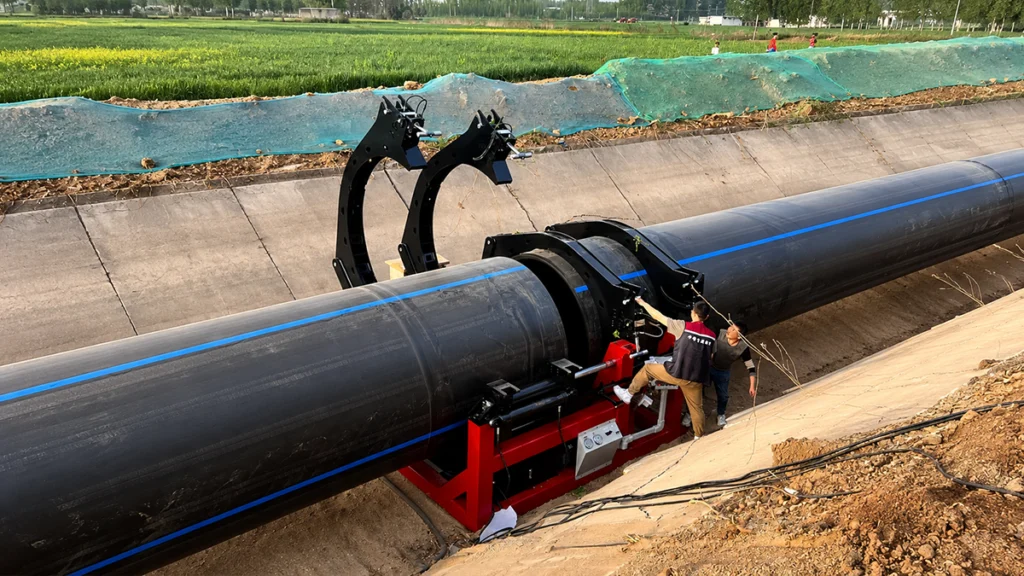
A HDPE pipeline is only as strong as its weakest joint. Fortunately, unlike legacy materials that depend on messy chemical solvents or prone-to-fail gaskets, polyethylene utilizes thermal fusion. This welding method results in a continuous, monolithic system. When done correctly, the fused joint becomes just as strong—if not stronger—than the pipe wall itself.
HDPE Pipe Jointing Methods Comparison:
| Jointing Method | Application & Characteristics | Typical Diameter Range | Equipment / Cost Profile |
|---|---|---|---|
| Butt Fusion | Main distribution lines, long-distance pipelines, and open trenches. Melts pipe ends and joins them under pressure. | 50mm to 2000mm | Lower fitting costs, requires higher initial equipment investment. |
| Electrofusion | Confined spaces, repairs, complex layouts, and joining pipes of different wall thicknesses. Uses fittings with embedded electrical heating coils. | 16mm to 710mm | Higher fitting costs, requires specialized electrofusion control boxes. |
| Mechanical Joints | Primarily used for transitioning to other materials (e.g., steel, PVC or ductile iron) using stub flanges and backing rings. | All sizes | Higher hardware costs, requires routine maintenance checks. |
You will predominantly see this piping in gas distribution networks, municipal water supplies, drainage setups, and mining slurry lines. Thanks to its leak-free fused joints, extreme flexibility, and total immunity to corrosion, it stands as the worldwide standard for heavy-duty municipal and industrial fluid transport.
Engineers design buried polyethylene networks to last anywhere from 50 to 100 years. Naturally, this lifespan hinges on proper installation practices, operating pressures, and soil temperatures. Because the material refuses to rust, rot, or succumb easily to environmental stress cracking, it vastly outlives traditional metallic options in underground scenarios.
It brings distinct advantages to the table against both materials. PVC can turn brittle as it ages and relies heavily on gasketed joints. Polyethylene, conversely, stays flexible and uses leak-proof thermal fusion. When stacked against steel, it is vastly lighter, completely immune to corrosion, and delivers far better abrasion resistance for brutal jobs like moving mining slurry.
Pressure limits are dictated by the material grade and the Standard Dimension Ratio (SDR). For instance, a PE100 pipe built to an SDR of 7.4 safely handles up to 25 bar (362 psi) at 20°C. Most standard municipal water networks run on either SDR 17 (10 bar) or SDR 11 (16 bar) profiles.
Standard polyethylene is built for cold and ambient fluids, maxing out safely around 140°F (60°C). If you are dealing with continuous high-temperature flows—like floor heating or industrial hot water systems—you need to step away from standard HDPE. In those cases, PE-RT (Polyethylene of Raised Temperature Resistance) or PPR piping is the correct choice.
It all comes down to the Minimum Required Strength (MRS) of the resin. PE100 features an MRS of 10.0 MPa, whereas PE80 sits at 8.0 MPa. Because of this strength bump, a PE100 pipe handles significantly higher internal pressures than a PE80 pipe with the exact same wall thickness. This allows engineers to specify thinner walls, which ultimately increases the internal flow capacity.
Crews predominantly rely on thermal fusion—specifically electrofusion and butt fusion. The equipment melts the pipe ends and presses them together under strictly controlled pressure. The result is a single, monolithic, leak-proof joint. When the network needs to transition to a different material, like steel or ductile iron, mechanical flanged joints are used.
Sizing is driven by your specific application, internal working pressure, and target flow rate. The market offers everything from tiny DN16 lines for backyard irrigation all the way up to massive DN3000 pipes meant for marine outfalls and city water mains. To get it right, engineers have to calculate the exact internal diameter required and pair it with the correct SDR to handle the system’s pressure.
High-Density Polyethylene (HDPE) pipe has completely rewritten the playbook for agricultural, municipal, and industrial infrastructure. Whether it is securing high-pressure potable water networks, safely moving combustible gas, or transporting highly abrasive mining slurry, the material’s reliability is virtually unmatched. The combination of a 50 to 100-year design life, absolute immunity to corrosion, and zero-leak fused joints delivers massive lifecycle cost savings over legacy concrete, PVC, and steel systems.
Achieving project success requires strict attention to the engineering details. Specifying the right PE100 grade, calculating the exact SDR for your pressure loads, and verifying adherence to global standards like ISO 4427 are non-negotiable steps. When you pair this rigorous technical evaluation with careful supplier qualification, you guarantee that the final pipeline network will hit every performance metric and provide decades of trouble-free service.