Address
Zhengzhou, Henan, China
Work Hours
Monday to Friday: 7AM - 7PM
Weekend: 10AM - 5PM
Address
Zhengzhou, Henan, China
Work Hours
Monday to Friday: 7AM - 7PM
Weekend: 10AM - 5PM


HDPE Pipe SDR Chart helps buyers compare SDR 11, SDR 17 and SDR 26 by wall thickness, pressure rating, cost, and application so they can specify the right pipe for water, industrial, or drainage projects.
Think of an HDPE Pipe SDR Chart as the ultimate reference tool for pipeline design. It maps out the precise mathematical relationship between a pipe’s nominal outside diameter (OD) and its minimum wall thickness (t), using the industry-standard formula: SDR = OD / t. What does this mean on the job site? Simply put, a lower SDR translates to a thicker wall and greater pressure resistance. Conversely, a higher number means a thinner wall suited for lighter loads.
Pipeline engineers and procurement teams rely heavily on this ratio. Why? Because the SDR system guarantees that any pipe sharing the same dimension ratio and material grade will boast the exact same pressure rating—no matter its actual size. Take a 63mm SDR 11 HDPE pipe and a 315mm SDR 11 pipe made from PE100 resin, for instance. Both easily manage a nominal pressure of PN16 (1.6 MPa). Leveraging an accurate HDPE pipe SDR chart helps buyers perfectly align structural strength and flow capacity with their specific site requirements.

Pinning down the right pipe means looking closely at the most common ratios used in the field. The table below breaks down the core differences between SDR 11, SDR 17, and SDR 26 when produced with standard PE100 resin.
| SDR Rating | Relative Wall Thickness | Pressure Rating (PE100) | Common Applications | Advantages | Trade-offs |
|---|---|---|---|---|---|
| SDR 11 | Heavy / Thick | PN16 (1.6 MPa / 232 psi) | High-pressure water mains, HDD trenchless installation, mining | Maximum structural strength, high surge resistance | Higher weight, higher material cost, reduced internal flow area |
| SDR 17 | Medium | PN10 (1.0 MPa / 145 psi) | Municipal water supply, irrigation, drainage force mains | Optimal balance of cost, strength, and flow capacity | Not suitable for extreme high-pressure industrial lines |
| SDR 26 | Light / Thin | PN6.3 (0.63 MPa / 91 psi) | Gravity sewers, surface water drainage, low-pressure transfer | Maximum internal diameter, lowest material cost per meter | Vulnerable to surge pressures, cannot withstand heavy external loads |
For high-stress environments, SDR 11 stands out as the go-to specification. Extruded from PE100 resin, an SDR 11 HDPE pipe hits a solid PN16 pressure rating (1.6 MPa or 232 psi). Swap that for PE80 resin, and the rating drops to PN12.5. Thanks to its exceptionally thick walls, this pipe shrugs off intense internal hydrostatic pressure alongside heavy external mechanical loads. To put it in perspective, a DN110 SDR 11 pipe carries a 10.0 mm wall, whereas a larger DN315 pipe boasts a massive 28.6 mm thickness.
You will see this spec everywhere across municipal water mains, rugged industrial pipelines, gas networks, and mining slurry operations. Its impressive tensile strength also makes it the default option for Horizontal Directional Drilling (HDD). When trenchless crews need a pipe that survives extreme pulling forces without yielding, SDR 11 delivers. There are trade-offs, of course. The thicker wall shrinks the internal diameter (ID), slightly restricting flow area compared to lighter pipes. It also demands more raw material, driving up both the total weight and the cost per meter.
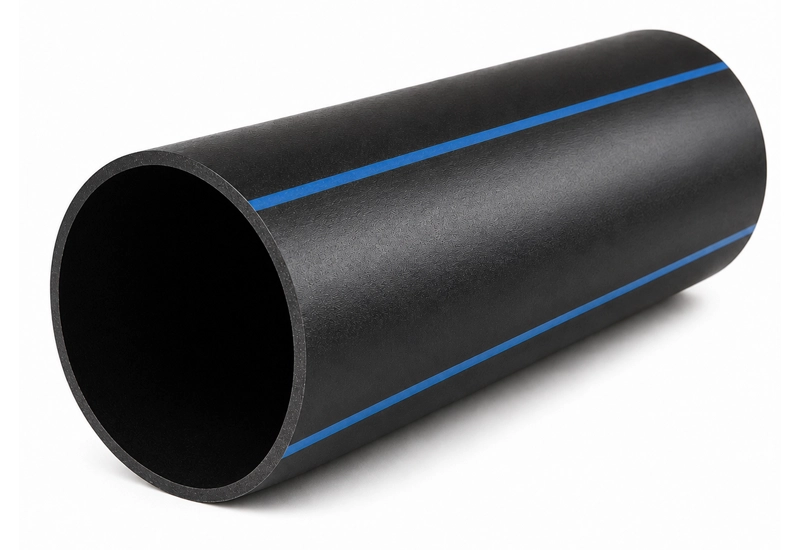
Think of SDR17 as the everyday workhorse of modern infrastructure. Delivering a PN10 pressure rating (1.0 MPa or 145 psi) with PE100 material—and PN8 with PE80—it handles moderate-pressure demands with ease. Walls here are noticeably slimmer than those found on SDR 11. A DN110 SDR 17 pipe features a 6.6 mm wall, while the DN315 version scales up to 18.7 mm.
Contractors frequently favor this ratio for standard municipal water networks, sprawling agricultural irrigation setups, and drainage force mains. Why? It strikes a perfect balance. You get reliable structural integrity without sacrificing internal flow capacity or blowing the material budget. Because the internal diameter remains larger than an SDR 11 HDPE pipe of the identical outside size, fluid pushes through at a higher volume. This efficiency makes SDR 17 the most widely specified option for general water distribution worldwide.

When managing low-pressure fluids, SDR 26 hits the mark. Formulated with PE100 material, this specific class yields a PN6.3 pressure rating (0.63 MPa or 91 psi). Switch to PE80, and you are looking at PN5. Among standard commercial ratios, this one features the thinnest walls. A DN110 SDR 26 pipe carries a mere 4.2 mm of wall thickness, and even a DN315 HDPE pipe only measures 12.1 mm.
The main draw of SDR 26 lies in its massive internal flow area combined with rock-bottom material costs. It proves incredibly economical for sprawling gravity sewers, surface water drainage, wastewater transport, and basic low-pressure transfer lines. That said, you absolutely need strict engineering verification before signing off on it. Never install SDR 26 in high-pressure networks or pipelines exposed to heavy surge dynamics like water hammer. Those thin walls simply cannot survive severe hydraulic shocks.

Choosing the right pipe means looking past steady-state pressure to evaluate real-world environmental and operational demands. Engineering and procurement units should run through this checklist before finalizing an SDR:
An HDPE pipe’s pressure capacity never hinges on the SDR alone. Instead, performance stems from the precise intersection of the SDR and the specific polyethylene material grade. The table below breaks down how these variables interact under global standards such as ISO 4427.
| Parameter | Definition & Impact on Pipe Performance |
|---|---|
| SDR | Standard Dimension Ratio (OD/t). Dictates the geometric profile and wall thickness of the pipe. |
| PE80 | Polyethylene resin with a Minimum Required Strength (MRS) of 8.0 MPa. Yields lower pressure ratings. |
| PE100 | Modern polyethylene resin with an MRS of 10.0 MPa. Yields higher pressure ratings for the same SDR. |
| PN Rating | Nominal Pressure expressed in bar (e.g., PN10 = 10 bar = 1.0 MPa). |
| Interaction | SDR 11 + PE100 = PN16. The exact same SDR 11 geometry + PE80 = PN12.5. |
| Design Factor | ISO standards apply a safety coefficient (typically 1.25 for water) to derive safe working pressures. |
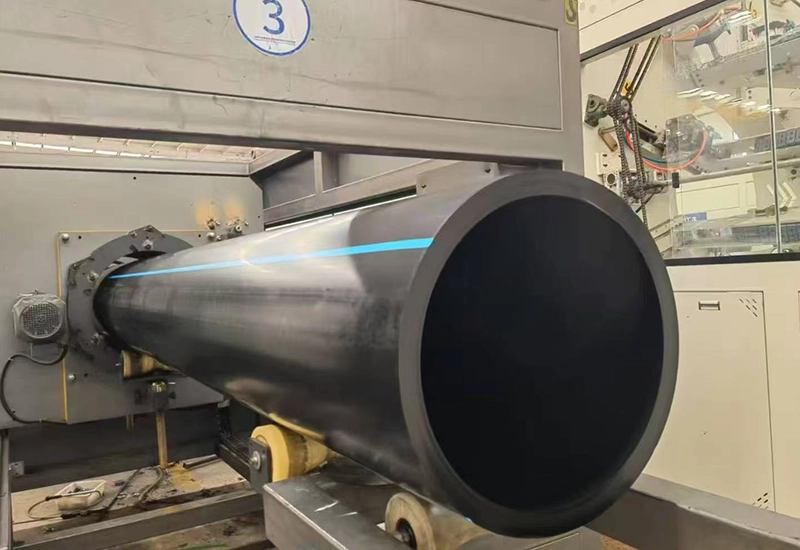
Sourcing HDPE pipe for massive infrastructure projects means juggling strict technical specs alongside harsh logistical realities. The SDR you select instantly impacts manufacturing timelines, freight weight, and the bottom line of your project budget.
| Procurement Factor | Impact Based on SDR Selection | JINQUAN Manufacturing Capabilities |
|---|---|---|
| Material Usage & Cost | SDR 11 requires significantly more raw material than SDR 26, proportionally increasing the cost per meter. | Factory-direct pricing from a 100,000+ ton/year facility eliminates middleman markups. |
| Transport & Logistics | Thicker walls increase overall pipe weight. SDR 11 maxes out container weight limits faster than SDR 26. | Standard sea freight LCL costs $100–$300 (plus port fees) with 25–40 day transit times. |
| Welding & Installation | SDR 11 requires longer heating and cooling times during butt-fusion welding due to the thicker wall mass. | Comprehensive technical support provided for butt fusion and electrofusion parameters. |
| Lead Times | Standard SDRs (11 and 17) are frequently produced, ensuring rapid fulfillment. | 7-15 days standard turnaround time for production at the 200-acre facility. |
Getting the SDR wrong paves the way for catastrophic system blowouts or massively inflated budgets. Steer clear of these frequent specification traps:

Securing pipeline integrity while keeping procurement efficient requires a structured approach. Follow this step-by-step workflow to lock in the correct SDR:
1. Step 1: Nail down the exact application, the type of fluid being moved, and the system’s absolute maximum operating temperature.
2. Step 2: Calculate your peak steady-state working pressure. Next, add in the expected surge pressure (water hammer) to establish the true peak pressure demand.
3. Step 3: Choose your material grade. Today, PE100 stands as the globally recognized standard for high-performance pressure lines.
4. Step 4: Pull up an ISO 4427 HDPE pipe SDR chart. Locate the specific ratio that comfortably meets or exceeds the peak pressure you calculated in Step 2.
5. Step 5: Double-check the internal diameter (ID) of your selected SDR. You need to verify that it still accommodates the project’s required volumetric flow rate.
6. Step 6: Gather your nominal diameter (DN), chosen SDR, material grade (PE100), and mandatory certifications (like ISO 9001, CE, SGS, or ISO 14001). Use this data to draft precise, bulletproof procurement documents for the manufacturer.
Q1: What is the difference between SDR 11, SDR 17, and SDR 26 HDPE pipe?
The main difference comes down to wall thickness and pressure handling. SDR 11 features the thickest walls, built to tackle high pressure (PN16 for PE100). SDR 17 hits the sweet spot with medium walls for standard pressure (PN10). Meanwhile, SDR 26 relies on the thinnest walls, engineered strictly for low-stress jobs like gravity drainage (PN6.3).
Q2: Which HDPE pipe SDR is best for high-pressure water supply?
SDR 11 is hands-down the top choice for high-pressure water networks. Extruded from PE100 resin, an SDR 11 HDPE pipe hits a rugged PN16 (1.6 MPa / 232 psi) rating. Those thick walls effortlessly absorb intense internal hydrostatic pressure, heavy external soil loads, and the sudden transient surges common in municipal mains.
Q3: Does a lower SDR mean a stronger HDPE pipe?
Absolutely. A lower SDR number points to a smaller ratio between the outside diameter and the wall thickness. Mathematically, that means a thicker wall. This added mass directly boosts tensile strength, increases ring stiffness, and bumps up the internal pressure rating, resulting in a much stronger pipe.
Q4: How do I calculate HDPE pipe wall thickness from SDR?
You calculate the minimum wall thickness by dividing the pipe’s nominal outside diameter (OD) by its SDR value. The formula looks like this: Wall Thickness (t) = OD / SDR. Take a 110mm pipe with an SDR of 11, for instance. You get a minimum wall thickness of 10.0mm (110 / 11 = 10).
Q5: Is SDR 17 suitable for underground water pipelines?
Yes, contractors specify SDR 17 for underground water pipelines all the time. Backed by a PN10 pressure rating (using PE100 material), it easily manages standard municipal distribution and irrigation flows. It delivers an ideal mix of structural toughness for open-trench burial and excellent internal flow capacity.
Q6: What information should I provide when requesting an HDPE pipe quotation?
To get an exact quote, give your supplier the nominal outside diameter (DN in mm), your target SDR or PN rating, and the material grade (PE80 or PE100). Do not forget to include the total project length, the specific application, and any non-negotiable international certifications (like ISO 4427, CE, or SGS).
Q7: How does PE100 material affect the pressure rating of an HDPE pipe?
PE100 is an advanced high-density polyethylene resin boasting a Minimum Required Strength (MRS) of 10.0 MPa. When stacked against older PE80 resin (MRS 8.0 MPa), PE100 lets a pipe with the exact same SDR and wall thickness hit a much higher pressure rating. For example, SDR 11 registers as PN12.5 in PE80, but jumps to PN16 in PE100.
Q8: Can SDR 26 HDPE pipe be used for pressure applications?
Generally, SDR 26 belongs in low-pressure environments. Even with PE100 material, it caps out at PN6.3 (91 psi). While it manages minor pressure, the thin walls leave it highly exposed to surge damage and water hammer. You are better off reserving it for gravity sewers, surface runoff, and low-stress fluid transfers.
Locking in the right specification from an HDPE pipe SDR chart is not just a box to check—it is a foundational engineering move that drives the safety, lifespan, and financial efficiency of your entire pipeline project. Once you grasp the practical differences separating SDR 11, SDR 17, and SDR 26, accurately matching wall thickness and pressure limits to your site’s environmental loads becomes straightforward. True project success hinges on calculating absolute peak pressures, building in generous surge allowances, and running the numbers on temperature derating before you sign off on a spec. On top of that, pairing your targeted SDR with a high-performance PE100 material grade locks in compliance with ISO 4427 standards. This guarantees your newly installed infrastructure will deliver uninterrupted, long-term performance, no matter how demanding the industrial or municipal environment gets.