Address
Zhengzhou, Henan, China
Work Hours
Monday to Friday: 7AM - 7PM
Weekend: 10AM - 5PM
Address
Zhengzhou, Henan, China
Work Hours
Monday to Friday: 7AM - 7PM
Weekend: 10AM - 5PM

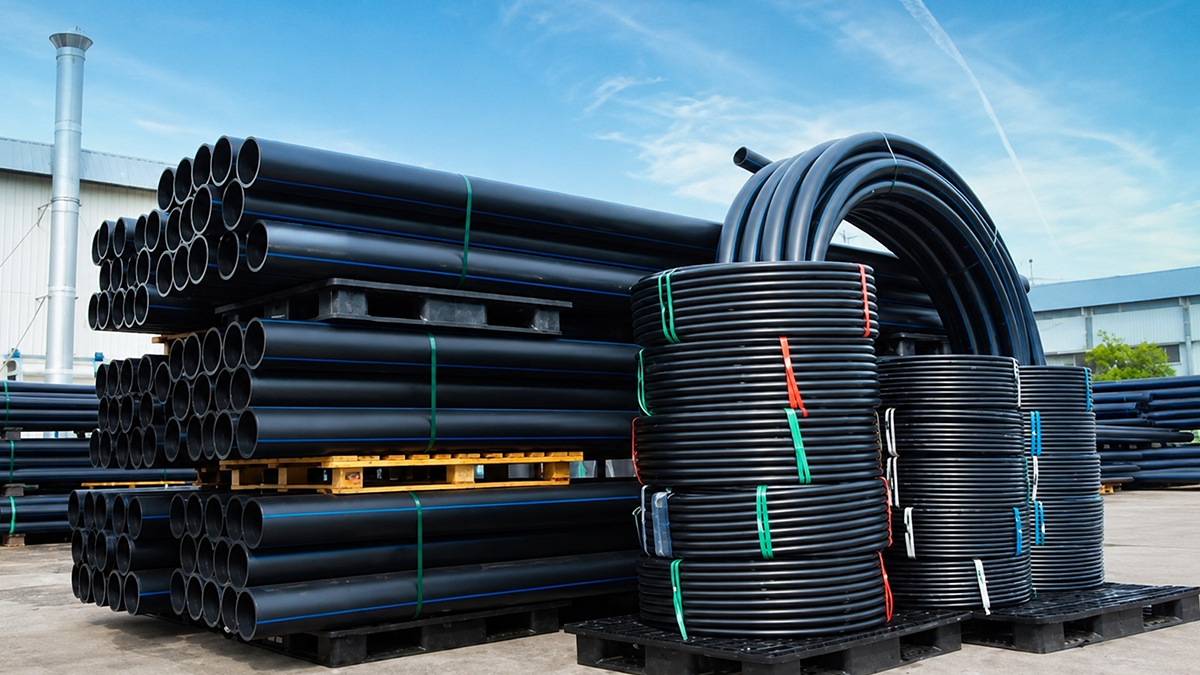
HDPE Pipe Installation requires correct trenching, welding, testing, and backfilling. This guide helps engineers, contractors, and buyers plan reliable underground pipeline projects.
Installing High-Density Polyethylene (HDPE) pipe systems involves a precise sequence of trenching, assembly, welding, and backfilling. Because HDPE acts as a flexible thermoplastic, getting the installation right hinges on flawless jointing techniques alongside proper soil-pipe interaction to handle external loads. When contractors execute these steps strictly by the book—following ISO 4427 or AWWA C906 standards—the resulting underground pipeline forms a monolithic, completely leak-free network.
A standard installation follows an unforgiving workflow. You start with pre-installation planning, move through trench excavation and bedding preparation, and then handle the actual pipe laying. From there, crews tackle fusion welding, joint inspection, hydrostatic pressure testing, and finally, structural backfilling. Whether a project involves municipal water distribution or heavy-duty industrial fluid transport, JINQUAN supplies the necessary HDPE pipes. Their inventory spans DN16 to DN3000 in both PE80 and PE100 grades, accommodating pressure ratings anywhere from PN4 up to PN25.
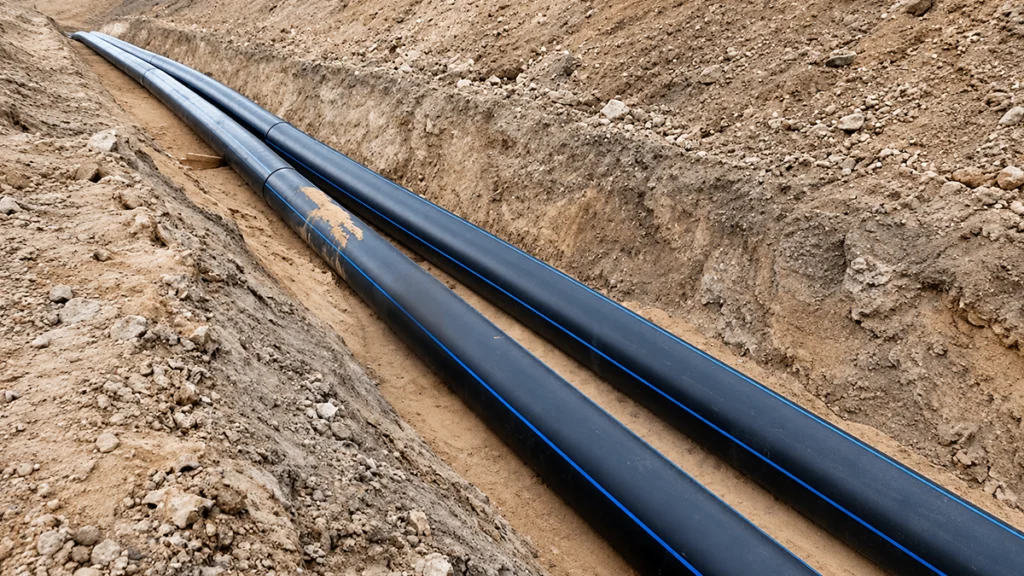
Thorough site preparation combined with strict data verification is the best defense against costly project delays. Long before the first excavator breaks ground, project engineers and utility contractors need to ensure the selected pipe specifications perfectly align with site conditions, fluid dynamics, and local regulations like ASTM D2774 for underground thermoplastic pressure piping.
Locking down procurement logistics early keeps the entire timeline on track. For bulk HDPE pipe and fittings sourced directly from JINQUAN’s factory, standard lead times generally run between 7 and 15 days. Naturally, this window fluctuates slightly based on the specific diameters and SDR (Standard Dimension Ratio) ratings your project requires.
Pre-Installation Planning Parameters
| Parameter | Project Consideration | Relevant Standard / Metric |
|---|---|---|
| Pipe Sizing | Outside Diameter (OD) and Wall Thickness (SDR) | DN16 – DN3000 |
| Pressure Rating | Maximum operating pressure + surge allowance | PN4, PN6, PN8, PN10, PN16, PN20, PN25 |
| Material Grade | Virgin resin requirements for application | PE80 or PE100 |
| Soil Conditions | Native soil load-bearing capacity and groundwater | ASTM D2774 |
| Delivery Schedule | Alignment with trenching phases | 7-15 days typical lead time |
Trenching sets the groundwork for a pipeline’s long-term survival. The main objective here is carving out enough space for safe handling, precise alignment, and robust compaction of the backfill material.
Frost lines, groundwater levels, and surface traffic loads dictate the necessary trench depth. Standard installations demand a minimum of 24 inches (600mm) of cover. However, if the pipeline sits under H-25 heavy traffic loading, crews must dig deeper, providing up to 60 inches (1500mm) of cover to protect the infrastructure.
Width is equally critical. The trench must be wide enough for personnel to operate fusion equipment and compaction tools safely around the pipe. A reliable rule of thumb is the pipe’s outside diameter (OD) plus an extra 18 to 24 inches of clearance. For deep excavations exceeding 5 feet, OSHA 29 CFR strictly mandates engineered safety systems—like trench boxes or shoring—to shield workers from sudden sidewall collapses.
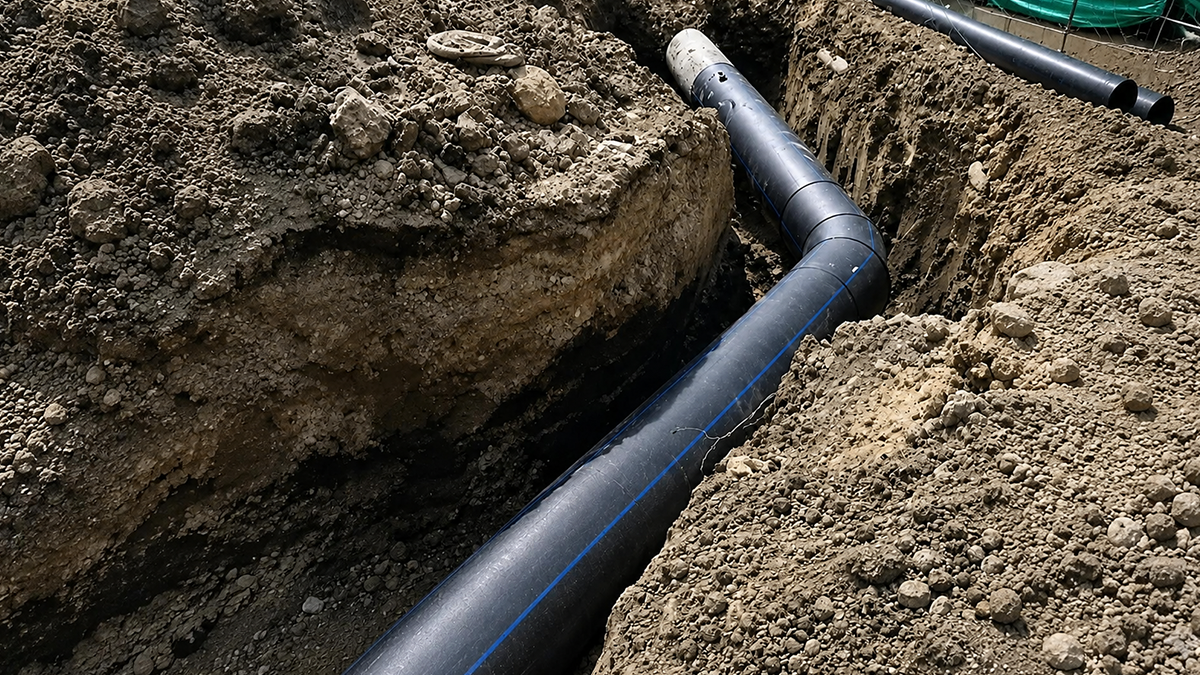
Because HDPE is inherently flexible, it leans heavily on the surrounding embedment soil to fight off deformation from external weight. Proper bedding shields the HDPE pipe from sharp point loads while providing uniform, consistent support along its entire length.
Following ASTM D2321 guidelines, bedding needs to feature Class I, II, or III materials. Crushed stone or gravel (such as VDOT No. 57 stone) works exceptionally well. This material must be absolutely free of sharp objects, random debris, and any rocks exceeding 1.5 inches (38mm) in diameter.
When laying the PE pipe, alignment strategies must factor in the natural flexibility and thermal expansion of polyethylene. HDPE expands and contracts roughly 1 inch per 10°F for every 100 feet of HDPE pipe. When bending the pipe to match the trench’s natural contours, crews must respect strict bend radius limits to avoid kinking and over-stressing the material:
Building a leak-proof, monolithic HDPE pipeline demands certified jointing strategies. The ideal method hinges on the pipe diameter, available trench space, and specific pressure requirements. JINQUAN provides a full ecosystem to support these techniques, supplying the pipe, the fittings, and the proprietary butt fusion Machines required to get the job done.
HDPE Pipe Jointing Methods Comparison
| Jointing Method | Typical Use Case | Advantages | Quality Control Focus |
|---|---|---|---|
| Butt Fusion | Long, straight pipeline runs | Cost-effective, creates a joint as strong as the pipe | Heating plate temperature (~230°C / 446°F), interfacial pressure |
| Electrofusion | Tight trenches, repairs, tie-ins | Requires minimal heavy equipment space | Cleanliness of the fusion zone, peeling/scraping accuracy |
| Mechanical Couplings | Temporary lines, transitions | Fast installation, requires no power | Proper torque on bolts, condition of elastomeric seals |
| Flange Connections | Connecting to pumps, valves, or steel pipes | Allows for future disassembly | Even bolt tightening pattern, correct flange adapter sizing |
When performing butt fusion, strict compliance with ASTM F2620 or ISO 21307 is non-negotiable. Operators must tightly control the heating plate temperature at roughly 230°C (446°F). This sweet spot achieves the necessary melt without degrading the polymer’s internal structure.
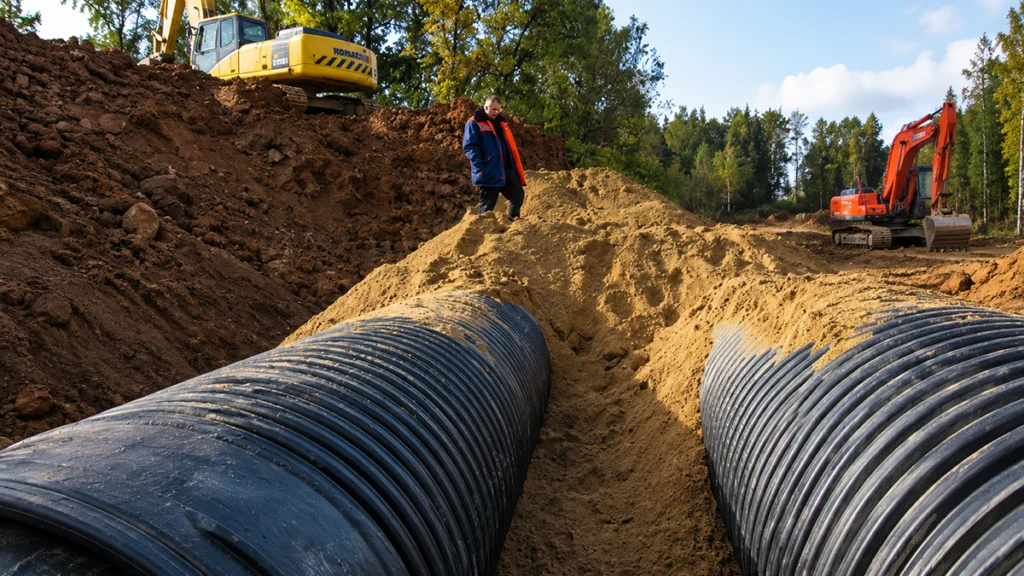
Visual inspections serve as the primary defense against future HDPE pipeline failures. A flawlessly executed butt fusion joint will feature a uniform, symmetrical double rollback bead circling the pipe’s entire circumference.
Inspectors actively hunt for common bead defects. Unequal bead sizes immediately signal a high-low misalignment between the two polyethylene pipe ends. If a bead looks too small or has a spongy texture, the operator likely used insufficient heat (dropping below 230°C) or failed to apply adequate pressure during the cooling phase. Furthermore, the fusion zone must remain completely devoid of dirt, moisture, and internal voids.
For high-stakes critical infrastructure, visual checks aren’t enough. Teams deploy advanced Non-Destructive Examination (NDE) methods—like Time of Flight Diffraction (TOFD) or ultrasonic phased array testing—to validate the weld’s internal integrity without ever cutting into the HDPE pipe.
Weld Inspection Checklist:
Before anyone backfills those joints, the HDPE pipeline must survive rigorous pressure testing to prove its structural integrity. Hydrostatic testing (using water) remains the gold standard. Pneumatic testing (using compressed air) carries extreme danger due to the explosive stored energy in compressed gas; industry standards generally prohibit it for exposed PE pipe.
Testing protocols dictate a pressure of 1.5 times the system’s designated working pressure. Crews measure this at the pipeline’s lowest elevation point to properly account for static head.
ASTM F2164 Hydrostatic Pressure Testing Procedure (Pressure Rebound Method):
1. Preparation: Fill the HDPE pipeline slowly with water, utilizing air release valves at all high points to bleed off trapped air.
2. Initial Expansion Phase: Pressurize the system and maintain this pressure for 4 hours. Because HDPE expands under pressure, make-up water must be added periodically to maintain the test pressure.
3. Test Phase: Rapidly reduce the pressure by 10 psi and isolate the test section. Monitor the system for exactly 1 hour.
4. Acceptance Criteria: The HDPE pipeline passes the test if the pressure remains within 5% of the reduced pressure target for the full hour, indicating zero leakage.
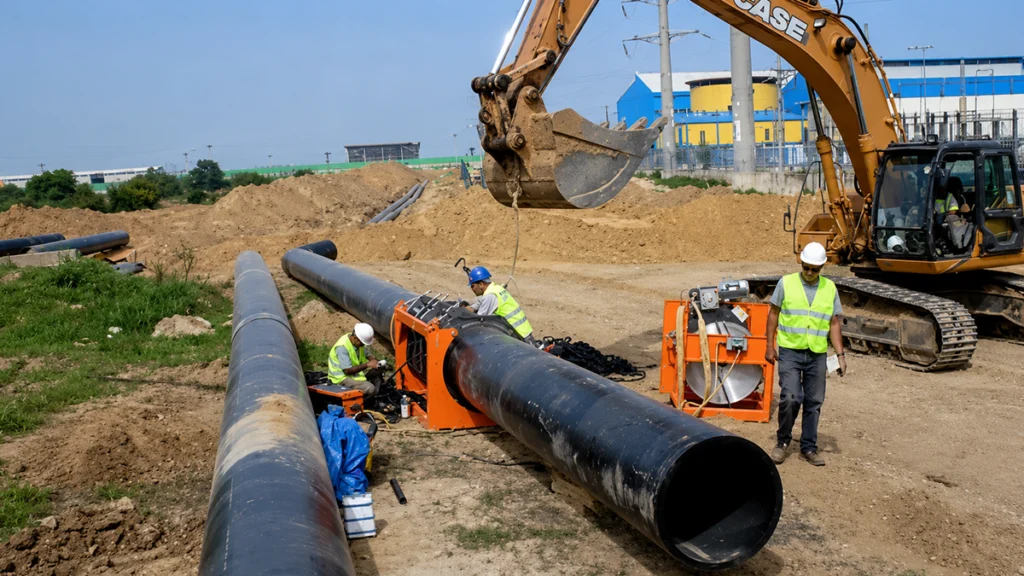
Proper backfilling dictates the structural integrity of any underground flexible HDPE pipe. Cut corners here, and you invite HDPE pipe ovality, dangerous settlement, or severe lateral displacement down the road.
Initial backfill—frequently referred to as structural backfill—requires careful placement and compaction around the pipe haunches (the lower half of the pipe), extending straight up to the pipe crown. When using Class III backfill materials, compaction efforts must hit a minimum of 90% Standard Proctor density to guarantee adequate side support.
Before dumping native soil back into the trench, crews must lay down a final layer of structural backfill measuring at least 6 inches (150mm) over the HDPE pipe crown. This critical buffer layer shields the HDPE material from harsh impacts during the final heavy compaction stages.
A project’s total financial footprint extends far beyond the raw price of the HDPE pipe. Procurement managers have to juggle a complex web of variables: the fluctuating market price of virgin PE80 or PE100 resin, the chosen SDR rating (thicker walls consume more resin and drive up costs), pipe diameter, fitting styles, specialized welding labor, and the realities of the trenching site. Electrofusion fittings, for instance, carry a steeper unit cost than standard butt fusion fittings. However, they can drastically slash labor and heavy equipment expenses when working in tight, complex trench environments.
Partnering with a massive-scale manufacturer smooths out these volatile variables. Operating a 200-acre facility with an annual output surpassing 100,000 tons, JINQUAN delivers distinct factory-direct procurement advantages. Buyers tap into comprehensive product availability—securing pipes, HDPE pipe fittings, and welding machines from one central hub—while benefiting from robust export packaging, sample availability, and highly predictable 7-15 day lead times.
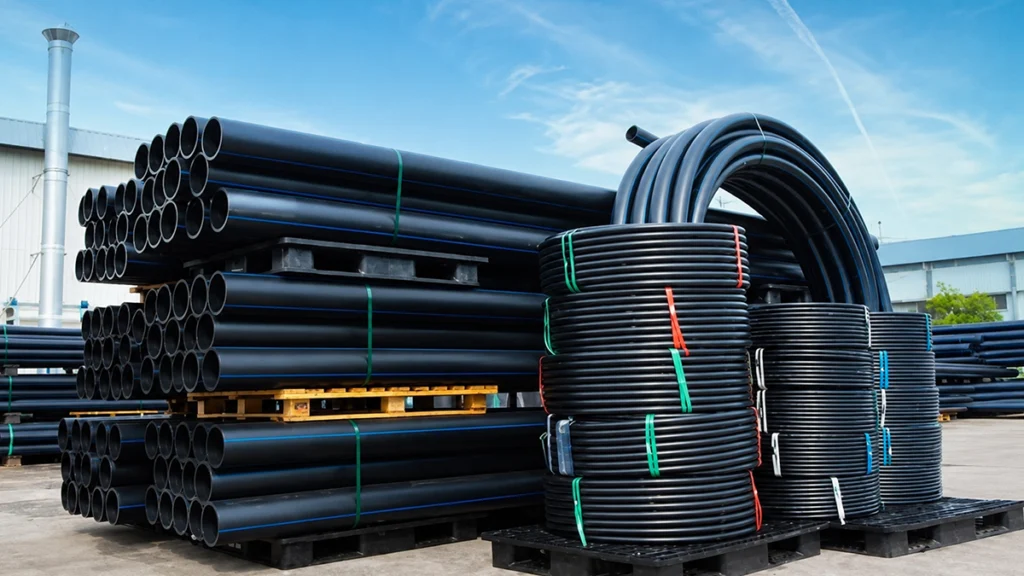
Premium materials cannot out-perform sloppy installation practices. The most frequent errors that cripple HDPE pipeline performance include improper cleaning of the fusion faces (trapping moisture or dirt), running heating plate temperatures too cold (dipping below 230°C), and dumping bedding materials loaded with rocks larger than 1.5 inches, which immediately create dangerous point loads. On top of that, failing to hit 90% Proctor compaction during the backfill phase almost always leads to PE pipe ovality once surface traffic begins.
Final Pre-Backfill Installation Checklist:
A typical process includes site preparation, trench or bore construction, pipe handling, alignment, joining, inspection, testing, and controlled backfilling. Always follow the approved project procedure and pipe manufacturer’s instructions.
Burial depth depends on pipe size, SDR, soil conditions, traffic loads, frost depth, groundwater, and local codes. There is no single minimum depth suitable for every project.
Butt fusion is commonly used for long, straight pipelines. Electrofusion is better suited to repairs, branch connections, tie-ins, and confined spaces. The correct method depends on pipe size and site conditions.
Pressure pipelines are usually hydrostatically tested under an approved procedure. Test pressure, conditioning time, duration, and acceptance criteria must follow the project specification and applicable standard.
Yes. HDPE pipe is suitable for horizontal directional drilling, sliplining, pipe bursting, and other trenchless methods when pulling force, bend radius, pipe SDR, and site conditions are properly checked.
Use clean, compactable material that meets the project specification. Avoid frozen soil, organic waste, construction debris, and oversized rocks that may create point loads.
Common causes include dirty or wet pipe ends, poor facing, misalignment, incorrect heating, improper fusion pressure, insufficient cooling, unsuitable equipment, or unqualified operators.
Cost depends on pipe size, SDR, installation method, excavation depth, soil conditions, labor, equipment, fittings, testing, transport, and local project requirements.
A reliable HDPE pipe installation depends on correct pipe selection, proper trench or bore preparation, approved joining procedures, careful inspection, testing where required, and controlled backfilling. Project teams should follow the applicable design standard, installation specification, and pipe manufacturer’s instructions rather than relying on one procedure for every application.
Procurement is equally important. Buyers should confirm the pipe material grade, SDR, fittings, welding equipment, technical documentation, delivery schedule, and after-sales support before ordering. Coordinating these requirements with an experienced supplier can reduce compatibility issues, limit rework, and support consistent long-term pipeline performance.