Address
Zhengzhou, Henan, China
Work Hours
Monday to Friday: 7AM - 7PM
Weekend: 10AM - 5PM
Address
Zhengzhou, Henan, China
Work Hours
Monday to Friday: 7AM - 7PM
Weekend: 10AM - 5PM


HDPE piping systems are widely used in water supply, drainage, and industrial applications due to their outstanding corrosion resistance, flexibility, lightweight nature, long service life, and environmental friendliness. In HDPE piping systems, pipe connections are indispensable, and reliable fusion joints are critical to the system. These joints impact fluid conveyance efficiency, prevent PE pipe leakage, and influence long-term maintenance costs. Secure welds ensure the long-term stable operation of the piping system. HDPE pipe fittings are indispensable for pipe connections. With numerous types available, this article focuses on exploring the application scenarios, advantages, and limitations of electrofusion and butt fusion HDPE pipe fittings. This enables the selection of a reliable and economical HDPE pipe connection method based on specific project conditions and requirements.
Butt fusion and electrofusion welding are the two most widely used connection methods for high-density polyethylene (HDPE) pipes. Both aim to ensure that the joint strength of HDPE pipes meets or exceeds that of the pipe itself. However, the working principles of electrofusion and butt fusion differ. The following analysis will clarify these differences to provide a clear understanding of these two HDPE water pipe connection methods.
Butt fusion welding HDPE pipe is a connection method that achieves molecular fusion by heating the pipe ends and joining them under pressure. The process utilizes specialized fusion welding equipment to heat the ends of two pipes or fittings to the melting temperature of polyethylene. Once the required molten state is achieved, the heating plates are promptly removed, and the pipe ends are pressed together under a predetermined fusion pressure. Under appropriate pressure and cooling time, the polymer molecular chains interdiffuse and intertwine, forming a robust, continuous joint upon cooling that matches the strength of the pipe itself.
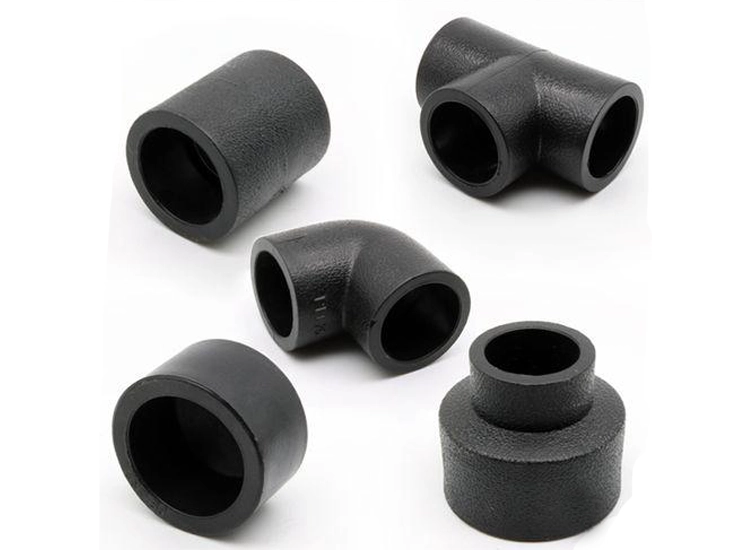
Butt fusion HDPE pipe fittings include reducers, tees, cross tees, elbows/bends, and flanges. These diverse HDPE pipe fittings accommodate complex pipeline layouts and functional requirements, enabling reliable, leak-free connections that ensure the sealing integrity and structural integrity of the entire piping system.
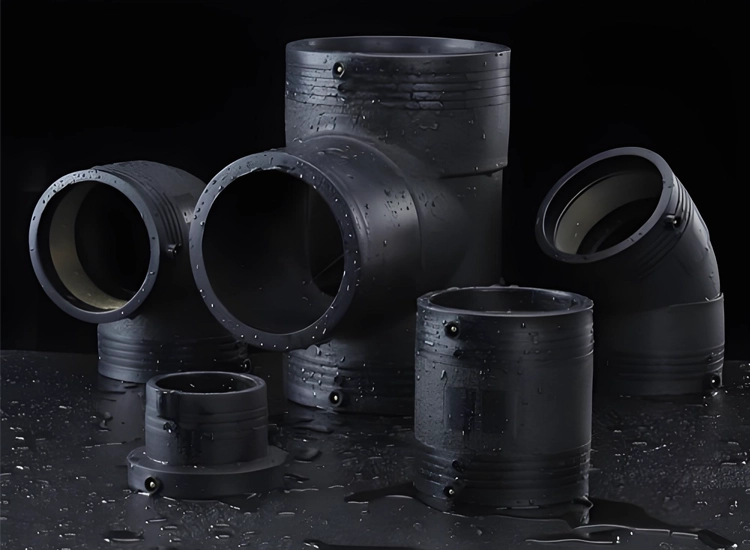
Electrofusion welding of HDPE water pipes is a connection method that utilizes pre-embedded resistance wires within the fittings to generate heat for fusion welding. The core principle involves using a specialized electrofusion welder to energize the resistance wires within the HDPE fittings, heating them to melt the polyethylene material both inside the fittings and on the exterior of the inserted pipe. As the material expands, the molten polyethylene fills the gap. Under controlled current, time, and cooling conditions, the polymer molecular chains of the fittings and pipe achieve molecular fusion, resulting in a high-strength, reliable joint.
Common electrofusion HDPE pipe fittings include electrofusion couplers, elbows, tees, plugs, reducers, and electrofusion flanges. Different types of electrofusion fittings serve distinct functions, accommodating complex pipeline layouts while ensuring reliable connections.
Electrofusion welding technology demonstrates distinct advantages in numerous specific applications due to its operational flexibility and minimal site requirements:
Butt fusion is one of the most widely used methods for connecting HDPE pipes, primarily applied in projects with specific requirements for diameter, pressure, and site conditions:
The primary advantages of electrofusion connections lie in their high automation, operational convenience, and outstanding environmental adaptability. First, electrofusion pipe welding machine features a high degree of automation, typically requiring only a barcode scan on the pipe fitting to automatically set precise welding parameters. This significantly reduces technical requirements for on-site personnel, enhancing construction efficiency and joint quality consistency.
Second, electrofusion connections offer superior compatibility, effectively joining pipes of varying wall thickness grades. This ensures broad applicability in complex pipeline configurations. Finally, since the heat for electrofusion originates from internal resistance wires within the fittings, the welding process remains largely unaffected by external environmental factors. Consequently, this technology maintains high reliability even under challenging or adverse climatic conditions.
The primary advantages of butt fusion lie in its cost-effectiveness, high fluid efficiency, and exceptional joint strength. From an economic perspective, long-term operating costs are relatively low. Butt fusion HDPE pipe fittings are more affordable than electrofusion fittings, and welding does not require expensive electrofusion equipment. For large-diameter or long-distance installation projects, butt fusion significantly reduces material and construction costs. Performance-wise, butt fusion creates internally smooth joints with minimal flow resistance, ensuring optimal hydraulic performance.
Since the welded section is homogeneous with the pipe material, the system can withstand high internal pressures and external impacts. It maintains excellent toughness and seal integrity even in seismic or foundation settlement environments. Most importantly, butt fusion achieves molecular-level fusion between the joint and the pipe material, forming an integrated structure with strength and pressure resistance comparable to the pipe itself. This ensures the highest reliability and structural integrity.
Although electrofusion welding of HDPE pipes is easy to operate, it also has certain limitations. First is the cost issue: since each electrofusion fitting contains embedded resistance wires, its unit price is typically higher than standard heat fusion fittings. Especially during large diameter HDPE pipe construction, the cost of electrofusion fittings increases significantly. Second, joint strength is slightly lower. The smaller fusion area in electrofusion connections necessitates stricter design and inspection protocols under long-term high-pressure operating conditions. Finally, construction demands high cleanliness standards. Pipes and fittings must be thoroughly cleaned before welding; otherwise, quality issues like cold welds and leaks may occur.
Butt fusion fittings for PE100 pipes offer high weld strength but also present certain construction and environmental constraints. First, construction demands high precision, requiring strict control over pipe dimensional consistency and welding parameters (temperature, pressure, time), necessitating operators with advanced technical skills. Second, butt fusion welding is highly sensitive to environmental conditions. Low temperatures, strong winds, or humidity can cause uneven heat dissipation from heating plates or contamination of the fusion surface, compromising weld quality. Protective measures are therefore typically required. Finally, spatial constraints pose a challenge: due to the large size of butt fusion pipe welding machine, they require flat, open operating areas. Consequently, they are unsuitable for confined spaces such as narrow trenches, manholes, or areas with dense piping.
Butt fusion is suitable for scenarios requiring high strength, cost-effectiveness, and large-diameter construction; electrofusion connections offer greater advantages in flexibility, adaptability, and ease of emergency repairs. Actual selection should be based on a comprehensive assessment of pipe specifications, construction environment, and budget constraints to ensure the connection method precisely matches project requirements.
Butt Fusion HDPE Fittings: Ideal for large-diameter HDPE pipes, long-distance pipelines, and open-area systems, butt fusion welding creates a permanent joint matching the pipe’s inherent strength.
Electrofusion HDPE Pipes and Fittings: Suitable for small-diameter PE pipes, confined spaces, emergency repairs, or connecting pipes with varying wall thicknesses, prioritizing construction flexibility and convenience.
Electrofusion and butt fusion HDPE pipe fittings are both common methods for connecting HDPE plastic pipes, each with its own advantages and limitations. Electrofusion HDPE pipe fittings offer simple operation and high precision, making them suitable for confined spaces and maintenance environments, but they come with a higher overall cost. Butt fusion HDPE fittings provide high connection strength and cost-effectiveness, making them ideal for large-diameter and long-distance pipeline construction, but they demand higher technical skill and specific environmental conditions. In practical engineering applications, the most suitable welding method should be selected by comprehensively considering factors such as pipe diameter, construction environment, and budget constraints. This ensures the safety, reliability, and long-term service life of the HDPE piping system.
Fill out the form and our team will contact you shortly.