Address
Zhengzhou, Henan, China
Work Hours
Monday to Friday: 7AM - 7PM
Weekend: 10AM - 5PM
Address
Zhengzhou, Henan, China
Work Hours
Monday to Friday: 7AM - 7PM
Weekend: 10AM - 5PM


Drainage systems are a critical component for the stable and long-term operation of modern infrastructure. They not only ensure the normal functioning of urban pipeline networks and manage water accumulation during extreme weather events but also impact public health and environmental safety. A high-quality, reliable drainage pipeline system is the cornerstone of a modern city’s stable operation. Traditional drainage pipes face challenges of corrosion and high maintenance costs. DWC pipe, with its unique dual-layer structure design and superior high-density polyethylene material properties, resolves issues of pipe corrosion and frequent replacement/maintenance. Aligning with sustainable development principles, it offers a more efficient solution for future drainage systems.
HDPE DWC pipe, fully known as high-density polyethylene double-wall corrugated pipe, is a plastic pipe featuring a specially designed structure. Manufactured through an extrusion molding process, it is melted at high temperatures and formed into a corrugated structure via a mold. Its core characteristic is the double-wall corrugated structure, combining the material properties of high-density polyethylene with the mechanical performance of double-wall corrugated pipes.

The smooth inner wall ensures efficient fluid conveyance by minimizing friction resistance, thereby enhancing drainage performance. The corrugated outer wall enhances the pipe’s ring stiffness, resistance to external pressure, and soil load-bearing capacity. The corrugated design enables the drainage pipe to effectively distribute stress when buried deep underground and subjected to significant external pressure, preventing deformation or rupture. In both production and application, HDPE DWC pipes comply with industry standards, ensuring their reliability as drainage conduits and safety in engineering projects.
HDPE DWC pipe holds a significant position in future drainage systems, owing to its superiority over traditional drainage pipes across multiple dimensions. The combined effect of these advantages ensures urban drainage systems are more robust, durable, efficient, and low-maintenance.
Due to the unique structure and material selection of double-wall corrugated pipes, they possess high strength and durability. The outer corrugated structure provides excellent ring stiffness. By leveraging the material’s geometric properties, HDPE drainage pipes effectively distribute and resist pressure from ground loads and soil pressure, maintaining the overall shape stability of the pipe. Simultaneously, the high-density polyethylene material endows it with outstanding crack resistance and flexibility, allowing it to adapt to foundation settlement and external impact forces. This ensures DWC HDPE pipes remain undamaged and continue to function efficiently even under deep burial conditions.
HDPE DWC pipe offers exceptional corrosion and chemical resistance, ensuring long-term stable operation of drainage systems. Drainage systems, particularly urban sewage pipelines, must handle complex wastewater containing corrosive agents such as acids, alkalis, and salts from domestic sewage and industrial effluents. HDPE is an inert polymer material unaffected by acids, alkalis, salts, and other chemicals. Constructed from HDPE, DWC drainage pipes do not rust, fundamentally eliminating corrosion issues common in traditional drainage systems. Their smooth inner walls also minimize leakage, blockage risks, and frequent maintenance needs caused by corrosion, significantly extending the service life of DWC HDPE pipes.
The lightweight of HDPE DWC pipes offers a significant advantage in engineering applications. Compared to heavy concrete or metal pipes, HDPE pipes have an extremely low density, making them far easier to handle, transport, and install on-site, thereby substantially reducing transportation costs. On construction sites, this lightweight design simplifies pipe positioning and lowering operations. Additionally, the simple and convenient connection method of double-wall corrugated drainage pipes enables rapid installation, boosting overall construction efficiency.
HDPE double-wall corrugated pipe features a smooth inner wall with a low friction coefficient, resulting in minimal resistance to fluid flow. This not only ensures long-term unobstructed flow, significantly reducing the risk of blockages caused by sediment and debris buildup, but also markedly enhances the overall efficiency of the drainage system. For drainage systems, high flow velocity and conveyance capacity enable handling substantial water volumes. Reduced friction losses directly translate to lower system energy consumption—particularly in scenarios requiring sewage pumping—thereby lowering long-term operational costs.
The economic benefits of HDPE double wall corrugated pipe are evident throughout its entire lifecycle. DWC drainage pipe production requires relatively low energy consumption, features lower transportation costs, offers simple installation with short project timelines, and demands minimal maintenance during use. Overall, considering its outstanding durability, corrosion resistance, and high fluid efficiency, selecting DWC HDPE pipe for drainage systems represents a highly cost-effective solution. The HDPE material used in DWC drainage pipes is recyclable, enabling regeneration into new products. This reduces environmental impact and promotes sustainable development within the industry.
HDPE DWC pipe has gained widespread application in modern drainage systems due to its advantages in multiple aspects.
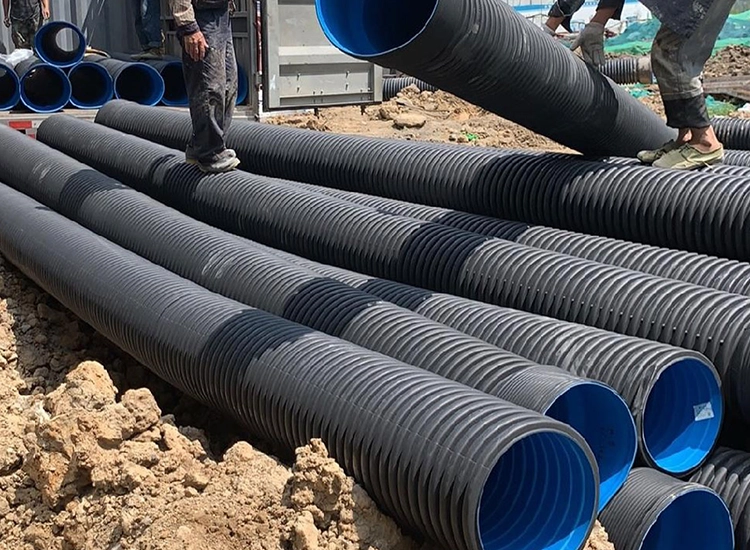
The selection of piping materials is critical in modern drainage systems. The emergence of DWC HDPE pipes has demonstrated multiple advantages. The following section outlines the differences between DWC pipes and other drainage piping materials, facilitating a clearer understanding of their distinctions and aiding in making the optimal choice.
| Comparison Item | DWC Pipe | PVC Pipe |
|---|---|---|
| Material | HDPE(high-density polyethylene) | PVC(polyvinyl chloride) |
| Structure | Dual-wall: Corrugated outer wall and smooth inner wall | Single wall with smooth surface |
| Strength | High strength and durability; corrosion resistance | Strong but brittle; less impact resistance |
| Application | Drainage, sewage, cable protection, rainwater management | Water supply, building plumbing, irrigation |
| Flexibility | Excellent flexibility | Rigid |
| Weight | Lightweight and easy to install | Heavier, more difficult to transport and install |
| Connection Method | Socket connection, rubber sealing ring | Solvent cement or rubber gasket joint |
| Cost | Higher | Lower |
| Environmental Impact | Recyclable and eco-friendly | Limited recyclability; releases harmful gases when burned |
| Comparison Item | DWC Pipe | Concrete Pipe |
|---|---|---|
| Material | HDPE(high-density polyethylene) | Reinforced Concrete |
| Structure | Dual-wall: Corrugated outer wall and smooth inner wall | Solid thick-walled rigid pipe |
| Strength | High strength and durability; corrosion resistance | Strong but heavy |
| Flexibility | Excellent, adapts to ground settlement | Rigid, prone to cracking under ground shifts |
| Application | Drainage, sewage, cable protection, rainwater management | Large-scale drainage, culverts, bridges |
| Weight | Lightweight and easy to install | Very heavy, requires cranes |
| Corrosion Resistance | Excellent | Poor |
| Sealing Performance | Rubber gasket or heat-sealed joints, excellent water tightness | Mortar joints, higher leakage risk |
| Cost | Lower than concrete pipe | High, difficult to transport and maintenance |
| Environmental Impact | Recyclable and eco-friendly | Non-recyclable, resource-intensive |
| Comparison Item | DWC Pipe | Metal Pipe |
|---|---|---|
| Material | HDPE(high-density polyethylene) | Carbon steel, galvanized steel, or stainless steel |
| Structure | Dual-wall: Corrugated outer wall and smooth inner wall | Single solid metal wall |
| Strength | High strength and durability; corrosion resistance | Extremely strong, high pressure resistance |
| Flexibility | Excellent, adapts to ground settlement | Rigid, may crack or deform with ground movement |
| Application | Drainage, sewage, cable protection, rainwater management | High-pressure water, oil, or gas transport |
| Weight | Lightweight and easy to install | Very heavy, requires cranes |
| Corrosion Resistance | Excellent; resists rust, acids, and chemicals | Prone to rust and corrosion without coating |
| Thermal Conductivity | non-conductive | High thermal conductivity |
| Sealing Performance | Excellent water tightness | May leak if joints are not properly sealed |
| Cost | Lower initial and maintenance cost | High material and maintenance cost |
| Environmental Impact | Recyclable and eco-friendly | Recyclable but energy-intensive to produce |
Future drainage systems will no longer be simple underground pipe networks. Instead, they will integrate advanced technology, sustainability, resilient design, climate change adaptation, and extended service life to create more advanced and stable drainage systems. Digital monitoring of drainage networks may also be implemented to enhance operational efficiency and reliability. Environmentally friendly materials will be adopted, integrating stormwater management with landscape design to form sustainable and eco-friendly systems. Global warming has increased the frequency of heavy rainfall events, demanding drainage networks with enhanced pressure resistance, deformation tolerance, and fluid conveyance capacity.
HDPE DWC pipe surpasses traditional drainage pipes with its unique structure and properties, offering superior structural performance while also being more competitive in terms of cost-effectiveness and sustainability. As urbanization accelerates and infrastructure renewal demands increase, future drainage systems will evolve toward intelligent, green, and highly resilient solutions. Double-wall corrugated pipe aligns perfectly with future drainage systems through its multifaceted advantages. Choosing DWC HDPE pipe means selecting a more durable, economical, and eco-friendly drainage solution for tomorrow. Jinquan delivers premium-quality DWC pipe.
Fill out the form and our team will contact you shortly.