Address
Zhengzhou, Henan, China
Work Hours
Monday to Friday: 7AM - 7PM
Weekend: 10AM - 5PM
Address
Zhengzhou, Henan, China
Work Hours
Monday to Friday: 7AM - 7PM
Weekend: 10AM - 5PM

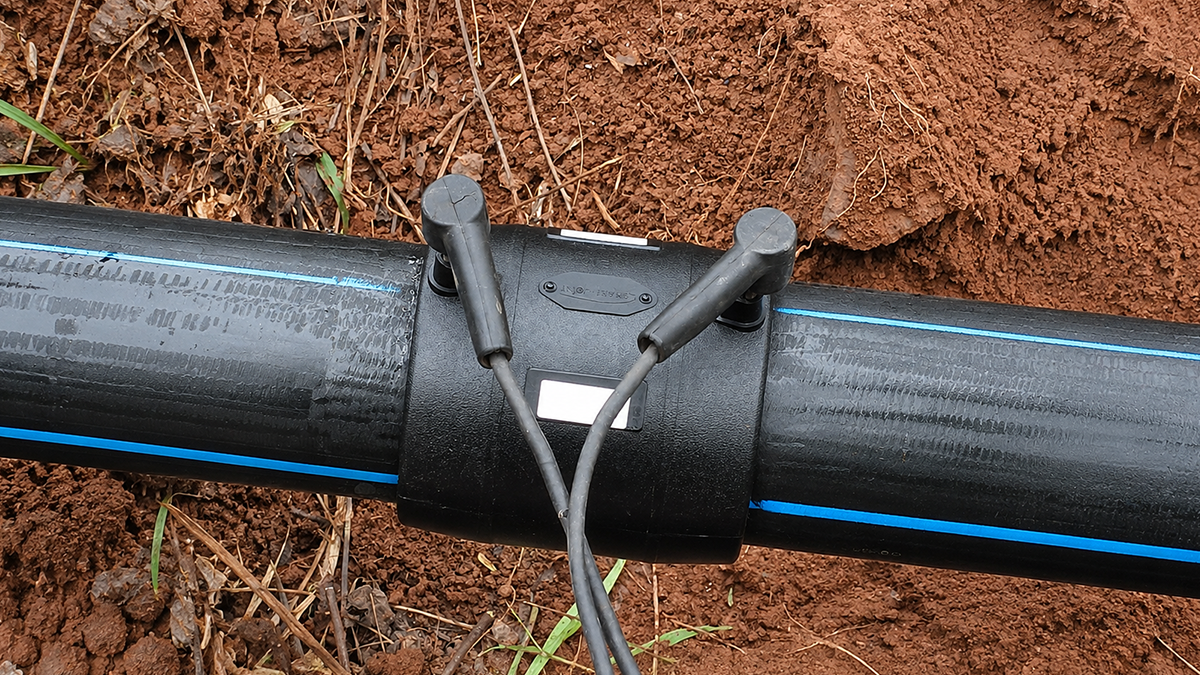
Butt fusion vs electrofusion is the core jointing decision for every HDPE pipe project. This guide compares cost per joint, joint strength, equipment, installation speed, and best-fit applications so engineers, contractors, and procurement teams can choose the right method with confidence.
When it comes to joining HDPE pipes, butt fusion works by directly heating the pipe ends with a PTFE-coated plate. Once melted, hydraulic pressure forces the ends together—eliminating the need for extra fittings. On the flip side, electrofusion relies on a specialized coupling. This fitting contains embedded electrical resistance wires that, when energized, melt the pipe and fitting together from the inside out. Both techniques deliver a monolithic, leak-free joint built to outlive the pipeline itself. However, they part ways completely regarding execution, required equipment, and overall cost per joint.
| Feature | Butt Fusion | Electrofusion |
|---|---|---|
| Strength | Stronger than parent pipe | Stronger than parent pipe |
| Cost per Joint | Low (Labor & Power only) | High (Requires expensive EF fitting) |
| Speed | Faster per joint (no fitting prep) | Slower (longer cooling times in fitting) |
| Best For | Long straight runs, large diameters (DN110-DN3000) | Tight spaces, repairs, tie-ins, dissimilar SDRs |
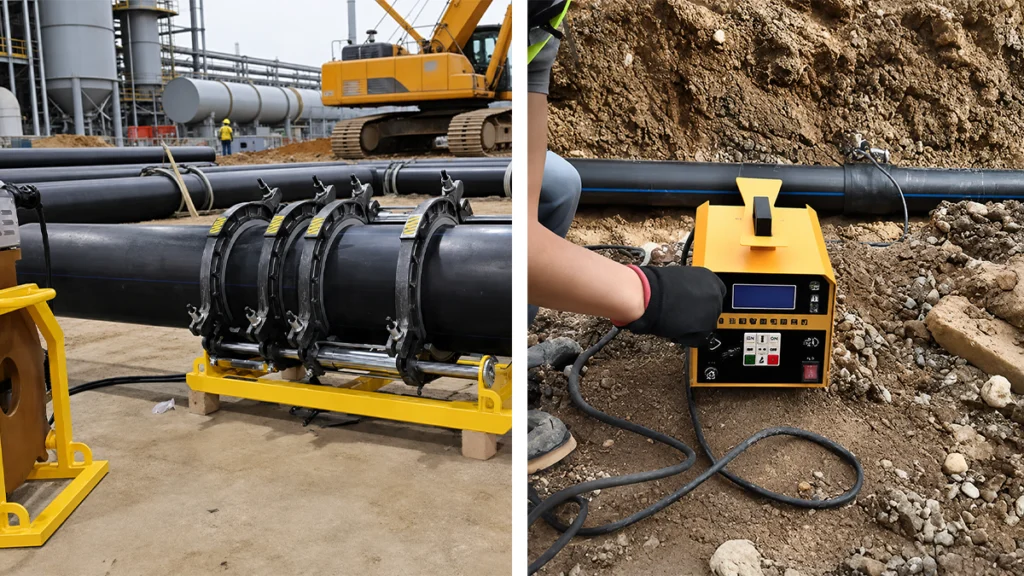
Creating a seamless bond through butt fusion welding hinges on exact temperature and pressure management. To guarantee maximum structural integrity, operators follow a rigorous five-stage sequence.
1. Preparation & Facing: First, alignment clamps secure the polyethylene pipes. Operators insert a mechanical facer between the ends to shave the pipe faces perfectly parallel, guaranteeing 100% surface contact.
2. Alignment: Next, the operator inspects the shaved ends for any high/low mismatch. Industry standards dictate that misalignment cannot exceed 10% of the HDPE pipe’s total wall thickness.
3. Heating (Bead-up & Heat Soak): A PTFE-coated heater plate—usually set between 200°C and 230°C—slides into place. The machine presses the polyethylene pipes against this plate until a specific bead size forms. Pressure then drops to near-zero, letting the heat soak deeply into the polymer.
4. Changeover: The operator swiftly removes the heater plate. This critical step must happen in under 10 seconds. Otherwise, the molten PE pipe ends will cool prematurely.
5. Joining & Cooling: Finally, the system drives the pipe ends together under a calculated fusion pressure (often 0.15 N/mm² interfacial pressure). The assembly remains clamped and stationary until it fully cools.
Process Parameters (Based on ISO 21307 / DVS 2207-1):
| Pipe SDR | Wall Thickness | Heating Temp | Interfacial Fusion Pressure | Min. Cooling Time |
|---|---|---|---|---|
| SDR 11 (DN110) | 10.0 mm | 200-230°C | 0.15 N/mm² | ~10-12 mins |
| SDR 17 (DN315) | 18.7 mm | 200-230°C | 0.15 N/mm² | ~18-22 mins |
| SDR 11 (DN500) | 45.4 mm | 200-230°C | 0.15 N/mm² | ~45-50 mins |
Electrofusion (EF) takes a different approach. Instead of applying external heat, this highly controlled method generates heat internally using resistance wires embedded right inside the fitting.
Core Components:
What really sets modern electrofusion apart is its barcode-driven parameter control. Every electrofusion HDPE pipe fitting features a barcode containing a 24-digit ISO standard code. When the ECU scans this code, it automatically dials in the exact voltage (usually 39.5V or 40V), heating time, and cooling time—even factoring in ambient temperature compensation. This automated handshake eliminates manual data entry errors, locking in repeatable quality across thousands of field joints.
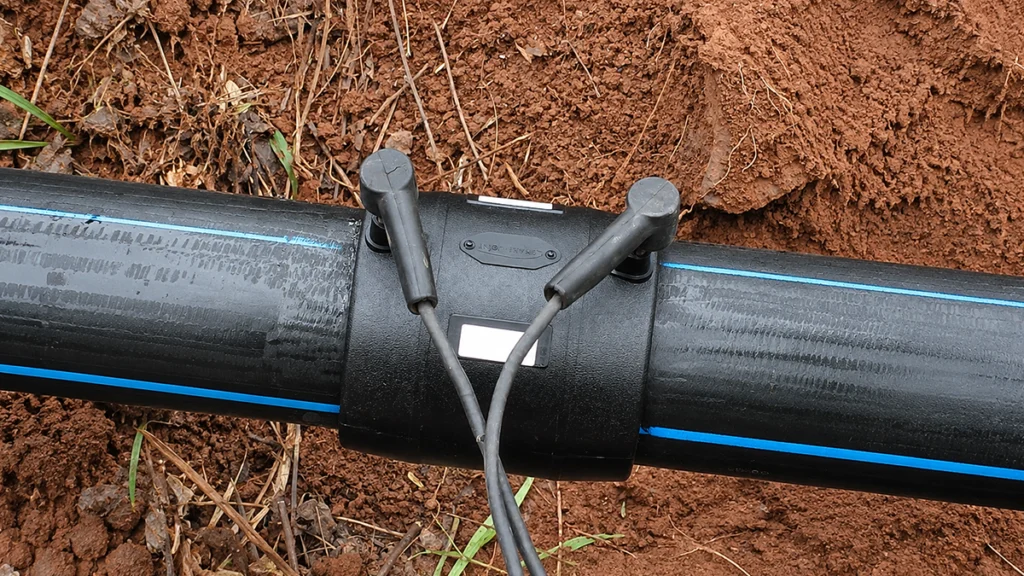
Execute either method correctly, and you get a monolithic joint boasting a 50-to-100-year design life, fully rated for PE100 MRS 10 MPa. You cannot objectively call one method “stronger” than the other. Rather, they achieve their structural integrity through entirely different fusion mechanics, which engineers verify using distinct testing standards.
Test Results & Standards:
Calculating the true cost per joint for electrofusion and butt fusion requires more than comparing machine prices. Contractors should evaluate both CAPEX, including equipment purchase and setup costs, and OPEX, including fittings, labor, power consumption, maintenance, and installation time.
Butt fusion generally requires a higher initial equipment investment, particularly for large-diameter, hydraulic, or automatic machines. However, its operating cost per straight pipe-to-pipe joint can be relatively low because no separate coupling is normally required. Recurring expenses mainly include labor, generator fuel or electricity, equipment maintenance, transport, and machine depreciation.
Electrofusion usually requires a lower initial investment in welding equipment, especially for small- and medium-diameter installations. However, each connection requires a dedicated electrofusion fitting, which increases the material cost per joint. The final cost can vary significantly depending on pipe diameter, fitting type, project quantity, site conditions, and installation efficiency.
For long pipelines with a large number of straight joints, butt fusion is often more economical over the full project. Electrofusion may provide better value for repairs, branch connections, confined spaces, and locations where butt fusion equipment is difficult to operate.
Estimated Cost per Joint by Pipe Diameter:
| Pipe Diameter |
Butt Fusion Cost (Labor + Power + Equipment Use) |
Electrofusion Cost (Fitting + Labor + Power) |
More Economical Option |
|---|---|---|---|
| DN63 | Approx. $2.00 | Approx. $12.00–$18.00 | Butt Fusion |
| DN110 | Approx. $5.00 | Approx. $25.00–$40.00 | Butt Fusion |
| DN200 | Approx. $15.00 | Approx. $90.00–$130.00 | Butt Fusion |
| DN315 | Approx. $30.00 | Approx. $250.00–$350.00 | Butt Fusion |
| DN500 | Approx. $80.00 | Approx. $800.00–$1,100.00 | Butt Fusion |
| DN630 | Approx. $120.00 | Approx. $1,500.00 or more | Butt Fusion |
Note: These values are indicative estimates for general comparison only. Actual costs may vary depending on pipe diameter, pressure rating, fitting type, labor rates, equipment configuration, project quantity, regional pricing, and site conditions.
As pipe diameter increases, the cost of electrofusion fittings tends to rise significantly. In many large-diameter transmission pipeline projects, this makes butt fusion the more cost-effective choice, especially where long runs of straight pipe are involved.
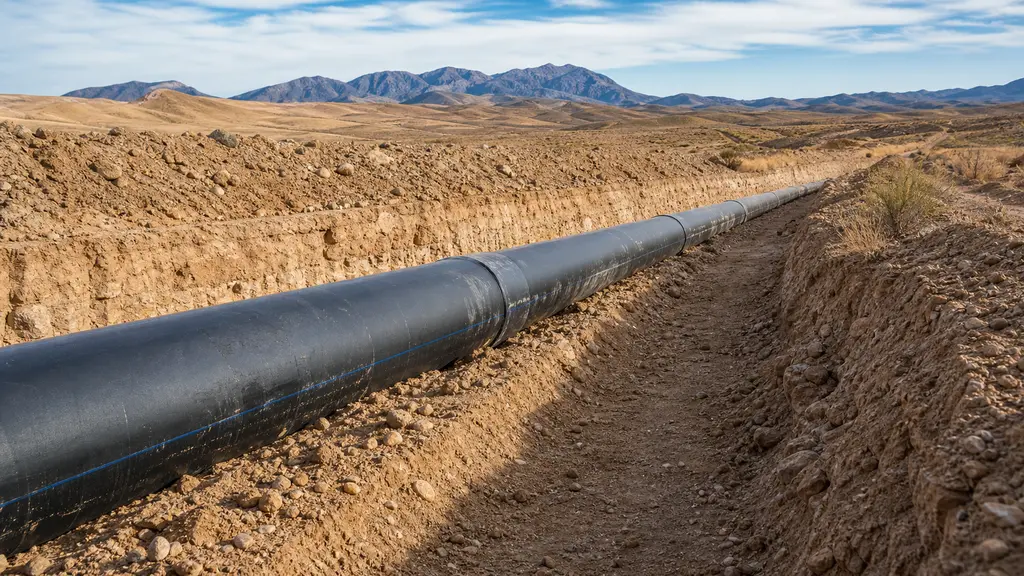
The project environment and HDPE pipeline geometry ultimately dictate which method to deploy. Each technique dominates in distinct scenarios.
Butt Fusion Scenarios:
Electrofusion Scenarios:
HDPE Pipeline engineers and EPC procurement officers juggle multiple variables when specifying HDPE pipe jointing methods. Use this decision matrix to align your project parameters with the right fusion technique.
1. Pipe Diameter:
2. SDR Compatibility: Butt fusion requires matching SDRs (like SDR11 to SDR11) to maintain structural integrity. Electrofusion easily bridges HDPE pipes with dissimilar SDRs.
3. Site Conditions: Wide-open trenches or above-ground installations heavily favor butt fusion. Confined spaces, vertical shafts, or trenchless pull-backs practically demand electrofusion.
4. Project Volume: A massive joint count easily justifies renting or buying a hydraulic butt fusion machine. You amortize the initial CAPEX over hundreds of low-cost joints.
Premium equipment alone won’t save a project from operator error or hidden supply chain risks. Understanding how these joints fail is a critical component of quality assurance.
Top Installation Mistakes:
1. Butt Fusion:
2. Electrofusion:
Hidden Risks:
Sourcing materials for HDPE pipe welding means ruthlessly vetting manufacturers for strict quality control and total system compatibility. B2B buyers should lean on this procurement checklist:
For today’s EPC contractors and utility planners, this isn’t a strict “either/or” debate. It’s about building a smart hybrid strategy. Optimizing a pipeline project means leveraging the economic strengths of both methods while sidestepping their respective limitations.
Plan to specify butt fusion for roughly 90% of your project. Capitalize on that zero-fitting cost for your long, straight runs and massive transmission mains. By relying on butt fusion for the bulk of the installation, contractors shave hundreds of thousands of dollars off consumable costs without sacrificing an ounce of structural integrity.
Keep electrofusion in your back pocket for the remaining 10%. Deploy EF fittings for final tie-ins, tight trench repairs, dissimilar SDR connections, and complex manifold assemblies where maneuverability trumps fitting costs. Partnering with a comprehensive supplier ensures your pipes, EF fittings, and butt fusion machines are engineered to the exact same tolerances—guaranteeing flawless integration from start to finish.
Both butt fusion and electrofusion can produce reliable joints when the correct materials, equipment, preparation, and procedures are used. Butt-fused joints may be evaluated using tensile testing under ISO 13953, while electrofusion assemblies may be evaluated using peel-decohesion testing under ISO 13954. Neither method should be described as universally stronger; joint performance depends on installation quality, fitting design, pipe compatibility, and compliance with the applicable procedure.
Butt fusion usually avoids the cost of a separate coupling for each straight joint, while electrofusion requires a compatible fitting for every connection. However, the actual cost per joint depends on pipe diameter, fitting price, machine cost, labour, surface preparation, power supply, installation space, productivity, and local market conditions. A project-specific cost comparison is more reliable than using fixed figures for every DN315 joint.
Yes, large-diameter electrofusion systems are available for some pipe sizes and projects. PPI provides field-joining guidance for electrofusion of PE pipe from 14 to 30 inches, showing that electrofusion is not limited to small diameters. However, availability, fitting cost, equipment capacity, cooling time, and supplier approval must be checked for the exact diameter and SDR. Butt fusion remains the dominant joining method for many medium- and large-diameter pipelines.
For long, accessible pipeline runs, butt fusion can be efficient because it does not require a separate electrofusion coupling at every straight joint. Electrofusion may be more practical for repairs, tie-ins, confined spaces, and locations where a butt fusion machine cannot be positioned. Installation speed depends on pipe size, preparation, heating and cooling time, site access, crew experience, and equipment setup. PPI specifically identifies electrofusion equipment as useful for close-quarter connections and repairs.
The two methods require different practical skills and may require separate training or qualification under the project specification. Butt fusion operators must control facing, alignment, heater temperature, drag pressure, fusion pressure, changeover, and cooling. Electrofusion operators must correctly scrape and clean the pipe surface, align and restrain the fitting, enter or scan the fusion parameters, and observe the full cooling period. Qualification requirements vary by country, utility, project, and applicable standard.
Electrofusion is commonly useful for gas-pipeline repairs, branch connections, tie-ins, and work in confined or congested areas because the equipment requires less working space around the joint. Barcode-controlled electrofusion processors can also support consistent input of fitting parameters and, on some models, weld-data recording. However, the preferred joining method depends on the utility specification, pipe size, fitting availability, site conditions, and local regulations.
Yes. Many projects use butt fusion for long, accessible pipeline sections and electrofusion for repairs, tie-ins, branch connections, restricted spaces, or transitions to existing systems. The final joining method should follow the approved design, fitting compatibility, installation procedure, and project specification.
Relevant standards depend on the project and jurisdiction. ASTM F2620 covers heat-fusion joining of polyethylene pipe and fittings, while ASTM F3565 covers electrofusion joining for pressure-pipe service. ASTM F1055 specifies requirements for electrofusion fittings, and ASTM F3124 addresses data recording for heat butt-fusion procedures. ISO 21307 covers butt-fusion procedures, ISO 13953 covers tensile testing of butt-fused joints, and ISO 13954:2025 covers peel-decohesion testing of electrofusion socket assemblies.
Choosing between butt fusion and electrofusion requires consideration of pipe diameter, SDR, joint location, site access, installation volume, equipment availability, documentation requirements, and total project cost. Butt fusion is generally well suited to long, accessible pipeline runs because it does not require a separate coupling at every straight joint. Electrofusion is often more practical for repairs, tie-ins, branch connections, and confined spaces where butt fusion equipment cannot be positioned easily.
Many projects use both methods according to the installation conditions. Matching the joining method to the approved design, pipe and fitting compatibility, operator capability, and project procedure can improve installation efficiency, control costs, and support reliable long-term joint performance.