Address
Zhengzhou, Henan, China
Work Hours
Monday to Friday: 7AM - 7PM
Weekend: 10AM - 5PM
Address
Zhengzhou, Henan, China
Work Hours
Monday to Friday: 7AM - 7PM
Weekend: 10AM - 5PM

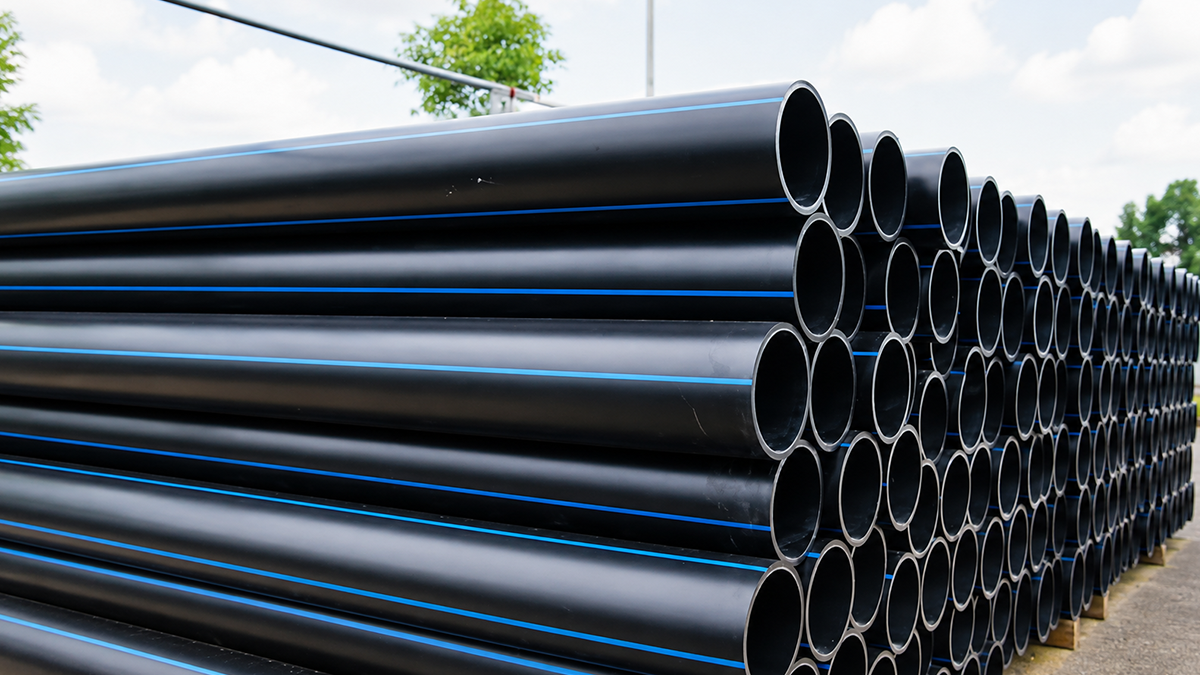
This HDPE Pipe Project guide helps engineers, EPC contractors and procurement managers specify the right pipe grade, fittings and welding equipment, plan budgets, evaluate suppliers, avoid common installation risks, and source a complete, export-ready project supply package with confidence.
At its core, an HDPE pipe project involves building critical infrastructure—think municipal water networks, gas distribution lines, mining slurry routes, or heavy-duty drainage systems—using High-Density Polyethylene. Delivering these builds successfully under an EPC (Engineering, Procurement, and Construction) contract requires a complete supply package. You need three non-negotiable components: the HDPE pipes, precision-matched fittings, and specialized fusion welding gear.
Sourcing this trio from a single, integrated manufacturer is the smartest way to eliminate compatibility risks and keep your procurement timeline on track. Mega-projects demand suppliers with serious production muscle to hit aggressive delivery windows. We are talking about massive operations—facilities spanning 200 acres and pushing out over 100,000 tons annually. That level of scale guarantees that construction phases never stall due to material bottlenecks. Ultimately, buying a bundled package ensures the dimensional tolerances between your pipes and fittings lock together perfectly. That exact alignment is what guarantees zero-leakage fusion joints in the field.
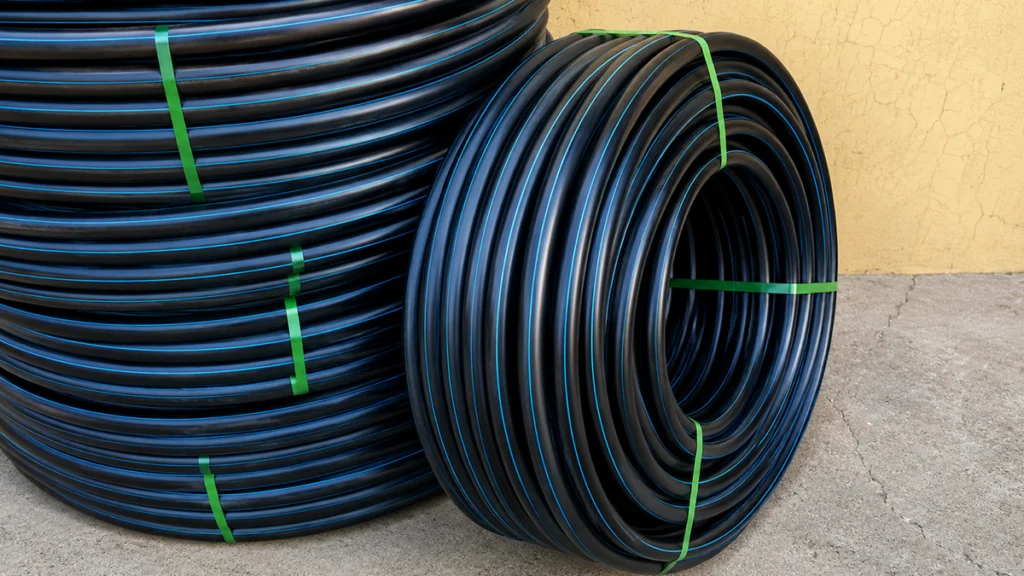
![[HDPE pipe project solution for water supply]](https://jq-pipe.com/wp-content/uploads/2026/07/image-95.webp)
Engineers heavily favor High-Density Polyethylene for civil and industrial builds because the material outlasts traditional alternatives. It fights off corrosion, flexes under ground movement, and offers an incredibly long service life. However, your specific application dictates exactly which material grade, pressure rating, and structural design you need to specify.
Selecting the correct HDPE pipe specification requires balancing the Standard Dimension Ratio (SDR), Nominal Pressure (PN) rating, pipe diameter, and material grade. SDR is the ratio of the nominal outside diameter to the nominal wall thickness. At the same outside diameter, a lower SDR indicates a thicker wall and generally a higher pressure capacity. The available diameter range depends on the applicable standard, production equipment, SDR, and manufacturer capability.
SDR to PN Mapping (Based on PE100 Water Pipe at 20°C):
| SDR Rating | PN Rating (Bar) | Pressure (MPa) | Pressure (PSI) |
|---|---|---|---|
| SDR 26 | PN 6 | 0.6 MPa | 87 psi |
| SDR 21 | PN 8 | 0.8 MPa | 116 psi |
| SDR 17 | PN 10 | 1.0 MPa | 145 psi |
| SDR 13.6 | PN 12.5 | 1.25 MPa | 181 psi |
| SDR 11 | PN 16 | 1.6 MPa | 232 psi |
| SDR 9 | PN 20 | 2.0 MPa | 290 psi |
Material Grade Comparison:
| Material Grade | Minimum Required Strength (MRS) | Primary Application | Characteristics |
|---|---|---|---|
| PE80 | 8.0 MPa | Low-pressure water/gas, smaller diameters | Standard density, highly flexible. |
| PE100 | 10.0 MPa | High-pressure mains, modern EPC projects | Handles 25% higher pressure than PE80 at the same wall thickness. |
| PE100-RC | 10.0 MPa | Trenchless drilling (HDD), rocky terrain | Superior slow crack growth (SCG) resistance. |
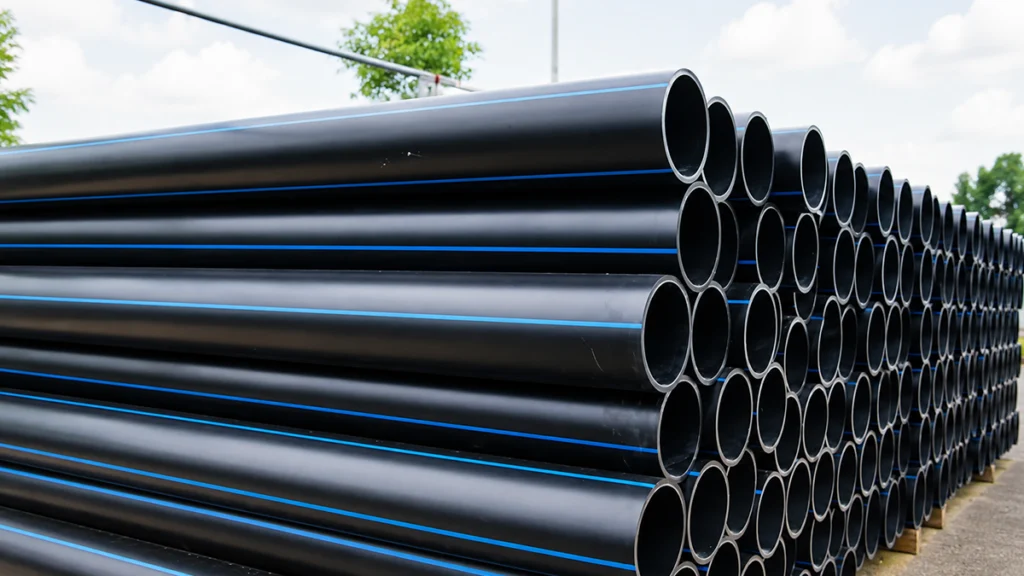
A HDPE pipeline is only as strong as its joints. HDPE pipe fittings generally fall into three categories: butt fusion, electrofusion, and PP compression. Your choice here directly impacts how fast your crews can install the line and how well the system holds up under stress.
| Fitting Type | Diameter Range | Connection Method | Pros | Cons |
|---|---|---|---|---|
| Butt Fusion | DN63 – DN3000 | Heat plate fusion | Joint is as strong as the pipe itself; highly cost-effective for large diameters. | Requires significant trench space for the welding machine; strict alignment needed. |
| Electrofusion | DN20 – DN630+ | Embedded resistance wires | Ideal for confined trench spaces, tie-ins, repairs, and critical gas lines. Fast setup. | Higher unit cost per fitting compared to standard molded fittings. |
| PP Compression | DN16 – DN110 | Mechanical joint | No welding machine or electricity required; extremely fast manual installation. | Lower pressure threshold; strictly prohibited for gas or critical high-pressure mains. |
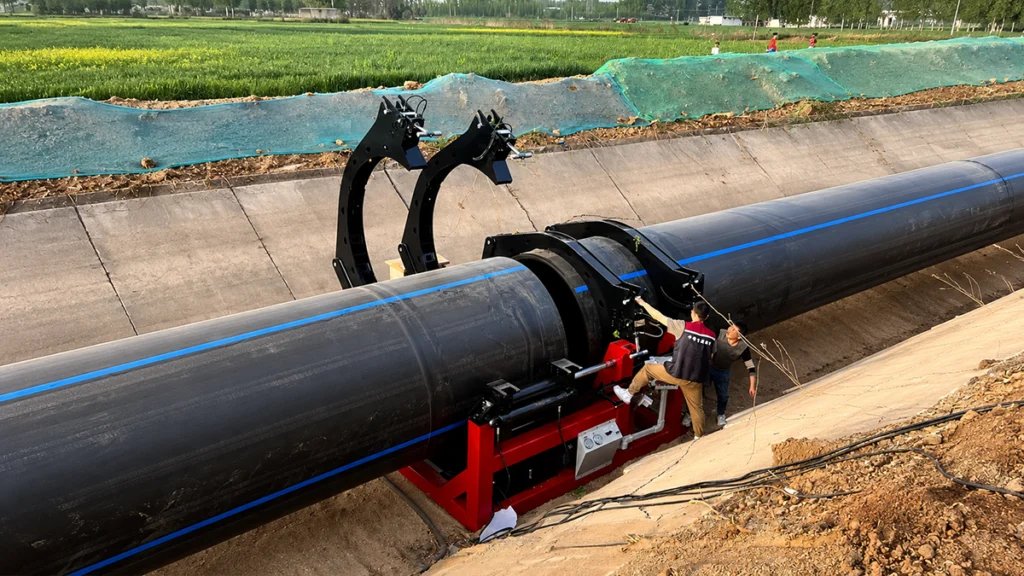
Picking the right fusion machine comes down to two things: pipe diameter and the reality of your job site. Generally, you will rely on hydraulic butt fusion machines for those long, straight open-trench runs. When things get tight or you are working in confined spaces, electrofusion welding machine units become necessary. Whatever you choose, verify the gear complies with ISO 21307 or DVS 2207 standards to guarantee joint integrity.
Machine to Pipe Diameter Mapping:
| Machine Category | Supported Pipe Diameters (DN) |
|---|---|
| Small Manual/Hydraulic | DN63-160mm, DN63-200mm, DN90-250mm |
| Medium Hydraulic | DN90-315mm, DN200-500mm |
| Large Hydraulic | DN315-630mm, DN500-2250mm |
Equipment Decision Tree for Project Sites:
1. Open trench + long straight runs + DN90 and above: Bring in the Hydraulic Butt Fusion Machines.
2. Confined space + tie-ins/repairs + gas distribution lines: Rely on Electrofusion Machines.
Where does the money actually go in a standard EPC contract? Typically, the HDPE pipes themselves consume about 45% to 55% of your total budget. The remaining funds are spread across fittings, welding gear, freight, and installation labor. Mapping out this distribution helps project managers spot clear opportunities to optimize their spend.
Standard EPC Cost Breakdown (Indicative %):
*Data Disclaimer:* Actual material prices shift constantly alongside global petrochemical resin indices (USD/ton). That said, securing a bundled package (Pipe + Fittings + Machine) from a single integrated factory routinely slashes total procurement costs by 10-15% thanks to bulk discounts and consolidated shipping.
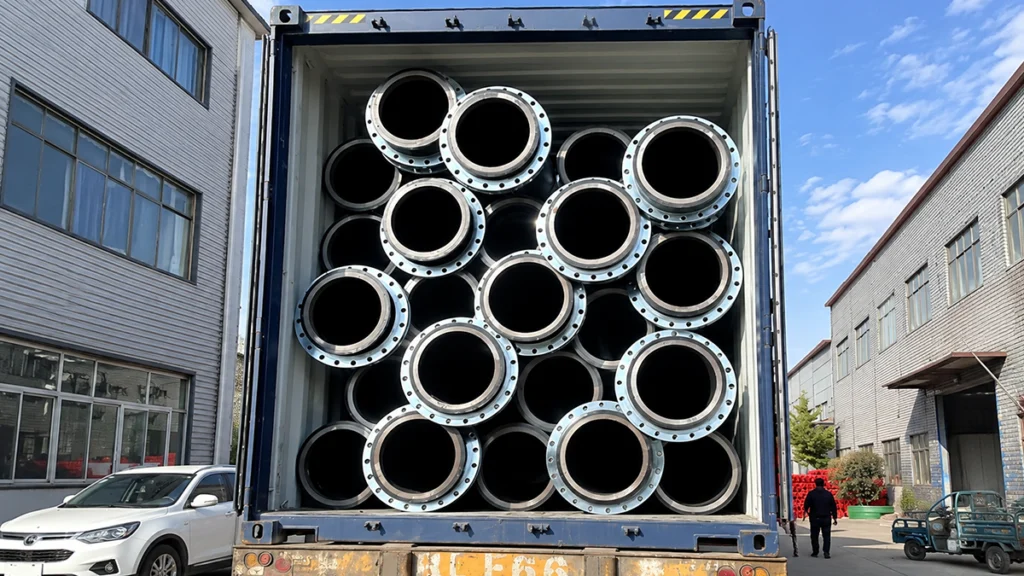
Shipping massive volumes of hollow plastic across oceans requires smart logistics. For EPC contractors handling export bulk orders, strategic packing—specifically pipe nesting—is the secret to maxing out container capacity and keeping ocean freight costs under control. When ordering direct from a major factory, expect standard lead times to hover between 7 and 15 days.
Container Loading & Capacity Strategies:
Vetting a manufacturing partner takes more than just glancing at a product catalog. You have to audit their resin sources, verify their actual production output, and check their quality control paperwork. Run potential suppliers through this 8-point checklist before signing any purchase orders.
8-Point Supplier Evaluation Checklist:
1. Resin Source: Are they utilizing 100% virgin PE100 resin (from brands like Borouge or Sabic), or are they cutting corners with risky recycled regrind?
2. Production Capacity: Can they actually handle high-volume EPC demands? You want a partner pushing out over 100,000 tons a year.
3. Package Capability: Do they manufacture the HDPE pipes, fittings, and machines under one roof to guarantee perfect system compatibility?
4. Certifications: Verify their paperwork. Look for ISO 9001, ISO 14001, CE, SGS, and ISO 4427 compliance.
5. Testing Lab: Ask for in-house hydrostatic pressure tests and melt mass-flow rate (MFR) reports.
6. Export Experience: Do they actively map out 40HQ container nesting plans and optimize lengths to 11.8m?
7. Lead Time: Will they put a strict 7-15 day delivery guarantee in writing?
8. After-Sales Support: Do they hand over technical welding parameters and offer troubleshooting for your site contractors?
Even the highest-grade materials will fail if installation protocols are ignored. Project blowouts usually trace back to terrible material selection, sloppy HDPE pipe prep, or crews ignoring strict welding parameters. You have to lock down these risks during installation if you want the pipeline to hit its 50-year design life.
1. Risk: Using recycled/regrind PE material.
2. Risk: Improper pipe end cleaning.
3. Risk: Incorrect cooling times (Cold Welding).
4. Risk: Misalignment during butt fusion.
5. Risk: Ignoring temperature derating.
A structured procurement strategy keeps budgets in check and timelines on track. Walking through a standardized sequence takes the guesswork out of the equation and prevents costly delays.
A complete project package may include HDPE pipes, compatible butt fusion, electrofusion, or compression fittings, welding equipment, reducing inserts, valves, flange connections, spare parts, and technical documents. Sourcing these items from one experienced supplier can simplify compatibility checks, logistics, installation support, and project coordination for EPC contractors.
PE100 has a Minimum Required Strength (MRS) of 10 MPa, compared with 8 MPa for PE80. This allows PE100 to achieve a higher pressure rating or a thinner wall under comparable design conditions. PE80 remains suitable where permitted by the applicable standard and project specification. The final choice should consider pressure, SDR, diameter, temperature, service life, availability, and local requirements.
Lead time depends on pipe diameter, SDR, order quantity, material grade, customization, testing, and production schedule. Standard specifications may be ready within approximately 7 to 15 days when materials and production capacity are available, while large or customized project orders may require additional time. Buyers should confirm the production and shipping schedule before ordering.
For straight pipeline installation, select a hydraulic butt fusion machine whose welding range covers the required outside diameters, such as 90–315 mm, 160–450 mm, or 315–630 mm models. Butt fusion is commonly used for long pipe runs, while electrofusion equipment may be more practical for repairs, branch connections, confined spaces, or locations where a butt fusion machine cannot be positioned.
The cost of a 1 km HDPE pipeline depends on the pipe diameter, SDR, material grade, application, fittings, installation method, transportation, and local labor costs. Trenching, valves, welding, testing, and site conditions can also significantly affect the final budget. Buyers should prepare a detailed bill of quantities and request a project-specific quotation rather than relying on a fixed cost per kilometer.
Yes. An integrated supplier may provide HDPE pipes, compatible fittings, butt fusion or electrofusion equipment, reducing inserts, valves, and related accessories. Sourcing the package from one supplier can simplify compatibility checks, documentation, logistics, and technical support, but all products and welding procedures should still be verified against the project specification.
The required certifications depend on the application, destination market, and project specification. Buyers should review the applicable product standard, quality-management certificates, raw-material certificates, batch inspection reports, dimensional results, and relevant pressure and material test reports. For water projects, ISO 4427 may apply, while gas, mining, industrial, or drainage systems may require different standards or approvals.
Common mistakes include poor pipe-end preparation, contaminated fusion surfaces, incorrect alignment, unverified welding parameters, excessive changeover time, insufficient cooling, and moving the joint too early. Other risks include using equipment outside its rated welding range and failing to apply temperature or pressure derating where required. Operators should follow the approved fusion procedure, pipe manufacturer’s instructions, and project specification.
A reliable HDPE pipe installation requires careful attention to material grade, pipe dimensions, SDR, pressure rating, joining procedures, and project standards. Selecting the correct PE100 or PE100-RC pipe for municipal water, gas, mining, or industrial applications helps support long-term pipeline performance and system safety.
Working with an experienced supplier that can provide HDPE pipes, compatible fittings, welding equipment, technical documents, and project support can also simplify procurement and logistics. EPC contractors should evaluate product quality, dimensional compatibility, production capability, testing records, certifications, delivery schedules, and after-sales service before selecting a supplier.