Address
Zhengzhou, Henan, China
Work Hours
Monday to Friday: 7AM - 7PM
Weekend: 10AM - 5PM
Address
Zhengzhou, Henan, China
Work Hours
Monday to Friday: 7AM - 7PM
Weekend: 10AM - 5PM

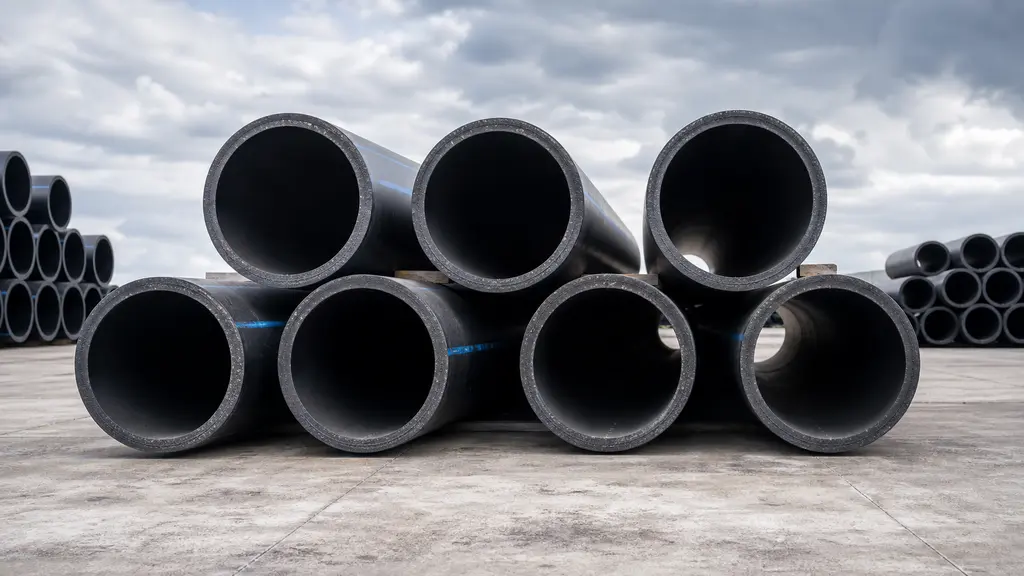
Large Diameter HDPE Pipe selection from DN630 to DN3000 depends on flow rate, SDR, pressure rating, installation method, application, cost, and supplier capability. This guide helps buyers compare sizes and request accurate specifications.
When you need to move massive volumes of fluid, large diameter HDPE pipe is the go-to solution. Engineered as a high-density polyethylene pressure or gravity pipeline, it handles heavy-duty transfer tasks with ease. Typically extruded from 100% virgin PE100 resin, these rugged conduits form the critical backbone of today’s industrial, marine, and municipal infrastructure. Forget standard commercial plumbing. Manufacturing these large bore pipes demands highly specialized extrusion technology, allowing them to carry immense loads of water, effluent, or abrasive slurry across vast distances.
Before specifying materials for a major engineering project, procurement teams need a firm grip on four core concepts:
Large bore HDPE pipes cover a broad sizing spectrum, starting at DN630 and scaling up to colossal DN3000 structures. Pinpointing the exact size within this range depends entirely on your project’s overall footprint and the specific fluid volumes you need to move.
DN630 to DN900:
Think of this tier as the sweet spot for heavy industrial fluid transport, medium-scale mining slurry operations, and major municipal water mains. Engineers frequently spec these diameters to replace failing ductile iron or concrete networks. Why? Because HDPE delivers vastly superior flow dynamics and creates a completely leak-free system through thermal fusion.
DN1000 to DN1600:
Moving up the scale, these PE pipes tackle heavy-duty applications like large-scale stormwater drainage, aggressive dredging jobs, and primary water transmission networks. Internal volume capacity jumps exponentially at this size. As a result, they act as critical arteries for industrial plant cooling loops and regional water distribution grids.
DN1800 to DN3000:
We reserve these ultra-large bore structures for the most demanding, specialized infrastructure megaprojects. You’ll find them deployed as power plant cooling water intakes, massive gravity sewage networks, or marine outfalls pushing treated effluent out into the ocean. Producing HDPE pipe at this extreme scale is no small feat—it requires highly advanced extrusion lines found only in a handful of top-tier manufacturing facilities.
ISO 4427 and EN 12201 provide key requirements for PE100 pressure pipes used in water supply and pressure drainage applications. Standard dimensions generally extend up to DN/OD 2500 under EN 12201, while larger sizes such as DN3000 are typically engineered according to project specifications and manufacturer capabilities.
| Nominal Diameter (DN/OD) | Standard Dimension Ratio (SDR) | Wall Thickness (t) | Pressure Class (PN) | Typical Application |
|---|---|---|---|---|
| DN630 | SDR11 | 57.2 mm | PN16 | High-pressure municipal water mains |
| DN630 | SDR17 | 37.4 mm | PN10 | Standard water transmission |
| DN800 | SDR11 | 72.6 mm | PN16 | Heavy-duty industrial fluid transport |
| DN800 | SDR17 | 47.4 mm | PN10 | General municipal distribution |
| DN1000 | SDR11 | 90.8 mm | PN16 | Directional drilling (HDD) projects |
| DN1000 | SDR17 | 59.3 mm | PN10 | Major water transmission networks |
| DN1200 | SDR11 | 109.0 mm | PN16 | High-pressure dredging lines |
| DN1200 | SDR17 | 71.1 mm | PN10 | Regional water supply pipelines |
| DN1600 | SDR21 | 76.2 mm | PN8 | Low-pressure transmission / Sewer force mains |
| DN1600 | SDR26 | 61.5 mm | PN6 | Gravity drainage / Stormwater |
| DN2000 | SDR26 | 76.9 mm | PN6 | Marine outfalls / Intake pipelines |
| DN3000 | Custom | Engineered | Custom | Ultra-large gravity sewage systems |
Nailing down the perfect large bore HDPE pipe size isn’t guesswork. It demands a rigorous look at site conditions, fluid dynamics, and expected operational lifespan. Project engineers have to crunch several key variables to guarantee the HDPE pipeline’s long-term structural integrity.
1. Flow Rate and Internal Diameter (ID): While the outside diameter (DN) remains fixed, the actual flow capacity hinges entirely on the Internal Diameter. You calculate ID by taking the OD and subtracting twice the wall thickness. High-capacity systems rely on specific flow velocities to minimize friction loss and keep sediment from settling.
2. Pressure Requirements: The HDPE pipeline has to shoulder the maximum sustained operating pressure, but that’s not all. Engineers must also build in a safety buffer to account for sudden surge pressures or brutal water hammer effects.
3. Installation Method: Trenchless techniques like Horizontal Directional Drilling (HDD) drag the HDPE pipe through the earth, subjecting it to immense tensile pulling forces. To survive that mechanical stress, HDD projects almost always require lower SDRs, meaning much thicker walls.
4. Chemical Exposure: Because PE100 resin boasts phenomenal chemical resistance, it safely transports aggressive fluids across a vast pH range (from 1 to 14) without breaking down.
5. Service Life Expectations: Assuming proper sizing and operation at standard 20°C temperatures, a well-engineered PE100 large bore pipeline will easily deliver a service life spanning 50 to 100 years.
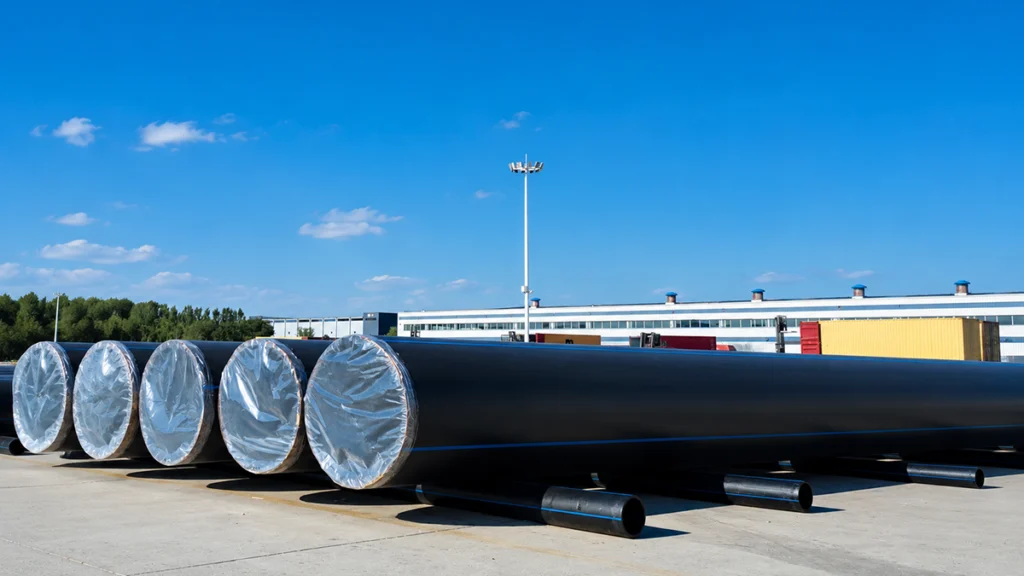
If there is one technical factor you must master during procurement, it is the interplay between SDR, PN, and wall thickness. Since the outside diameter never changes for a specific DN, adjusting the SDR directly impacts both the wall thickness and the available internal diameter.
| SDR Rating | Pressure Class (PE100 at 20°C) | Wall Thickness Profile | Primary Project Fit |
|---|---|---|---|
| SDR 11 | PN16 (approx. 232 psi) | Thickest standard wall | High-pressure water transmission, severe HDD installations, highly abrasive slurry. |
| SDR 17 | PN10 (approx. 145 psi) | Industry standard wall | General municipal water supply, standard pressure industrial transport. |
| SDR 21 | PN8 (approx. 116 psi) | Medium-thin wall | Low-pressure transmission, sewer force mains, treated effluent transport. |
| SDR 26 | PN6 (approx. 87 psi) | Thinnest standard wall | Gravity drainage, stormwater management, marine outfalls with minimal internal pressure. |
Thanks to their unique blend of structural integrity, flexibility, and total corrosion resistance, large bore HDPE pipelines thrive in some of the most punishing civil and industrial environments on earth.
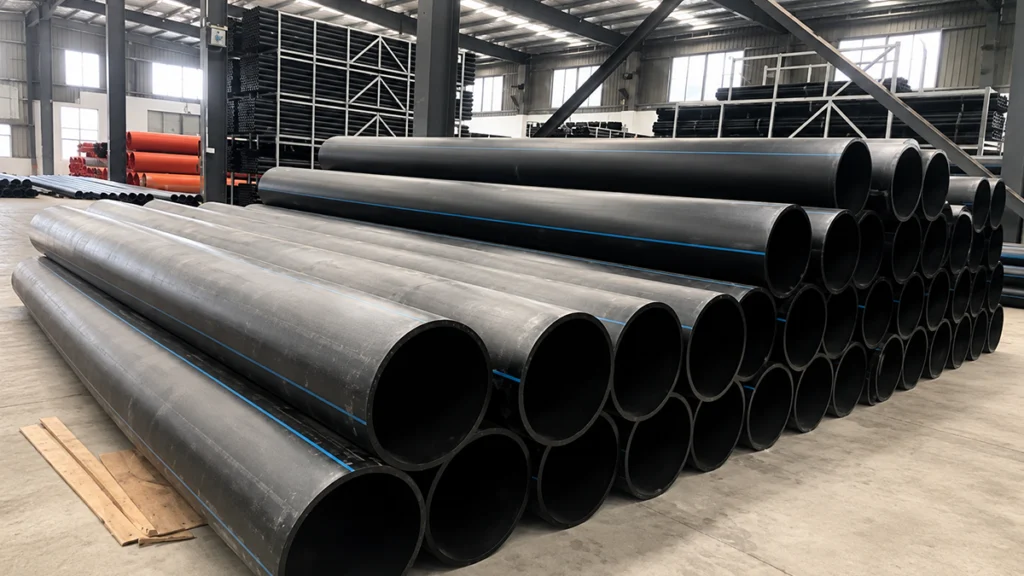
A HDPE pipeline is only as strong as its weakest joint. Fortunately, instead of relying on failure-prone rubber gaskets like older legacy materials, HDPE uses thermal fusion to create a single, continuous, monolithic system.
Butt Fusion (Primary Method)
This serves as the undisputed standard for fusing pipes anywhere from DN630 up to DN3000. Crews execute the process in four highly controlled steps:
1. Clean and mechanically face both HDPE pipe ends until the surfaces are perfectly parallel.
2. Apply heat to the ends using a specialized, PTFE-coated heating plate (usually hovering between 210°C and 225°C).
3. Quickly remove the plate and drive the molten ends together using precise hydraulic pressure.
4. Hold the joint steady under continuous pressure until fully cooled. When done correctly, the resulting weld is actually stronger than the native HDPE pipe wall.
Flange Connections
Pipelines rarely exist in isolation. When you need to tie an HDPE line into steel piping, large gate valves, or a pumping station, you use a flange connection. Crews fuse an HDPE stub end to the main pipe, then slip a steel backing ring over it to bolt the entire assembly securely to the adjoining infrastructure.
Electrofusion
Though technically possible, electrofusion isn’t something you see often on ultra-large diameters. The massive fittings required simply cost too much. When project specs do demand it, crews use specialized fittings containing embedded electric heating coils that energize and melt the components together.
JINQUAN actively supports these installation methods by engineering and supplying heavy-duty pipe welding machinery, purposefully built to wrangle these massive diameters even on the most unforgiving job sites.
Sourcing massive HDPE pipelines requires serious logistical and commercial foresight. Pricing fluctuates constantly, tethered directly to the global market rate for 100% virgin PE100 resin. Think about it: a thick-walled DN2000 SDR11 PE pipe consumes exponentially more raw material per meter than a thin-walled DN630 SDR26. Ultimately, the SDR determines the weight per meter, and that weight drives your final cost.
Production Capacity and Lead Times
Extruding pipe up to DN3000 takes serious manufacturing muscle. Operating out of a sprawling 200-acre facility, JINQUAN pushes an annual output well past 100,000 tons. Standard large diameter orders generally see lead times between 7 and 15 days. However, if you are spec’ing custom ultra-large bore structures, expect a more tailored production schedule. As for Minimum Order Quantities (MOQ), those are assessed project-by-project, heavily influenced by your specific diameter and SDR requirements.
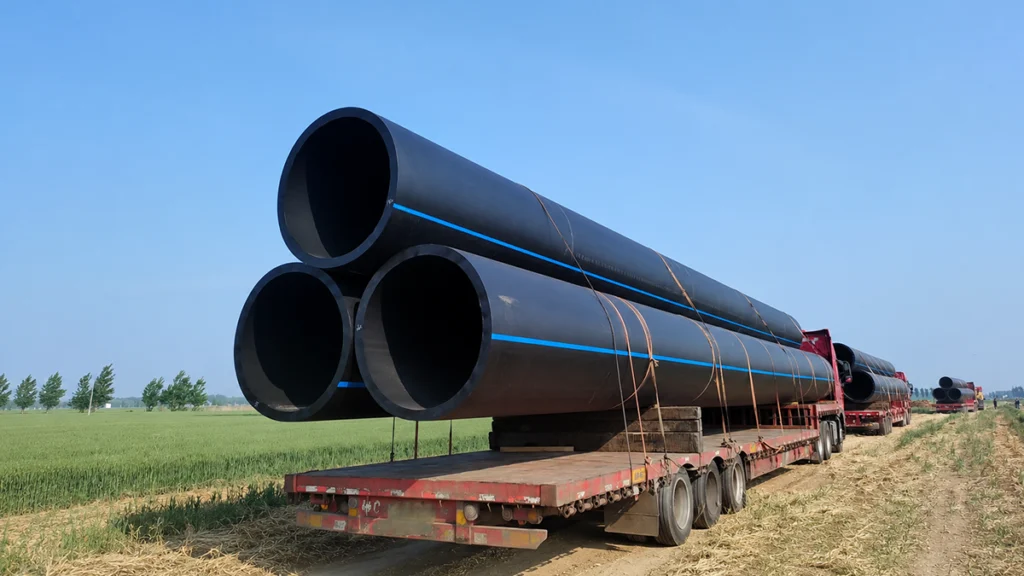
Logistics and Shipping Challenges
Moving these giants from the factory to the trench involves highly specialized transport:
Procuring polyethylene pipes in the DN630 to DN3000 range carries a high degree of project risk. To protect your investment, you must rigorously audit a potential supplier’s physical manufacturing floor and their internal quality control frameworks.
Before pulling the trigger on a purchase order, procurement teams need to lock down their technical parameters. Consolidate the following data points to guarantee seamless manufacturing and zero logistical headaches down the line:
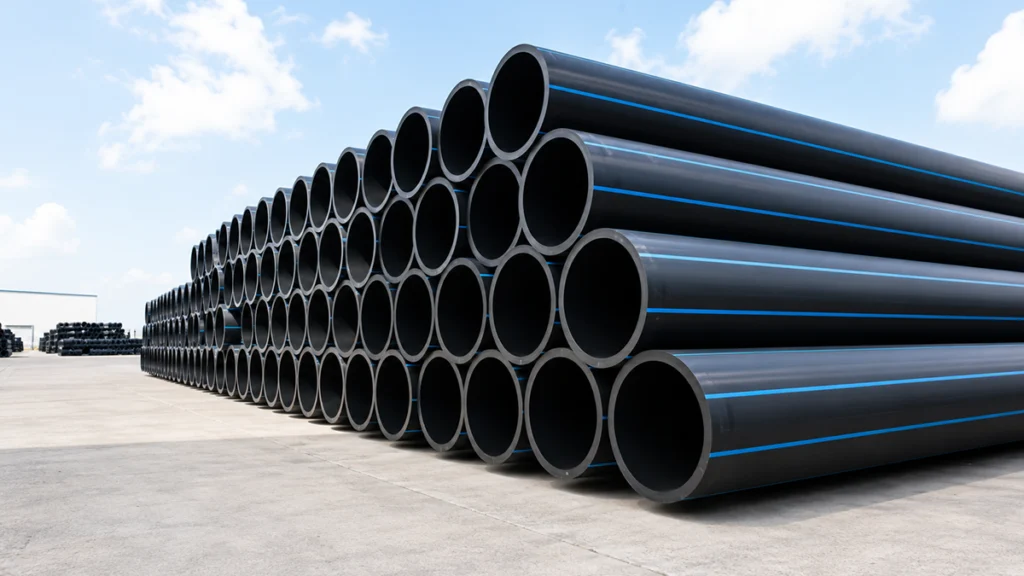
Large-diameter HDPE pipe generally refers to polyethylene pipe used for major water, drainage, marine, mining, and industrial projects. In this article, the term covers sizes from DN/OD 630 to DN/OD 3000. However, the exact definition of “large diameter” may vary by manufacturer, market, and project specification.
Common large-diameter sizes include DN630, DN800, DN1000, DN1200, DN1600, DN2000, and project-specific sizes up to DN3000. Available diameters, SDR classes, wall thicknesses, and production lengths depend on the applicable standard and the manufacturer’s equipment. Extruded PE pressure pipes larger than DN3000 are technically available in some markets, so DN3000 should not be described as a universal maximum.
SDR is the ratio of the pipe’s outside diameter to its minimum wall thickness. A lower SDR means a thicker wall and generally higher pressure capacity, while a higher SDR means a thinner wall. The correct SDR should be selected according to operating and surge pressure, temperature, installation method, external loads, transported medium, and the applicable project standard.
For metric PE pipes, DN/OD identifies the nominal outside diameter in millimetres. SDR is the ratio between outside diameter and minimum wall thickness. PN is a nominal pressure designation used under defined material, temperature, and design conditions; it should not be described as the unconditional maximum operating pressure of the pipeline.
Yes. Large-diameter PE pipes can be used for sea outfalls, intake lines, and pipelines installed in water. Because an air-filled PE pipeline is buoyant, marine installation may require engineered ballast weights, controlled sinking, anchoring, and seabed preparation. Final design must account for waves, currents, water depth, pipe contents, joints, and installation loads.
Provide the required outside diameter, SDR or pressure rating, material grade, quantity, pipe length, application, operating temperature, applicable standard, fittings, testing requirements, delivery destination, and shipping terms. For marine, mining, or trenchless projects, installation conditions and engineering requirements should also be included.
Butt fusion is commonly used to join large-diameter HDPE pipes. The pipe ends are clamped, faced, heated, joined under controlled pressure, and cooled according to the selected fusion procedure. Flange adaptors and backing rings may be used when connecting HDPE pipe to valves, pumps, steel pipelines, or other flanged equipment.
Pricing depends on diameter, SDR, pipe weight, resin grade, production length, testing, fittings, project documentation, packaging, and delivery method. Large diameters require more material, specialized production equipment, lifting arrangements, and project-specific logistics. Depending on the pipe size and length, shipping may involve open-top containers, flat racks, conventional vessels, or break-bulk transport.
Selecting large-diameter HDPE pipes from DN630 to DN3000 requires careful consideration of SDR, pressure requirements, installation conditions, transported medium, production capability, and shipping logistics. The final specification should be based on the applicable project standard and confirmed through engineering calculations.
Buyers should also verify the supplier’s extrusion capacity, material traceability, dimensional inspection, test documentation, large-diameter project experience, and delivery capability. Working with an experienced manufacturer can simplify specification review, production coordination, and international transport for water, drainage, marine, mining, and industrial pipeline projects.