Address
Zhengzhou, Henan, China
Work Hours
Monday to Friday: 7AM - 7PM
Weekend: 10AM - 5PM
Address
Zhengzhou, Henan, China
Work Hours
Monday to Friday: 7AM - 7PM
Weekend: 10AM - 5PM

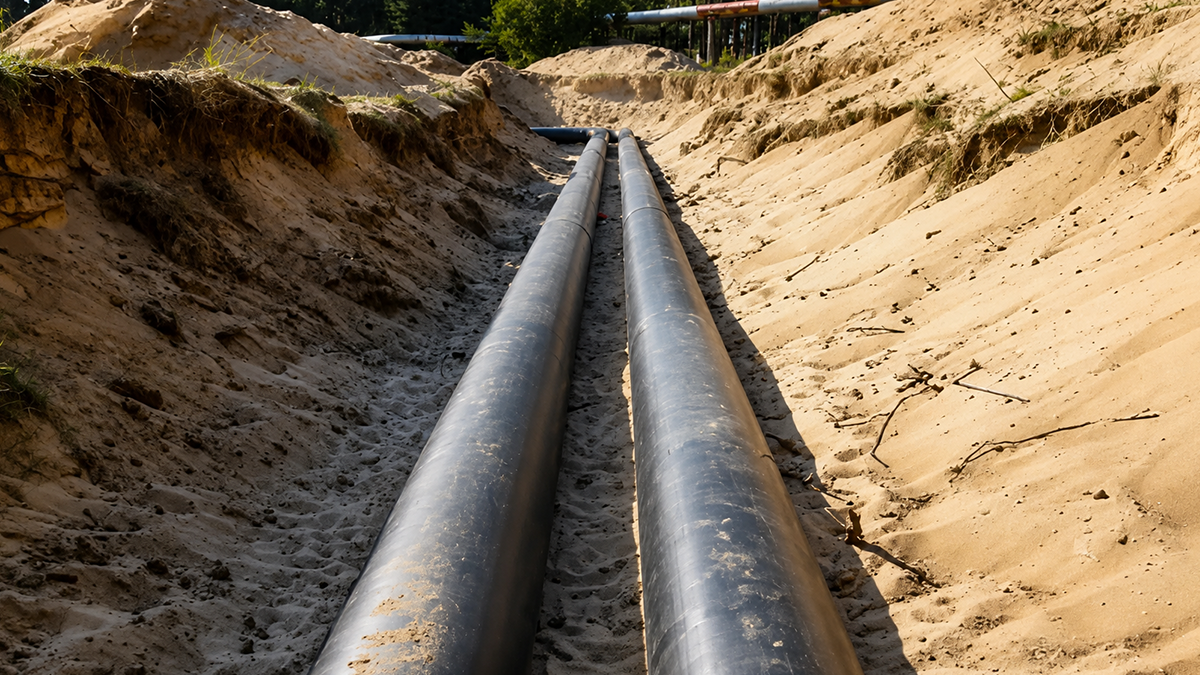
HDPE Pipe for Sewerage helps project buyers compare pipe types, specifications, installation factors, costs, and supplier criteria for reliable underground sewerage and drainage pipeline selection.
High-Density Polyethylene (HDPE) sewerage pipe is a resilient thermoplastic conduit crafted from petroleum-based resin. Manufacturers engineer these HDPE pipes specifically to handle underground wastewater, stormwater, and harsh industrial effluents. Thanks to its natural resistance to chemical corrosion and structural stress, HDPE delivers a highly durable, leak-proof alternative to the rigid materials typically found in municipal and industrial networks.
To properly evaluate this material, several key engineering terms must be defined:
Underground sewerage networks present highly aggressive environments. Pipeline infrastructure faces constant threats from chemical attacks, shifting soils, and crushing surface loads. Project managers and civil engineers consistently select HDPE sewer pipe because its unique material properties directly counteract these common failure points.
Zero Corrosion Risk
Unlike traditional concrete or ductile iron, HDPE refuses to rust, rot, or break down when exposed to harsh chemicals. It boasts 100% resistance to hydrogen sulfide (H2S) gas. In older concrete sanitary sewers, H2S is the primary culprit behind severe crown corrosion and eventual structural collapse. By eliminating this risk, HDPE drastically cuts maintenance costs and extends the system’s service life.
Leak-Free Monolithic Joints
Crews join solid wall HDPE using heat fusion—typically butt fusion or electrofusion. This technique melts the HDPE pipe ends together to form a seamless, monolithic pipeline. A fused system completely locks out groundwater infiltration, which can easily overload municipal treatment plants, while simultaneously preventing raw sewage from leaking out into the surrounding soil.
High Flexibility and Seismic Resilience
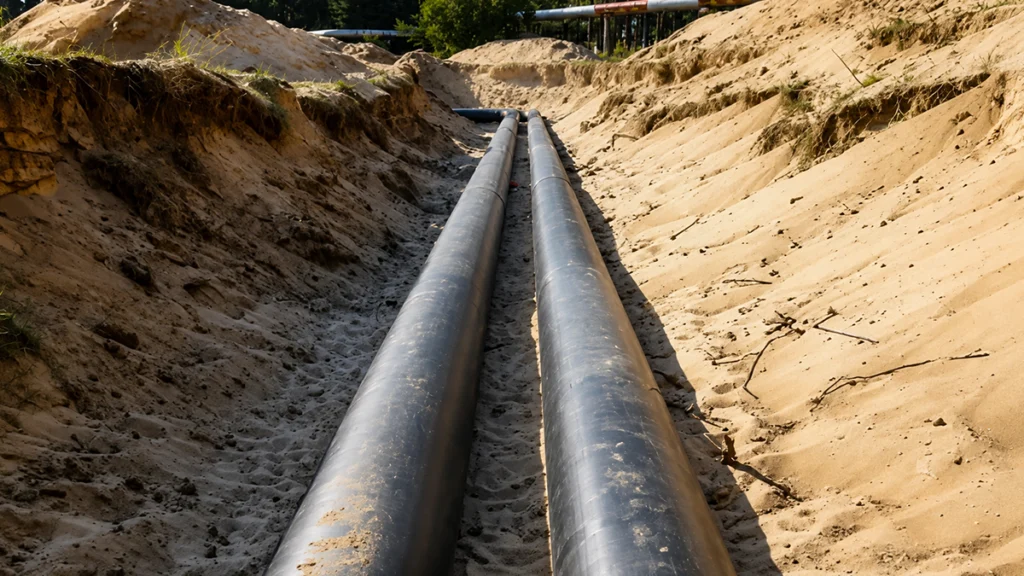
HDPE easily bends to accommodate uneven terrain, natural soil settlement, and even seismic activity without fracturing. This inherent flexibility minimizes the need for directional fittings. More importantly, it allows the HDPE pipeline to safely absorb ground movements that would quickly shatter rigid alternatives like PVC or concrete.
Superior Hydraulic Efficiency
The exceptionally smooth interior of an HDPE drainage pipe actively prevents scaling and biological buildup. High flow rates and low friction losses are maintained throughout the pipeline’s entire lifespan. Because of this hydraulic efficiency, engineers can sometimes downsize pipe diameters during the initial design phase without losing any flow capacity.
Extended Lifespan and Lightweight Installation
When operating under standard conditions, underground HDPE pipe reliably delivers a service life spanning 50 to 100 years. On top of that, it weighs roughly one-eighth as much as steel. Such a drastic weight reduction shrinks transportation costs, allows crews to use smaller lifting equipment, and significantly speeds up installation timelines.
Choosing the right HDPE pipe structure entirely depends on the system’s operational mechanics: does it run under internal pressure, or does it rely on gravity flow?
Solid Wall HDPE Pipe
Manufactured with a smooth interior and exterior, solid wall HDPE easily handles high internal pressure. This makes it a mandatory requirement for pressure sewers and force mains. Furthermore, it remains the only viable choice for trenchless installation methods like horizontal directional drilling (HDD), where the HDPE pipe must survive intense tensile pulling forces. However, it is rarely cost-effective for standard gravity drainage projects where internal pressure capabilities simply aren’t needed.
Double-Wall Corrugated (DWC) HDPE Pipe
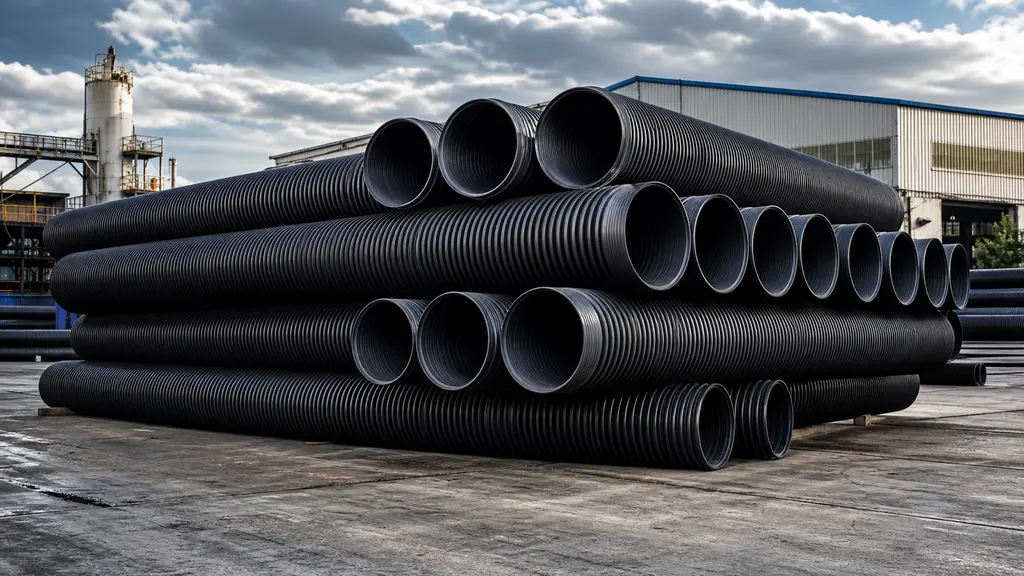
Engineers specify DWC HDPE pipe for gravity sewers and stormwater networks. The design features a smooth interior to ensure optimal hydraulic flow, paired with a corrugated exterior that provides massive structural strength against external soil loads. You will typically find it in stiffness classes like SN4 and SN8. DWC pipe is incredibly material-efficient and perfect for deep burials beneath heavy traffic, though it cannot be used in pressurized force mains.
Perforated HDPE Pipe
This variation consists of a corrugated HDPE drainage pipe manufactured with slotted perforations running along its length. It serves a highly specific purpose: subsurface water collection. Contractors use it extensively for agricultural field drainage and landfill leachate collection, where surrounding groundwater or toxic effluent must actively enter the pipeline for safe transport.
Procuring HDPE pipe for underground sewerage systems requires buyers to carefully evaluate specific technical parameters. This ensures the purchased material aligns perfectly with the project’s engineering demands.
Below is a comprehensive specification table outlining the manufacturing capabilities available through the JINQUAN factory:
| Specification Parameter | Technical Range / Options |
|---|---|
| Diameter Range | OD 20mm to 2250mm (DN20-DN22500) |
| Material Grades | PE80, PE100, PE4710 (high strength and pressure resistance grades available) |
| Pressure Ratings (PN) | PN4 to PN25 (depending on diameter, SDR, and material grade) |
| SDR Ratings (Solid Wall) | SDR7.4 to SDR41 (SDR11, SDR13.6, SDR17, and SDR17.6 widely used for water and utility applications) |
| Jointing Methods | Butt fusion, electrofusion, mechanical fittings, and flanged connections |
| Standard Lengths | 5.8m, 11.8m, 12m straight lengths, or coils for small diameters |
| Pressure Pipe Standards | ISO 4427, EN 12201, ASTM F714, ASTM D3035 |
| Corrugated Pipe Standards | ASTM F2306, AASHTO M252, AASHTO M294 |
Infrastructure engineers constantly weigh the benefits of HDPE against legacy materials. The final choice drastically impacts installation speed, long-term maintenance budgets, and overall system integrity.
| Material | Corrosion Resistance | Flexibility | Joint Integrity | Weight | Expected Lifespan | Typical Application |
|---|---|---|---|---|---|---|
| HDPE | Excellent (high resistance to H2S and chemical corrosion) | High (excellent flexibility and resistance to ground movement) | Leak-free fused joints (butt fusion/electrofusion) | Lightweight | 50+ years (depending on design conditions) | Sewer mains, force mains, corrosive environments, unstable soils |
| PVC | Excellent | Moderate to low (less flexible than HDPE) | Gasket or solvent joints (installation quality affects performance) | Lightweight | 50+ years | Residential drainage, gravity sewer systems, utility pipelines |
| Concrete | Low (susceptible to H2S corrosion without protection) | Low (requires stable soil support) | Gasket joints (performance depends on installation quality) | Very Heavy | 50+ years (depending on environment) | Large diameter stormwater and gravity sewer systems |
| Ductile Iron | Moderate (requires internal and external corrosion protection) | Low (limited flexibility compared with HDPE) | Gasket and flange connections | Heavy | 50+ years | High-pressure water mains, exposed and industrial pipelines |
HDPE Pipe vs PVC Pipe for Sewer Applications
HDPE offers significantly higher flexibility and better resistance to ground movement compared with PVC. While PVC is widely used for simple gravity sewer applications, its gasketed or solvent-welded joints require proper installation to maintain long-term performance. HDPE uses butt fusion or electrofusion joints, providing excellent leak resistance and making it a preferred choice for demanding municipal sewer and drainage projects.
HDPE Pipe vs Concrete Pipe for Sewer Systems
Concrete pipes provide excellent structural strength but are heavier and require more demanding installation equipment. In sanitary sewer environments, concrete may require additional protection against H2S-related corrosion. HDPE offers lightweight handling, high chemical resistance, and flexible fused joints, making it suitable for sewer systems installed in challenging ground conditions.
HDPE Pipe vs Ductile Iron Pipe for Underground Applications
Ductile iron provides high strength and is widely used for high-pressure water transmission systems. However, it requires appropriate corrosion protection depending on soil conditions and water chemistry. HDPE offers excellent corrosion resistance, lightweight installation, and flexible fused joints, reducing maintenance requirements in many underground applications.
Thanks to its versatility, HDPE is successfully deployed across a wide range of infrastructure sectors. Naturally, different scenarios demand specific HDPE pipe structures and technical specifications.
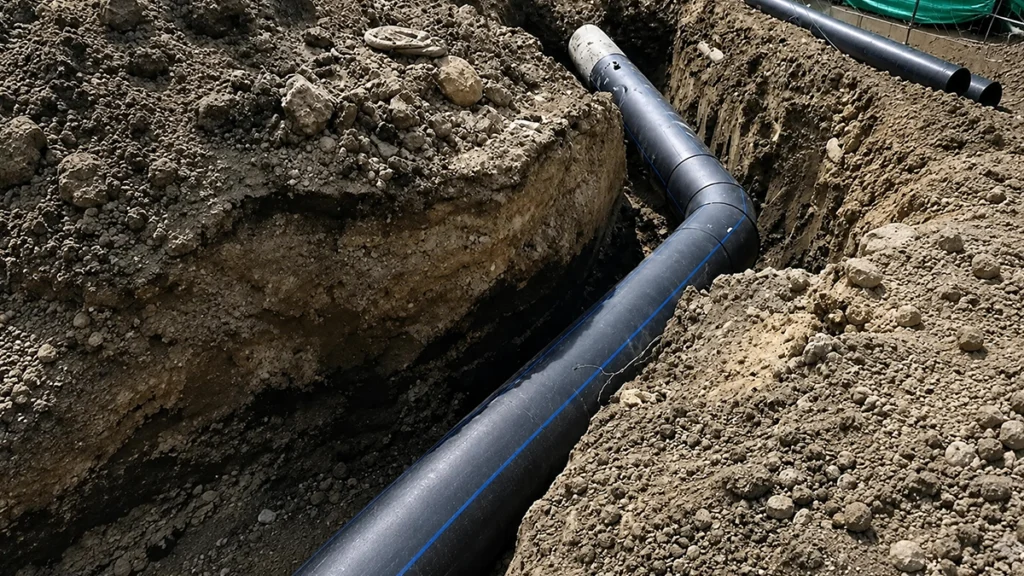
An underground sewerage system’s long-term success hinges just as much on strict adherence to installation standards as it does on the actual material quality.
1. Trenching
Trench width must provide ample space between the pipe’s outside diameter (OD) and the trench wall. This gap allows crews to properly compact the backfill material in strict accordance with standards like ASTM D2321.
2. Bedding
To prevent point-loading, HDPE pipe requires a stable, highly uniform bed. Suitable bedding materials include sand or Class I, II, or III granular soils. Crews must strictly avoid soils containing sharp, angular gravel or large cobbles, as these will gouge the pipe’s exterior under pressure.
3. Jointing
When working with solid wall pipes, fusion welding demands rigorous control over environmental conditions, temperature, and pressure using calibrated pipe welding machines. For DWC pipes relying on bell-and-spigot joints, contractors must use proper lubrication and precise alignment to ensure the elastomeric seals remain absolutely watertight.
4. Backfilling and Compaction
Because HDPE is inherently flexible, it relies heavily on the surrounding soil for long-term structural support. Final backfill—often consisting of cement-stabilized sand or flowable fill—must be compacted in even, consistent layers. This prevents the pipe from deflecting under the weight of surface traffic.
5. Testing and Inspection
Pressure sewers mandate hydrostatic pressure testing before crews fully close the trench. Conversely, gravity sewers require low-pressure air testing or water infiltration/exfiltration testing to verify that every joint maintains absolute integrity.
Procurement managers need a firm grasp on the variables driving HDPE sewer pipe pricing, as well as the criteria for qualifying a reliable manufacturing partner.
The volume of polyethylene resin required for a project heavily dictates the final price. This volume depends directly on the HDPE pipe diameter and the SDR (wall thickness) or SN rating. Furthermore, choosing between PE100 and PE80 resin grades, selecting the HDPE pipe structure (Solid versus DWC), and navigating global petroleum market trends will all cause final costs to fluctuate.
JINQUAN Factory Capabilities
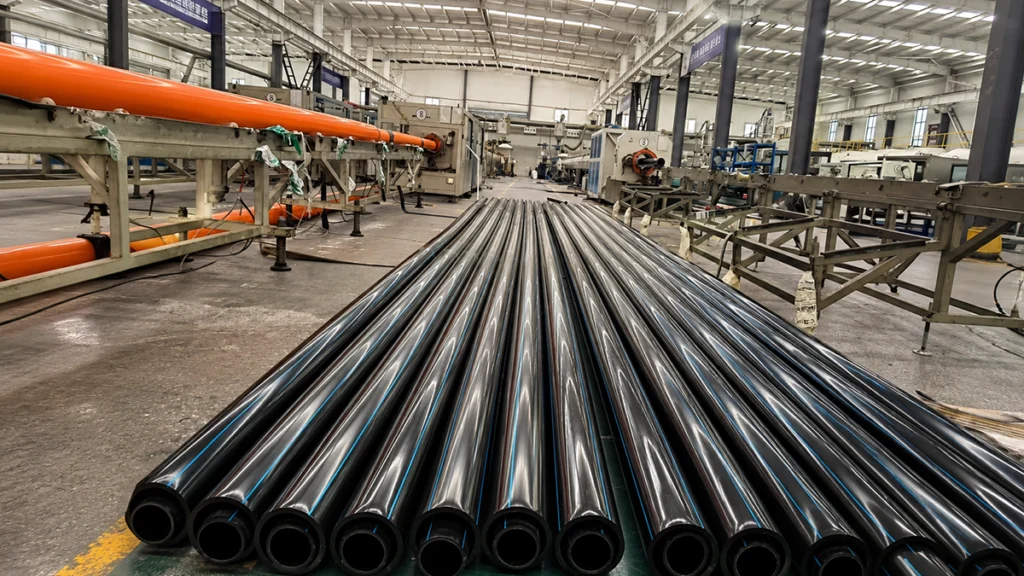
Operating as a primary manufacturer, JINQUAN runs a massive 200-acre facility equipped with over 40 high-speed pipe extrusion lines. This setup produces upwards of 100,000 tons of material annually. Such scale enables rapid production turnarounds, keeping standard lead times between 7 and 15 days. Sourcing directly from the factory guarantees optimized pricing, customized dimensional manufacturing, and secure export packaging for safe international transit.
Supplier Evaluation Checklist
When vetting an HDPE pipe supplier for major sewerage projects, procurement teams should always verify the following:
Nailing down the exact specifications for an underground HDPE pipeline demands a highly systematic engineering approach.
Step 1: Determine Flow Type
Start by identifying the system’s operational mechanics. If the pipeline is gravity-fed, specify Double-Wall Corrugated (DWC) pipe based on its required SN rating. If pumps will pressurize the system, specify Solid Wall pipe based on the necessary SDR/PN rating.
Step 2: Calculate Sizing
Determine the internal diameter required to comfortably meet the calculated flow capacity. From there, select the appropriate outside diameter (OD) sizing standard—such as Metric/ISO versus IPS/DIPS—to guarantee seamless compatibility with existing infrastructure and fittings.
Step 3: Assess External Loads
For underground gravity pipes, carefully evaluate the burial depth, native soil type, and anticipated surface traffic loads. These factors dictate the required Ring Stiffness. For instance, you would specify SN8 rather than SN4 for HDPE pipelines buried beneath areas experiencing heavy commercial traffic.
Step 4: Choose Jointing Method
Opt for butt fusion when dealing with high-pressure systems or environments that have a zero-leak tolerance, like chemical transport. Alternatively, select bell-and-spigot connections with elastomeric seals for faster, more cost-effective installations in standard municipal gravity sewers.
HDPE stands out as the optimal engineering solution for corrosive wastewater environments, regions plagued by unstable soils or seismic activity, and projects demanding trenchless installation methods. Its proven ability to deliver a 50+ year leak-free lifespan makes it the premier choice for upgrading municipal and industrial infrastructure.
That said, certain extreme scenarios still require rigorous engineering verification before final selection. You will need additional structural reviews and careful material selection for extreme high-pressure pumping stations, areas with heavy hydrocarbon ground contamination (which can permeate standard polyethylene), or incredibly shallow burials under heavy dynamic traffic loads. In those highly specific edge cases, traditional rigid HDPE pipes might still be necessary to bear the immediate physical force.
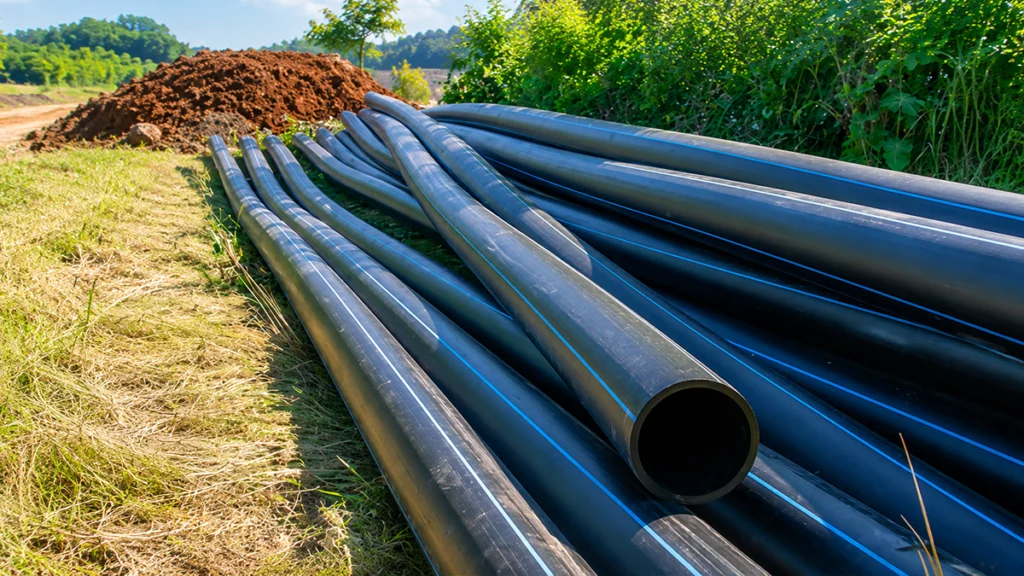
Yes. HDPE pipe is widely used for underground sewer systems because of its excellent resistance to H2S and chemical corrosion commonly found in wastewater environments. Its flexibility helps accommodate soil movement and ground settlement without cracking. Butt fusion and electrofusion joints provide strong leak-resistant connections, helping reduce the risk of groundwater infiltration and sewage leakage.
Solid wall HDPE pipe features a smooth inner and outer wall and is commonly used for pressure sewer systems, force mains, and applications requiring high-pressure performance. Double-wall corrugated (DWC) HDPE pipe uses a corrugated outer wall to achieve high ring stiffness against soil loads while maintaining a smooth inner wall for efficient gravity flow. DWC HDPE is a cost-effective solution for non-pressure drainage and stormwater applications.
Under normal operating conditions, HDPE sewer pipe can achieve a service life of 50 years or more. Its long-term durability comes from excellent resistance to corrosion, chemicals, biological attack, and abrasion commonly found in wastewater environments. Proper material selection, installation, and operating conditions can further extend pipeline service life.
HDPE offers advantages over PVC in flexibility, resistance to ground movement, and joint reliability. While PVC is widely used for gravity sewer systems, its gasketed or solvent-welded joints require proper installation to maintain long-term performance. HDPE uses butt fusion or electrofusion joints, providing strong leak-resistant connections for demanding sewer and drainage projects.
The required rating depends on whether the system is a pressure sewer or gravity drainage application. Pressure sewer pipelines commonly use SDR11 or SDR17 based on required pressure ratings, while gravity drainage systems are usually specified by Ring Stiffness (SN) ratings such as SN4 or SN8. The correct selection depends on pipe diameter, burial depth, soil conditions, and expected loading.
Yes. HDPE pipe can be used for both stormwater and wastewater applications. Large-diameter DWC HDPE pipe is commonly selected for stormwater drainage because of its high flow capacity and structural strength. Solid wall HDPE or specially designed DWC systems are used for sanitary wastewater pipelines due to their excellent resistance to corrosive gases and chemicals found in sewage environments.
To receive an accurate quotation, buyers should provide the required outside diameter (OD) or nominal diameter (DN), SDR or Ring Stiffness (SN) rating, material grade (PE80, PE100, or PE4710), project quantity, preferred joining method, and required standards such as ISO 4427 or EN 12201.
HDPE sewer pipes should comply with relevant international standards based on the application. Pressure sewer pipes commonly follow ISO 4427, EN 12201, or ASTM F714 standards. Corrugated drainage pipes typically follow EN 13476, ASTM F2306, or AASHTO M252/M294 requirements. Manufacturers should also maintain quality management systems such as ISO 9001 and environmental management certification such as ISO 14001.
Selecting the right HDPE pipe for a sewerage project requires careful evaluation of site conditions, pipeline requirements, and installation methods. The process starts by understanding the difference between gravity drainage systems and pressurized force mains. By choosing the appropriate pipe structure—whether solid wall or double-wall corrugated—and matching the required Ring Stiffness (SN) or Standard Dimension Ratio (SDR), engineers can achieve reliable long-term performance under soil loads and operating pressure.
Using suitable materials such as PE80, PE100, or PE4710, together with proper joining methods, helps create durable and leak-resistant pipeline systems for wastewater and drainage applications. Working with an experienced HDPE pipe manufacturer also helps ensure consistent quality, reliable supply, and compliance with relevant international standards.