Address
Zhengzhou, Henan, China
Work Hours
Monday to Friday: 7AM - 7PM
Weekend: 10AM - 5PM
Address
Zhengzhou, Henan, China
Work Hours
Monday to Friday: 7AM - 7PM
Weekend: 10AM - 5PM

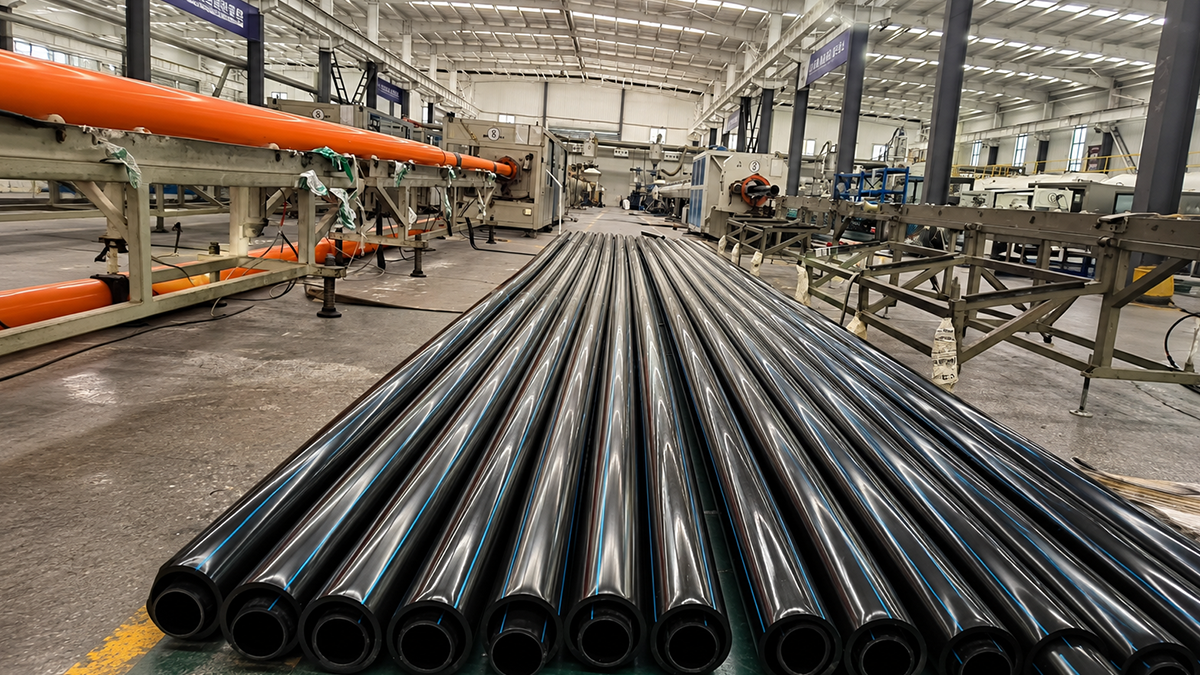
HDPE pipe price depends on PE100 resin, diameter, SDR, pressure rating, fittings, freight, MOQ, and certification needs. This guide helps buyers compare quotes and estimate total project cost.
Extrusion weight ultimately dictates the baseline cost of any high-density polyethylene (HDPE) pipe. If you are handling commercial or industrial B2B procurement, expect finished products to fall somewhere between $1.50 and $2.50 per kilogram. This per-kilo figure bakes in the base PE100 resin expense, factory margins, and everyday manufacturing overhead.
Switch that to a per-meter perspective, and the price jumps exponentially alongside diameter and wall thickness. Based on current petrochemical benchmarks—where virgin PE100 resin hovers around $1,050 to $1,125 per metric ton—you can estimate per-meter baseline pricing like this:
The global market for these materials is massive, on track to hit $39.6 billion by 2032. Consequently, raw material availability heavily influences day-to-day pricing. Grasping this per-kilogram baseline gives procurement teams a solid anchor when evaluating supplier quotes.
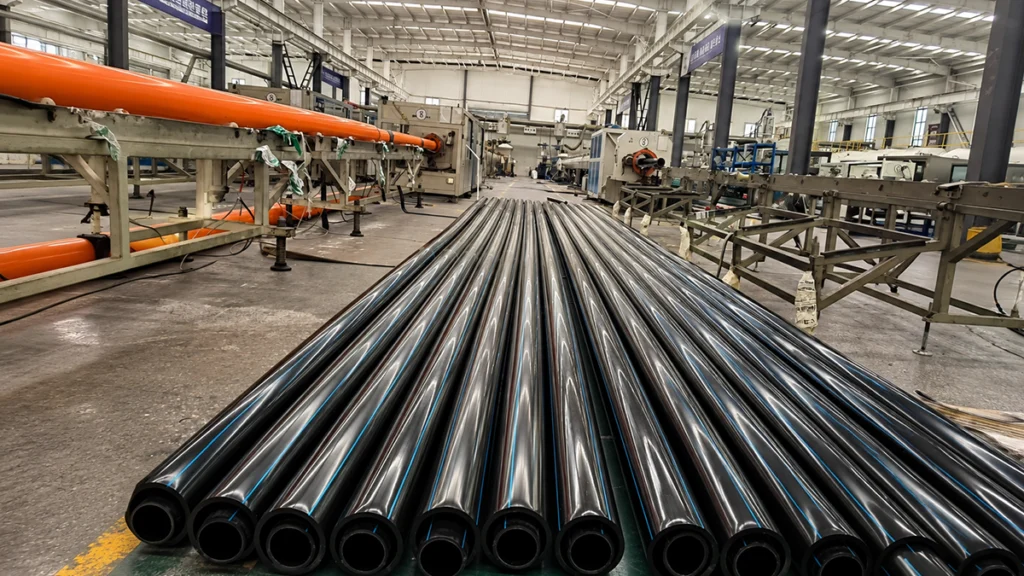
Procurement managers sizing up project budgets must juggle a variety of manufacturing and supply chain variables. Quotation unit prices are never pulled out of thin air. Instead, they mathematically reflect raw material inputs and production scale.
Resin Grade and Purity
Raw material eats up 70% to 80% of total manufacturing expenses. High-pressure systems and potable water networks demand 100% virgin PE100 resin—it is non-negotiable. While recycled blends slash upfront HDPE pipe costs, they severely weaken structural integrity and will instantly fail ISO 4427 certification tests.
Weight per Meter
Here lies the ultimate PE100 pipe cost driver. Heavier HDPE pipe profiles demand more plastic per meter. Two pipes sharing the exact same outer diameter will carry vastly different price tags if their wall thicknesses differ.
Manufacturing Scale and Supply Chain
Buying straight from a primary manufacturer bypasses steep distributor markups. Facilities that leverage massive economies of scale—like JINQUAN’s 200-acre plant churning out 100,000+ tons across 40+ extrusion lines—can effectively absorb overhead. The result? A much lower per-kilogram extrusion fee for the buyer.
HDPE Pipe Pricing Parameter Table
| Cost Factor | Impact on Pricing |
|---|---|
| Diameter (DN/OD) | Larger diameters require exponentially more resin, increasing the per-meter price. |
| SDR / PN Rating | Lower SDR means a thicker wall and higher pressure capability, driving up material weight and cost. |
| Resin Quality | 100% virgin PE100 commands a premium over PE80 or mixed-regrind materials. |
| Certifications | ISO 4427, CE, and SGS certified pipes incur strict quality control and testing costs. |
| Order Volume (MOQ) | Bulk container orders reduce the amortized setup and calibration costs per meter. |
Grasping how Standard Dimension Ratio (SDR) interacts with pressure rating (PN) is essential for mapping out costs.
The math is simple: SDR = Outside Diameter (OD) ÷ Wall Thickness.
The golden rule of procurement here is that a lower SDR equals a thicker wall. Thicker walls mean higher pressure tolerance and, naturally, a steeper price per meter. To see the real-world financial impact, look at a standard 110mm PE100 pipe:
The SDR 11 version eats up roughly 50% more plastic per meter. Even with matching outside diameters, the SDR 11 HDPE pipe costs proportionally more. A 63mm SDR 11 pipe handles the exact same internal working pressure as a 315mm SDR 11 pipe. Yet, as you scale up the diameter, the sheer volume of resin needed to maintain that 11-to-1 ratio causes the price to skyrocket.
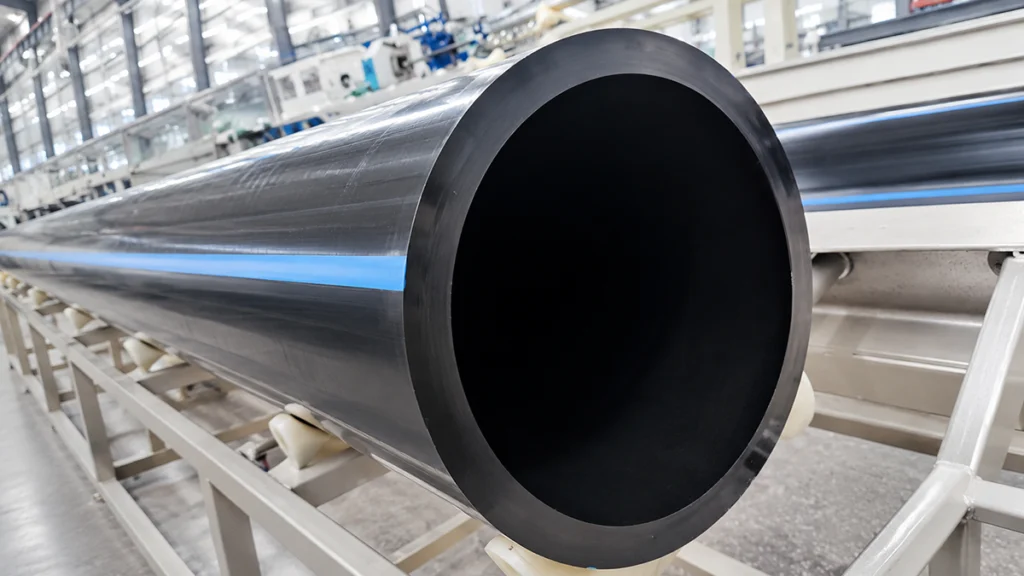
Specifications change wildly across industries. An agricultural irrigation setup will have a completely different cost profile than a municipal water grid.
Municipal Water Supply
Drinking water networks require 100% virgin PE100 resin, strict adherence to ISO 4427, and pressure ratings usually sitting between PN10 and PN16. Because of rigorous health and safety benchmarks, these materials occupy a mid-to-high pricing tier.
Mining and Slurry Transport
Mining environments punish infrastructure. Operators need extreme abrasion resistance and massive pressure handling, often relying on thick-walled SDR 9 or SDR 11 configurations. The sheer weight of the plastic makes mining pipes the most expensive per meter on the market.
Agricultural Irrigation
Farm networks generally run at lower pressures. Designers can confidently specify PE80 or PE100 resins at SDR 21 or SDR 26 (PN6 – PN8). Thinner walls slash the material weight, which drives down the per-meter cost across sprawling agricultural acreage.
Underground Cable Protection
Burying non-pressure electrical or telecom lines doesn’t require heavy-duty pressure HDPE pipes. That would be an expensive over-specification. Instead, contractors favor (DN100-355mm) or Double-Wall Corrugated (DWC) variants (SN4/SN8). These options deliver optimal ring stiffness without the hefty resin price tag.
Staring at a supplier’s price list only covers step one of project budgeting. Real-world procurement and installation demand a broader financial view.
Fittings and Joints
Every HDPE pipeline needs butt fusion, electrofusion, socket fusion, or PP compression fittings. Electrofusion fittings might cost more upfront than fabricated butt fusion alternatives, but they require less bulky machinery and save crucial labor hours in cramped trenches.
Welding Equipment and Labor
Fusing seamless joints takes specialized machinery. In Western markets, certified fusion operators command roughly $75.00 per hour. Buying welding machines directly alongside your HDPE pipe shipment guarantees dimensional compatibility and streamlines site operations.
Earthworks and Trenching
Moving dirt often costs more than the plastic going into it. Depending on soil conditions, trenching runs between $15 and $35 per meter. A USDA benchmark for standard HDPE irrigation pipe showed that while materials hit about $10.76/ft, equipment and installation tacked on $1.28/ft, and direct labor added another $0.45/ft.
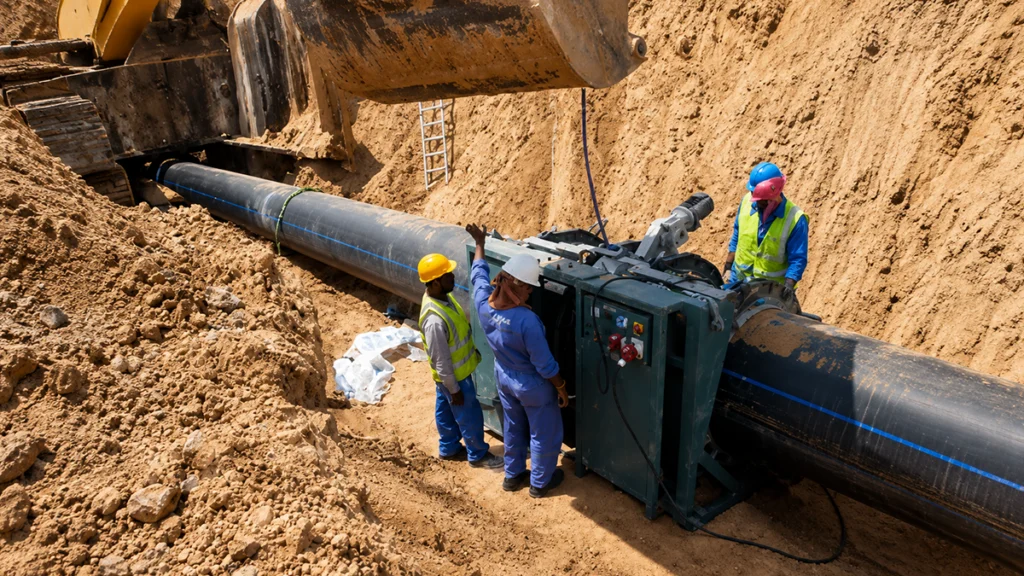
Choosing the right material dictates your upfront capital spend and your long-term lifecycle costs.
PE80 vs PE100 Cost Dynamics
Virgin PE100 resin carries a slight premium over PE80—usually 1% to 2% higher per metric ton. However, PE100 boasts higher density and a superior minimum required strength (MRS). Engineers can specify thinner walls while hitting the exact same pressure rating. As a result, a PE100 pipe often ends up cheaper per meter than PE80 simply because it uses less material to achieve the same performance.
HDPE vs PVC Price Dynamics
Standard PVC pipe usually wins the upfront per-meter price war. Yet, HDPE dominates total lifecycle value. Its inherent flexibility means it can be coiled, erasing the need for frequent joints. It skips chemical glues entirely, handles seismic shifting beautifully, and stops crack propagation in its tracks. All of this slashes installation labor and virtually eliminates future maintenance bills.
Material Comparison Matrix
| Feature | PE100 HDPE | Standard PVC |
|---|---|---|
| Upfront Cost per Meter | Moderate to High | Low to Moderate |
| Installation Labor Cost | Low (coiling, fusion welding) | High (frequent joints, gluing) |
| Flexibility / Coiling | Excellent (DN16-110mm can coil) | Rigid (straight lengths only) |
| Joint Integrity | Monolithic (fusion joints) | Vulnerable (glued/gasket joints) |
| Best Applications | High pressure, underground, shifting soils | Low pressure, static indoor plumbing |
Dissecting a supplier quote takes a sharp eye for engineering parameters. You must verify you are comparing apples to apples.
Mandatory Quote Checklist
Every document crossing your desk must feature these data points:
1. Outer Diameter (OD): Always in millimeters (e.g., DN160).
2. SDR and PN Rating: The precise dimension ratio and pressure class (e.g., SDR11 / PN16).
3. Material Grade: Must explicitly declare 100% virgin PE100.
4. Weight per Meter (kg/m): This is your most vital metric. It proves the supplier isn’t thinning out the walls to offer a deceptively cheap product.
5. Manufacturing Standard: Clear compliance with ISO 4427, DIN 8077/8078, or EN 12201.
Identifying Red Flags
Toss out quotes that use vague language like “HDPE Pipe 4-inch” without listing the SDR, resin grade, or exact kg/m weight. If a vendor hides test reports or refuses to state the weight per meter, they are likely cutting corners on the factory floor.
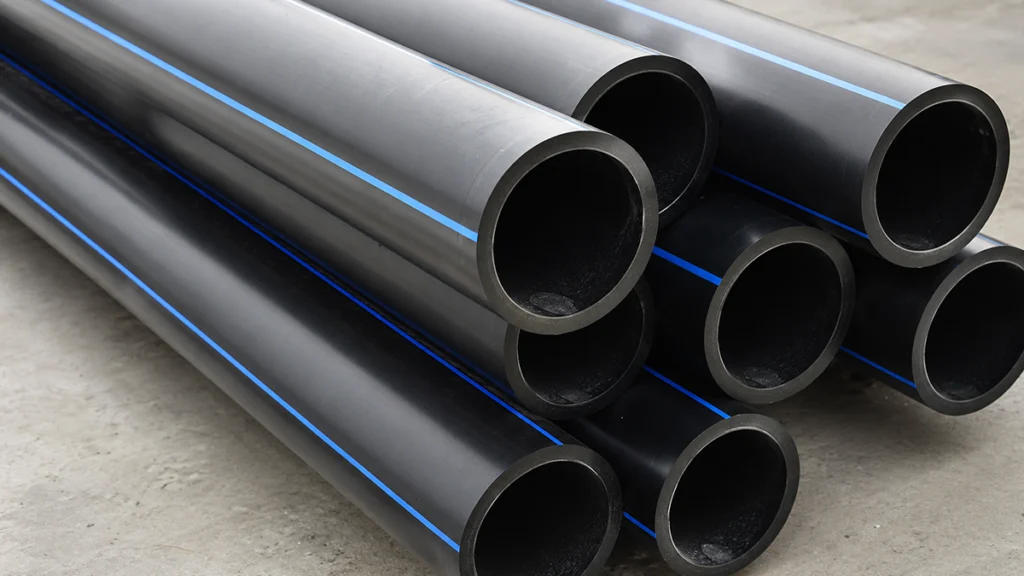
Sourcing internationally adds logistics variables that hit your landed costs directly.
Shipping Lengths and Container Optimization
To squeeze maximum value out of ocean freight, factories cut straight HDPE pipes to fit shipping containers perfectly. Standard lengths hit 5.8 meters for 20-foot containers, or 11.8 meters to pack out 40-foot High Cube (HQ) units.
Coiling for Small Diameters
For sizes between DN16 and DN110, extrusion lines can spool continuous coils of 50m, 100m, or 200m. Coiling shrinks the shipping footprint and speeds up trench work since crews aren’t fusing joints every 12 meters.
Production Lead Times
Factory bandwidth controls your project timeline. runs over 40 high-speed extrusion lines, turning around standard export orders in a brisk 7 to 15 days. This keeps tight schedules on track without triggering emergency rush fees.
Smart value engineering lets buyers trim budgets without settling for garbage materials.
Right-Size the SDR
Overkill wastes money. If your municipal grid tops out at 8 bar, ordering SDR 11 (16 bar) HDPE pipe burns 50% more plastic than you need. Dropping to a properly calculated SDR 17 (10 bar) HDPE pipe satisfies the engineering specs while carving out massive material savings.
Implement Pipe Nesting
When booking international freight, instruct the factory to “nest” the shipment. They will slide smaller HDPE pipes inside larger ones—think a 110mm HDPE pipe tucked into a 160mm HDPE pipe. This tactic optimizes shipping volume, driving down the freight cost per meter.
Adopt Factory-Direct Sourcing
Cut out regional distributors and trading houses. Going straight to the primary manufacturer sheds 20% to 40% in middleman markups. You pay strictly for resin, machine time, and logistics.
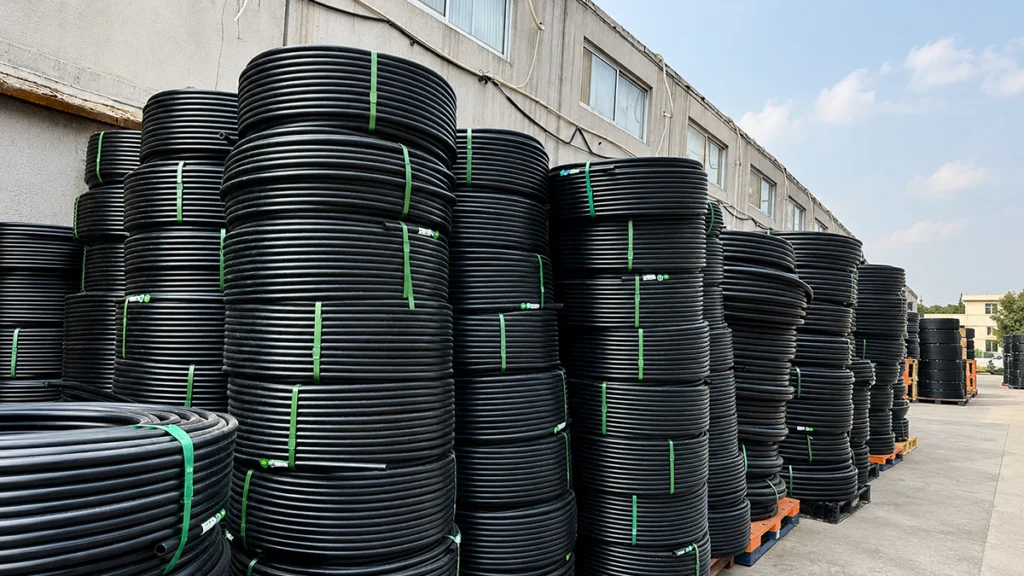
Securing top-tier materials means looking past the spreadsheet and vetting the manufacturer’s technical chops.
Always demand hard proof of ISO 9001, CE, and SGS certifications. These documents validate resin purity and dimensional precision. Before signing off on bulk container volumes, request physical samples. Use them to independently check wall thickness, concentricity, and the smoothness of the interior bore.
Lastly, embrace total system procurement. Buying your HDPE pipes, fittings, and welding machines from a single source guarantees dimensional harmony across the entire network. Plus, bundling the order gives you serious leverage to negotiate a better blended project rate.
Q1: How much does HDPE pipe cost per meter?
Prices generally run $0.50 to $2.00 per meter for smaller profiles (DN20-DN50) and $2.00 to $10.00 for medium sizes (DN63-DN160). Massive diameter HDPE pipes are priced entirely by weight, hovering between $1.50 and $2.50 per kilogram of finished product. Ultimate costs hinge on your required wall thickness and pressure class.
Q2: Why is PE100 pipe more expensive than some other plastic pipes?
PE100 relies on high-density, high-purity virgin resin engineered for extreme pressure retention, crack resistance, and a 50+ year lifespan. While standard PVC might beat it on upfront per-meter pricing, PE100 needs fewer joints, zero chemical glues, and barely any maintenance. That makes the long-term lifecycle cost far cheaper.
Q3: What information is needed to get an accurate HDPE pipe quotation?
To get a reliable quote, hand the vendor the precise outer diameter (OD in mm), the target Standard Dimension Ratio (SDR) or pressure rating (PN), the intended application (like mining or potable water), total order volume, and your preferred delivery format (coiled or straight lengths).
Q4: Does SDR affect HDPE pipe price?
Absolutely. SDR directly controls the price tag. A lower SDR means a thicker wall and a higher pressure threshold. Because thicker walls consume more plastic per meter, an SDR 11 HDPE pipe will command a much higher price than an SDR 17 PE pipe of the exact same diameter.
Q5: Is HDPE pipe cheaper than PVC pipe for water supply projects?
Upfront, HDPE usually costs more per meter than PVC. However, HDPE’s flexibility reduces the need for fittings and utilizes monolithic fusion joints rather than weak glued connections. The resulting drop in installation labor and future maintenance makes HDPE the cheaper option over the lifespan of the project.
Q6: How do freight and packaging affect HDPE pipe cost?
HDPE Pipes consume massive amounts of space, so ocean freight heavily dictates landed costs. Buyers can slash shipping bills by requesting standard lengths (5.8m or 11.8m) to fill containers perfectly, coiling smaller diameters, or nesting HDPE pipes inside one another to maximize volumetric efficiency.
Q7: What are the risks of buying very low-priced HDPE pipe?
Rock-bottom prices usually mean the factory is mixing in recycled regrind plastic instead of pure virgin PE100. This wrecks pressure ratings and violates drinking water safety standards. Shady suppliers might also thin out the walls, resulting in HDPE pipelines that burst under normal operational stress.
Q8: How can I reduce HDPE pipe project cost without lowering quality?
Trim budgets by right-sizing the SDR so you aren’t paying for unnecessary pressure capacity. Use HDPE pipe nesting to shrink international freight bills, and buy directly from the manufacturer to kill distributor markups. Bundling your HDPE pipes, fittings, and fusion machines into one order also unlocks better pricing.
Pinning down accurate HDPE pipeline procurement costs demands a deeper look than just skimming a per-meter price tag. The real financial weight of an order stems from PE100 resin purity, the specific SDR needed for your operational pressure, and the logistical strategy behind shipping straight lengths versus nested or coiled formats. By auditing the weight per meter on vendor quotes and matching specifications tightly to your project—be it agricultural irrigation, mining slurry, or municipal water—procurement teams can fiercely protect capital expenditure. Holding the line on ISO certifications and factory-direct sourcing guarantees that any budget savings come from supply chain efficiency, not compromised materials.