Address
Zhengzhou, Henan, China
Work Hours
Monday to Friday: 7AM - 7PM
Weekend: 10AM - 5PM
Address
Zhengzhou, Henan, China
Work Hours
Monday to Friday: 7AM - 7PM
Weekend: 10AM - 5PM

When selecting plastic piping, it’s crucial to understand that not all HDPE is created equal. The terms PE100 and HDPE are often confused, but they represent different classifications: one is a material type, and the other is a critical performance grade. Making the right choice is essential for ensuring the safety, efficiency, and longevity of your pipeline infrastructure.
This article will demystify the relationship between PE100 and HDPE. We will explore the technical differences in density and performance ratings, compare PE100 with its predecessor PE80, and explain why PE100 is the superior choice for high-pressure industrial applications, all while highlighting its impressive 50-year lifespan.
In the world of plastic piping, the terms HDPE and PE100 are often used, sometimes interchangeably, leading to confusion. However, they refer to different classifications. High-Density Polyethylene (HDPE) describes the material itself—a thermoplastic polymer known for its high strength-to-density ratio. The “high density” aspect points to its molecular structure, which gives it superior rigidity and chemical resistance compared to lower-density variants.
On the other hand, PE100 is a performance grade. The “PE” stands for Polyethylene, and “100” signifies its Minimum Required Strength (MRS) of 10 MPa (megapascals), as defined by ISO 4427. This rating is a crucial indicator of the material’s long-term hydrostatic strength at 20°C over 50 years. Therefore, a PE100 pipe is a type of HDPE pipe qwsdfghjengineered to meet this high-performance benchmark, offering enhanced durability and pressure-handling capabilities. Understanding this distinction is the first step in selecting the right material for demanding applications.
While all PE100 pipes are made from HDPE, not all HDPE pipes meet the PE100 classification. Lower grades like PE80 (with an MRS of 8 MPa) also exist, serving different needs. The choice depends entirely on the project’s performance requirements, such as operating pressure, environmental stress, and desired service life.
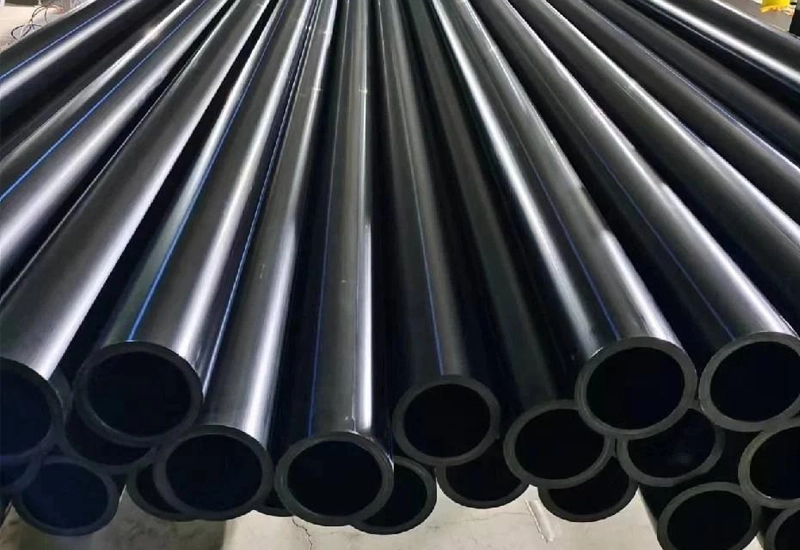
The superior strength of PE100 makes it an ideal material for a wide array of industrial applications where reliability is non-negotiable. Its 10 MPa MRS translates directly to enhanced resistance against internal pressure, external loads, and environmental stress cracking. This makes PE100 an excellent choice for large-diameter pipelines, such as those used in municipal water distribution and wastewater management. A high-quality HDPE water pipe made from PE100 material ensures a leak-free system, preserving precious resources and protecting the environment.
In demanding sectors like mining and chemical processing, PE100’s robustness is a significant advantage. It can safely transport abrasive slurries and corrosive chemicals without degrading, a common failure point for traditional materials like steel or ductile iron. According to industry data, PE100 exhibits exceptional resistance to a wide range of chemicals, as outlined in ISO/TR 10358. Furthermore, its inherent toughness provides high resistance to slow crack growth (SCG), a critical factor for ensuring long-term pipeline integrity under sustained pressure. This resilience minimizes the need for maintenance and reduces the total cost of ownership over the pipeline’s lifespan.
This combination of high strength, chemical inertness, and durability positions PE100 as a premier material for critical infrastructure projects, offering engineers and contractors peace of mind and unparalleled performance.
When it comes to high-pressure systems, material selection is critical to ensuring operational safety and efficiency. PE100 stands out as the preferred choice due to its exceptional hydrostatic strength. Because PE100 has a higher MRS than lower grades like PE80, engineers can design pipelines with a thinner wall for the same pressure rating (PN). This not only reduces material consumption, making the pipe lighter and more cost-effective, but also increases the internal bore for a given external diameter, thereby improving flow capacity.
The different polyethylene pipe grades are classified based on their long-term strength, and PE100’s superiority is evident in its pressure handling. For instance, in a Standard Dimension Ratio (SDR) 11 pipe, a PE100 system can operate at a pressure of 16 bar (PN16), whereas a PE80 system is limited to 12.5 bar (PN12.5). This higher pressure rating makes PE100 indispensable for applications such as high-pressure water mains, gas distribution networks, and industrial process piping. Its ability to withstand pressure surges and resist fatigue ensures a reliable, long-lasting infrastructure with minimal risk of failure.
Ultimately, the selection of PE100 for high-pressure applications is a decision rooted in engineering principles that prioritize safety, cost-efficiency, and long-term performance.
The choice between PE80 and PE100 hinges on the specific demands of a project, including pressure requirements, installation conditions, and budget. The primary distinction in the PE100 vs HDPE grade debate lies in their Minimum Required Strength (MRS). PE80 has an MRS of 8.0 MPa, while PE100 is rated at 10.0 MPa. This 25% increase in strength allows PE100 pipes to offer significant advantages in many scenarios, but that doesn’t make PE80 obsolete. For low-pressure applications or smaller-diameter pipes, PE80 remains a perfectly suitable and more economical choice.
When making a selection, consider the operating pressure. If a project requires a PN16 rating, using PE100 allows for a thinner-walled pipe (SDR11) compared to the thicker wall a PE80 pipe would need (SDR9), making installation easier and potentially reducing costs on larger projects. Conversely, for a gravity-fed irrigation system or a low-pressure drainage line, the higher strength of PE100 may be unnecessary, and the cost savings of using PE80 could be substantial.
Ultimately, a thorough analysis of the system’s hydraulic design and budget will guide the best choice. Consulting with a knowledgeable supplier who can provide a range of butt fusion HDPE pipe fittings and pipes in both grades ensures a tailored solution that optimizes both performance and cost.
One of the most compelling reasons to choose HDPE for piping systems is its remarkable longevity. Pipes made from high density polyethylene are engineered for a service life of 50 years and, in many cases, can last up to 100 years under optimal conditions. This durability is not just a claim; it is backed by decades of real-world performance and rigorous testing protocols like those outlined in ASTM D2837, which determines the long-term hydrostatic strength of thermoplastic materials.
This extended lifespan is attributed to several key properties of HDPE. First, it is completely resistant to corrosion, rust, and tuberculation, the internal buildup that plagues metallic pipes and reduces flow over time. Second, its chemical resistance means it won’t degrade when exposed to aggressive soils or the vast majority of chemicals transported within. Finally, its flexibility and the use of fused joints create a monolithic, leak-free system that is resilient to ground movement, vibrations, and freeze-thaw cycles. This resilience ensures that the pipeline maintains its structural integrity and performance characteristics for decades.
Investing in an HDPE piping system is an investment in future-proof infrastructure. Its proven 50-year design life minimizes replacement costs, reduces service interruptions, and provides a sustainable solution that conserves resources by preventing leaks.
In conclusion, while PE100 is a type of HDPE, the two terms are not synonymous. HDPE refers to the base material—High-Density Polyethylene—while PE100 is a high-performance grade defined by its Minimum Required Strength of 10 MPa. This superior strength allows PE100 pipes to handle higher pressures, enabling thinner walls, improved flow rates, and greater cost-efficiency for demanding applications. The choice between PE100 and a lower grade like PE80 depends entirely on the project’s specific requirements, especially the pipe pressure rating.
Understanding these distinctions empowers procurement specialists, contractors, and engineers to make informed decisions that optimize for both performance and budget. For high-pressure water and gas distribution, industrial processing, and large-scale infrastructure, PE100 is the clear engineering choice. For less demanding roles, PE80 remains a viable and economical option.
At our factory, we specialize in manufacturing a comprehensive range of HDPE pipes and fittings in both PE80 and PE100 grades, adhering strictly to international standards like ISO 4427. Whether you require a large-diameter pipeline for a municipal project or custom-fabricated fittings, our team has the expertise to deliver a reliable, high-quality solution tailored to your needs. We are committed to helping you select the right materials to ensure the long-term success of your project.