Address
Zhengzhou, Henan, China
Work Hours
Monday to Friday: 7AM - 7PM
Weekend: 10AM - 5PM
Address
Zhengzhou, Henan, China
Work Hours
Monday to Friday: 7AM - 7PM
Weekend: 10AM - 5PM


In today’s infrastructure development, finding a safe and durable piping solution is crucial. HDPE pipe fittings have become the core choice for modern water supply, drainage, gas, and industrial fluid transportation systems due to their exceptional corrosion resistance, extended service life, and high safety standards. As a professional HDPE pipe fittings manufacturer, Jinquan is committed to providing comprehensive solutions covering multiple connection methods and specifications to meet stringent engineering requirements across diverse scenarios. Jinquan deliver reliable, efficient, and enduring pipeline system support for various infrastructure construction projects.
HDPE pipe fittings refer to pipe connectors manufactured from high-density polyethylene, serving as critical junctions within fluid transportation networks. In terms of production processes, standard and complex HDPE pipe fittings primarily rely on injection molding to ensure dimensional accuracy, while large-diameter HDPE fittings are predominantly fabricated through welding. These two processes collectively guarantee the high quality and reliability of HDPE pipes and fittings. The core function of HDPE fittings is to integrate individual HDPE pipes into a complete and efficient delivery system by altering flow direction, performing branch connections, adjusting pipe diameter, and connecting terminal equipment. They are widely applied in various engineering projects.
Based on connection methods, HDPE pipe fittings can be categorized as follows:
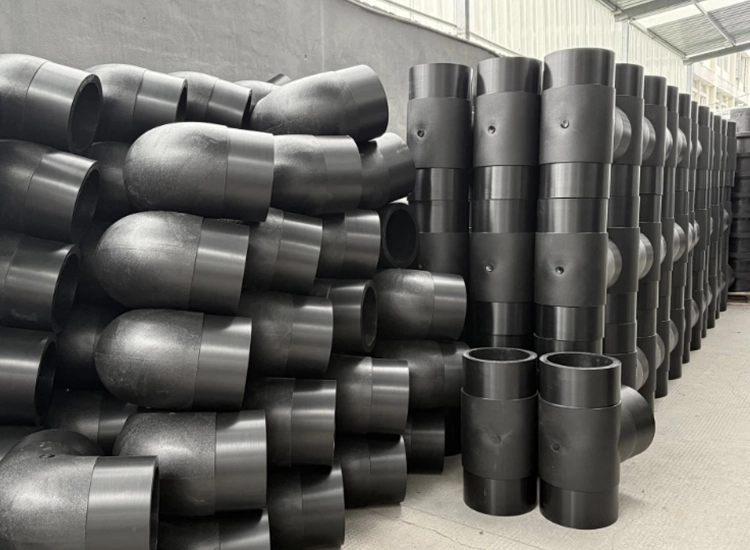
Butt fusion fittings are HDPE pipe fittings specifically designed for HDPE piping systems. They are joined by simultaneously heating the ends of HDPE pipes and fittings and applying pressure during butt fusion welding to form a seamless bond. The welded joint achieves strength comparable to the pipe material itself, offering corrosion resistance and leak prevention. These fittings are suitable for medium-to-high pressure fluid conveyance projects.
Common Butt Fusion Fittings Types: elbow, tee, reducer, cross tee, flange, end cap, and others. These fittings accommodate changes in pipeline direction, branching, diameter transitions, and connections to valve equipment.
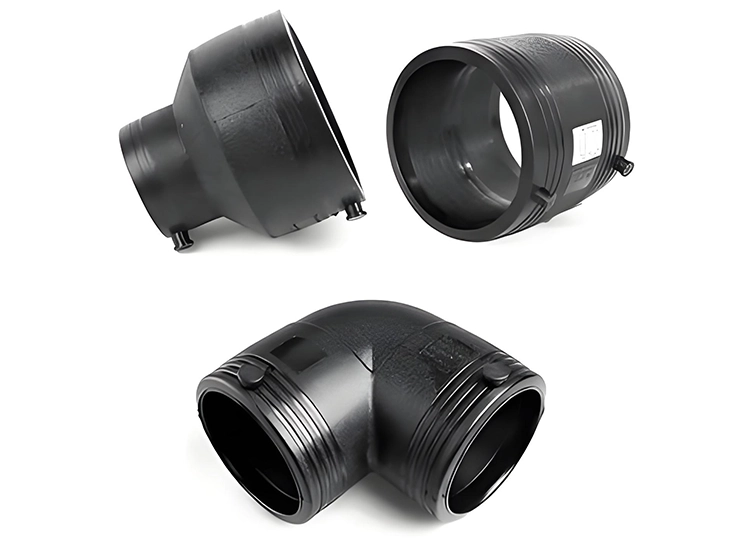
HDPE electrofusion fittings are HDPE pipe fittings with embedded resistance wires. Using a specialized electrofusion welding machine, the fittings are electrically heated to melt and fuse their inner walls with the outer surface of the inserted pipe, thereby achieving pipe connection. Electrofusion connection offers high operational flexibility, is less affected by environmental and on-site construction conditions, and is suitable for use in confined spaces.
Common Electrofusion Fittings: elbow, tee, reducer, cross tee, flange, and others. Installation is straightforward and highly reliable.
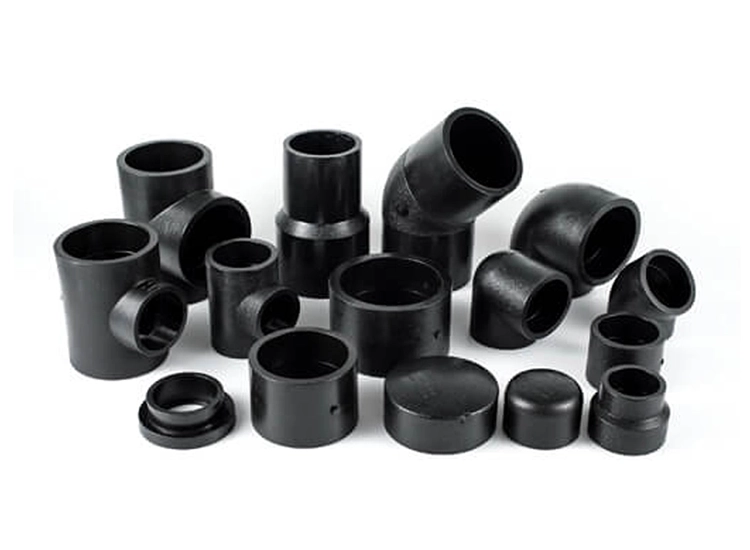
HDPE socket fusion fittings are mechanical pipe fittings that connect by directly inserting the pipe end into the socket of the fitting. Their sealing and fixation do not rely on welding fusion but are achieved through internal elastic sealing rings or compatible adhesives. Socket fittings are widely used in low-pressure fluid conveyance, building water supply and drainage systems, electrical cable protection conduits, and temporary or non-permanent piping systems.
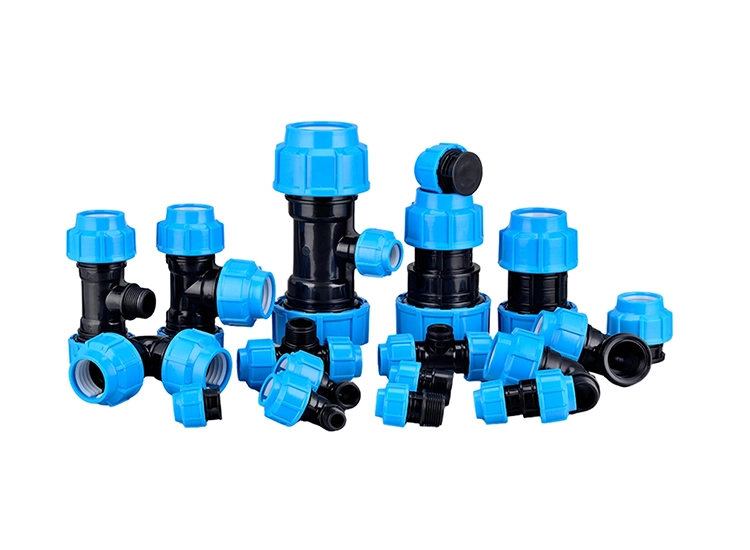
PP compression fittings are a type of pipe fitting that enables quick connection and sealing of PE pipes without any welding or heating. They rely on threaded structures and compression elements to function. When the external nut is tightened, it pushes the internal elements against and firmly compresses them onto the pipe’s outer wall, achieving a physical seal and mechanical fixation. Installation is simple and convenient, requiring no tools. These fittings are commonly used in agricultural irrigation, low-pressure potable water systems, and drip irrigation systems, providing a flexible, removable, and easily maintainable connection solution for HDPE pipes.
HDPE fabricated fittings are manufactured through the precise cutting, assembly, and professional welding of existing HDPE pipes. This manufacturing process enables the production of large-diameter fittings tailored to specific construction requirements, including 45-degree wye fittings, cross reducers, Y fittings, stub ends, and other fabricated fittings designed to meet project needs. Due to their manufacturing flexibility and customizability, these fabricated welded fittings are widely used in municipal water supply and drainage systems, water treatment plants, specialized chemical pipelines, and marine dredging projects.
Jinquan HDPE pipe fittings deliver high-performance, durable, and reliable solutions for modern piping projects. Through premium raw materials, precision manufacturing processes, and rigorous quality control systems, Jinquan ensures long-term safe and stable operation of piping systems, delivering outstanding performance in diverse complex applications.
HDPE pipe fittings are manufactured from high-density polyethylene, featuring a stable molecular structure that remains completely unaffected by acids, alkalis, salts, or microbial corrosion. This endows HDPE fittings with exceptional corrosion resistance. This characteristic makes them an ideal choice for demanding environments such as sewage conveyance, chemical medium processing, and long-term underground burial, ensuring the long-term safety and stable operation of piping systems in corrosive conditions.
The most notable physical advantage of HDPE material is its exceptional flexibility and impact resistance. Not only does it adapt flexibly to terrain variations during pipeline installation, effectively reducing the risk of stress cracking caused by external forces or temperature fluctuations, but it also maintains outstanding toughness and impact resistance in low-temperature and complex engineering environments. Even at temperatures as low as -40°C, HDPE retains its inherent high toughness, resists embrittlement, and demonstrates exceptional impact resistance. This significantly enhances the reliability and service life of the entire piping system.
Using professional butt fusion and electrofusion welding techniques, HDPE pipes and fittings are fused together to form a homogeneous, integrated pipeline network with molecular-level connections. This permanent connection fundamentally eliminates the risk of joint leakage, while the seamless, monolithic structure ensures long-term fluid conveyance integrity. This not only safeguards environmental security and operational efficiency but also significantly reduces maintenance, repair, and replacement costs for pipeline systems, greatly enhancing their reliability and economic benefits.
Under normal operating and installation conditions, HDPE pipe fittings can achieve a service life exceeding 50 years. HDPE fittings possess inherent chemical inertness and durability, resisting corrosion from various substances in soil. The material’s outstanding resistance to aging, corrosion, and fatigue significantly reduces overall system maintenance requirements and lifecycle costs, providing long-term reliable and cost-effective solutions for diverse infrastructure applications.
HDPE pipe and fittings feature exceptionally smooth inner walls with outstanding hydrodynamic properties. This smooth surface minimizes friction losses during fluid flow and resists scaling or sediment buildup, ensuring long-term stable delivery capacity. Compared to traditional metal pipes, their lower hydraulic resistance enhances water delivery efficiency and reduces long-term operational energy consumption, making them particularly suitable for water supply, slurry transport, and various continuous delivery systems.
Fittings for HDPE pipes feature a significantly lower density than traditional metal or concrete materials, offering lightweight properties and excellent flexibility. This substantially reduces transportation costs and on-site handling difficulties, particularly for large-diameter pipes. When installing HDPE pipeline systems, heavy machinery is unnecessary, and the connection methods are simple and efficient, significantly shortening construction timelines. These advantages make fittings for HDPE pipes well-suited for remote areas, projects with complex terrain, and large-scale pipeline installation projects.
HDPE pipes and fittings have become a versatile, cross-industry piping system solution with multiple advantages, making them the preferred material for infrastructure projects across various sectors. From municipal water supply and drainage networks and efficient agricultural irrigation systems to the transportation of various media in industrial and mining enterprises; from wastewater treatment and seawater desalination projects to gas and energy transmission under specific standards—their applications span virtually all modern industrial and civil sectors involving fluid conveyance, demonstrating exceptional adaptability and reliability.
HDPE pipes and fittings are environmentally friendly products that highly align with modern green infrastructure requirements. HDPE material possesses recyclable properties, effectively reducing resource consumption and waste generation, consistent with the principles of green infrastructure and sustainable development. At the end of a pipeline system’s service life, old HDPE pipes can be recycled, crushed, melted, and reprocessed into new plastic products or pipes, significantly reducing environmental pressure from waste. Their production energy consumption and full lifecycle carbon emissions are far lower than those of traditional metal pipes. While delivering reliable engineering performance, they substantially lessen environmental impact, making them the ideal choice for eco-friendly pipeline systems.
HDPE pipes and fittings demonstrate significant overall advantages throughout the entire pipeline lifecycle. Although the initial material cost is higher compared to other pipe materials, the long-term economic benefits far exceed those of traditional pipe materials. HDPE pipe fittings offer rapid and convenient installation with minimal maintenance requirements, reducing costly anti-corrosion treatments, repairs, and blockage clean-up expenses. Furthermore, they boast a service life exceeding 50 years. In the long run, HDPE pipe fittings represent a more economical and sustainable engineering choice.
HDPE pipe fittings have become the reliable and efficient material of choice in modern pipeline engineering due to their outstanding properties: corrosion resistance, high toughness and impact resistance, leak-free connections, exceptionally long service life, and environmental sustainability through recyclability. As a professional HDPE pipes and fittings manufacturer, Jinquan is committed to providing customers with a full range of high-standard HDPE pipe fittings that meet stringent quality systems, along with comprehensive welding technical support. Whether applied in water supply systems, municipal networks, industrial conveyance, or agricultural irrigation, we ensure safe, stable, and cost-effective long-term operation of pipeline systems, providing robust support for the sustainable development of diverse infrastructure projects.
Fill out the form and our team will contact you shortly.