Address
Zhengzhou, Henan, China
Work Hours
Monday to Friday: 7AM - 7PM
Weekend: 10AM - 5PM
Address
Zhengzhou, Henan, China
Work Hours
Monday to Friday: 7AM - 7PM
Weekend: 10AM - 5PM

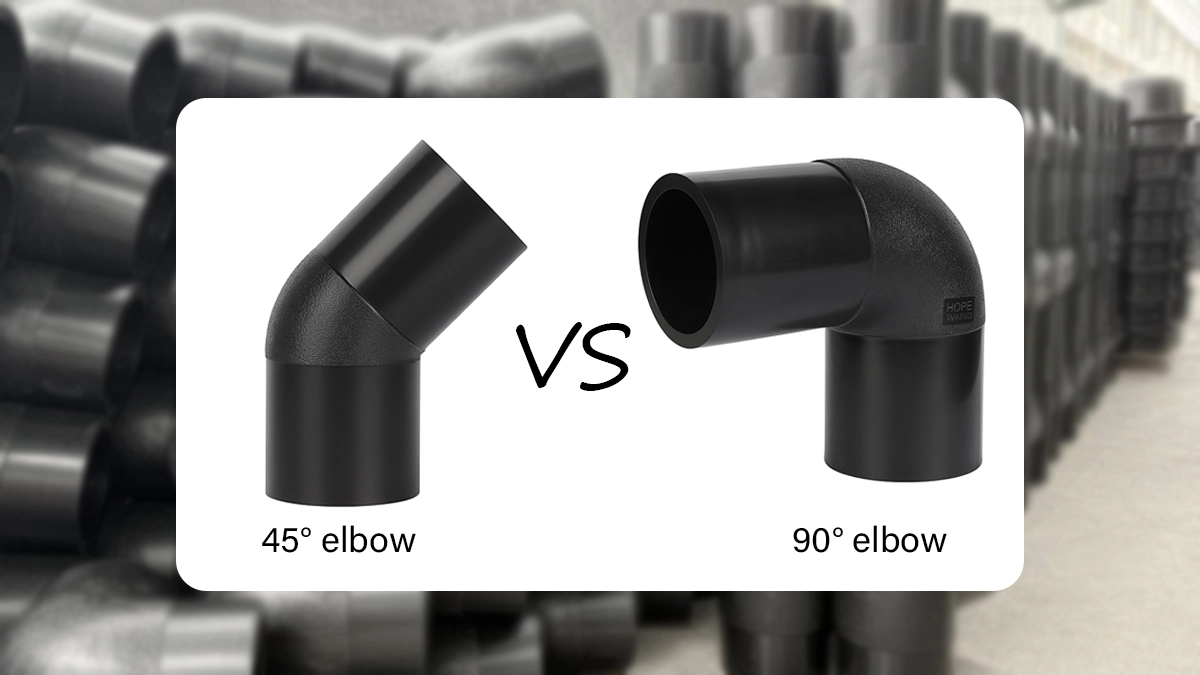
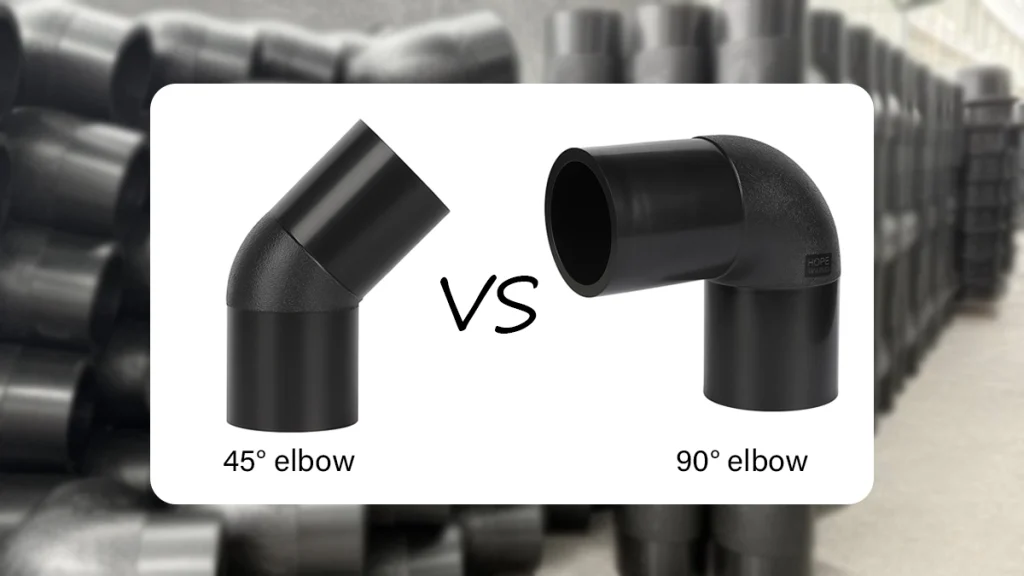
In modern pipeline networks, HDPE pipe systems have gained widespread adoption across core sectors such as urban water supply, agricultural irrigation, gas transmission, and industrial fluid conveyance due to their exceptional corrosion resistance and high strength. However, within these intricate networks, achieving turns and redirecting fluid flow relies entirely on HDPE pipe fittings—specifically elbows. The selection of HDPE elbows directly impacts the hydraulic performance and operational safety of the pipeline system. Among these, the most common are 45° elbows and 90° elbows. Though seemingly differing only in angle, they exhibit significant variations in fluid resistance, spatial layout, and stress distribution. This article will conduct an in-depth comparative analysis of these two HDPE elbow types, aiding engineering technicians in making more precise selection decisions during design and construction to ensure the efficiency and stability of pipeline systems.
During the installation of high-density polyethylene (HDPE) pipelines, various types of HDPE pipe fittings are utilized. The HDPE elbow is a critical connecting component specifically designed to alter the direction of fluid flow. Manufactured from HDPE resin, it is precision-formed through processes such as injection molding or extrusion.
Common angles for HDPE pipe elbows include 22.5°, 45°, and 90°, all designed to provide smooth directional transitions within piping systems. This minimizes flow losses and fluid impact. HDPE elbows are typically connected to the main pipeline via butt fusion welding, electrofusion welding, or socket fusion welding. This ensures the joint shares identical material properties and performance with the pipeline itself, forming a reliable, leak-free unit. This unique connection method endows HDPE elbows with the same lifespan as the pipeline, along with exceptional corrosion resistance and resistance to seismic stress cracking. It serves as the cornerstone for ensuring the long-term stable operation of modern high-pressure, long-distance pipeline networks.
HDPE pipe fittings are essential components for connecting and controlling fluid conveyance in HDPE pipelines. Elbows specifically serve to alter pipeline routing. The classification of HDPE elbows primarily depends on their bend angle and connection method, enabling adaptation to diverse engineering environments and technical requirements.
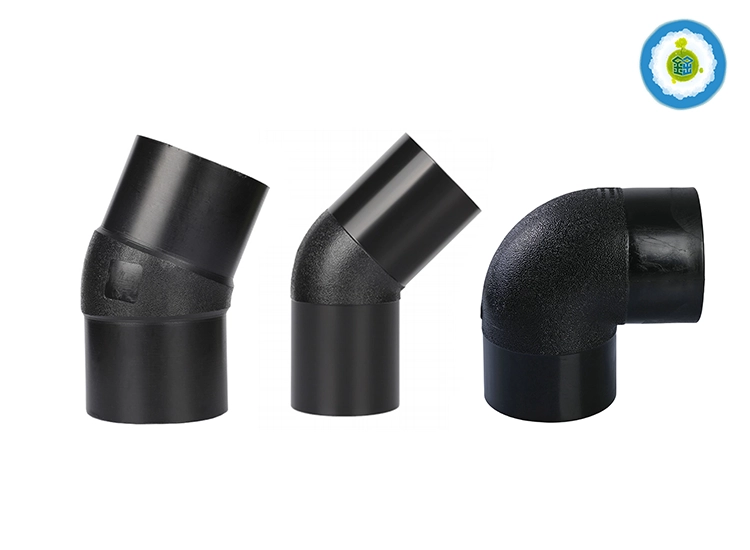
The angle of an HDPE elbow determines the sharpness of a pipe turn and the space it occupies. Angle selection directly impacts fluid resistance, construction difficulty, and installation space. Elbows are categorized by angle into 22.5°, 45°, and 90° types.
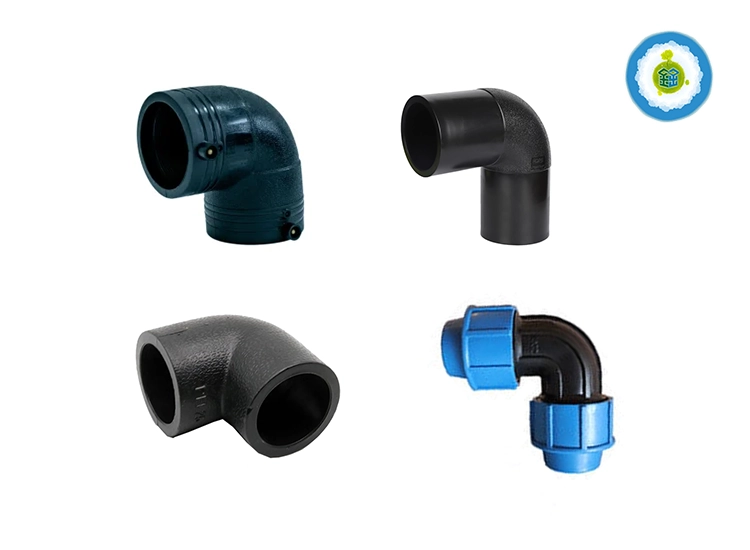
The connection method of HDPE elbow fittings determines their installation process, sealing reliability, and operating environment. Based on connection type, they are categorized into HDPE butt fusion elbows, HDPE electrofusion elbows, HDPE compression elbows, and HDPE socket fusion elbows.
The 45-degree HDPE elbow and 90-degree HDPE elbow serve as critical components in PE piping systems, offering outstanding corrosion resistance, exceptional impact resistance, and superior stress crack resistance. Through various connection methods, they form leak-free joints comparable to the pipes themselves, ensuring long-term stable operation of the piping system. However, the 45-degree HDPE elbow and 90-degree HDPE elbow possess distinct design advantages to accommodate different hydraulic performance requirements and spatial constraints.
HDPE 45-degree elbow is a pipe fitting that allows the pipeline direction to change by 45 degrees.
HDPE 90-degree elbow is a fitting used to achieve right-angle turns in piping systems.
The primary difference between HDPE 45° elbows and 90° elbows lies in their respective impacts on fluid dynamics, space utilization, and structural stress distribution. Below is a detailed analysis of their differences to assist construction personnel in selecting the appropriate option based on specific project requirements.
The 45 degree HDPE elbow provides a smoother angular transition, significantly reducing fluid velocity compared to the 90-degree HDPE elbow. Consequently, it offers a lower flow system coefficient, which is crucial for long-distance transportation systems prioritizing high efficiency and low energy consumption. In contrast, the HDPE 90-degree elbow subjects the fluid to a sharp directional change at the bend, generating substantial separation vortices. This results in high fluid resistance, significantly reducing the delivery efficiency of the HDPE piping system.
HDPE 90° Elbow: Capable of achieving the sharpest, most abrupt directional change (90 degrees) in a single installation. This fitting facilitates transitions from horizontal to vertical, or vertical to horizontal pipe runs.
HDPE 45° Elbow: Permits only a moderate degree of directional change (45 degrees) per installation. To achieve a 90-degree turn, two 45° elbows are typically combined.
The HDPE 45-degree elbow has a larger bend radius than the 90-degree elbow, requiring more construction and installation space. In contrast, the 90-degree elbow features a smaller bend radius, occupying minimal lateral space on a horizontal plane. This makes it an ideal choice for narrow trenches or other confined spaces.
The 45-degree elbow’s gentle transition design disperses fluid impact pressure and thermal stress along a longer arc, resulting in more uniform water pressure distribution and extending the service life of HDPE pipes. In contrast, the abrupt directional change in 90-degree elbows subjects pipe walls to higher fluid impact forces, creating potential stress weak points during long-term operation.
HDPE elbows have become the preferred choice in numerous critical fluid conveyance applications due to their exceptional corrosion resistance, high strength, and reliable connection technology.
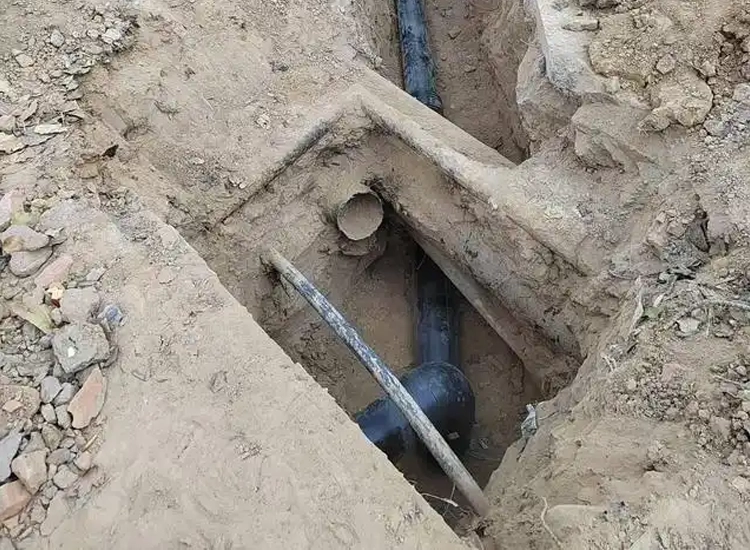
HDPE 90-degree elbows significantly impact water flow. Because 90-degree elbows force fluids to undergo abrupt directional changes over short distances, they generate substantial vortices and fluid separation zones within the elbow. This results in significant local resistance, which reduces flow velocity within the pipeline. When designing pipelines requiring high hydraulic efficiency, engineers typically exercise caution when using 90-degree elbows or opt for elbows with larger radii whenever possible to mitigate these effects.
The core function of an HDPE elbow is to alter the direction of fluid flow. During pipeline installation, turns are unavoidable due to terrain variations, obstacle avoidance, or connecting equipment interfaces at different locations. Elbows serve as the critical fittings enabling these directional changes. Elbows with varying angles determine the sharpness or smoothness of the fluid’s path change. Construction personnel can combine elbows of different angles based on specific site conditions to achieve flexible layouts, ensuring the pipeline system fully adapts to project requirements.
The primary function of the HDPE 90° elbow is to enable efficient, compact right-angle turns within piping systems. It allows pipelines to swiftly transition from one direction to a perpendicular direction over the shortest possible distance, maximizing lateral space savings. HDPE 90-degree bends are commonly used in space-constrained areas such as complex indoor piping layouts, industrial facilities, or urban underground utility networks.
The impact of 45° elbows on water flow is significantly less than that of 90° elbows. The 45-degree angle design provides a smoother flow transition, greatly reducing the vortices generated by the fluid at the bend. 45-degree elbows typically measure only about 30% to 50% of the size of a 90° elbow of the same specification. Therefore, 45° elbows are the optimal choice for maintaining stable flow velocity in long-distance delivery systems.
The impact of 45° elbows on water flow is significantly less than that of 90° elbows. The 45-degree angle design provides a smoother flow transition, greatly reducing the vortices generated by the fluid at the bend. 45-degree elbows typically measure only about 30% to 50% of the size of a 90° elbow of the same specification. Therefore, 45° elbows are the optimal choice for maintaining stable flow velocity in long-distance delivery systems.
HDPE 45° elbows and 90° elbows are indispensable flow diversion solutions in modern piping engineering. The 90-degree elbow is the preferred choice for overcoming space constraints and achieving rapid right-angle turns, while the 45° elbow, with its smooth transition, is a popular option for long-distance water conveyance. Selecting the appropriate HDPE elbows not only effectively reduces the operational energy consumption of piping systems but also enhances overall system safety and extends service life. Jinquan delivers high-quality HDPE elbows, offering robust directional transition solutions for diverse complex fluid conveyance scenarios through exceptional corrosion resistance, durability, and reliable connection technology.
Fill out the form and our team will contact you shortly.