Address
Zhengzhou, Henan, China
Work Hours
Monday to Friday: 7AM - 7PM
Weekend: 10AM - 5PM
Address
Zhengzhou, Henan, China
Work Hours
Monday to Friday: 7AM - 7PM
Weekend: 10AM - 5PM


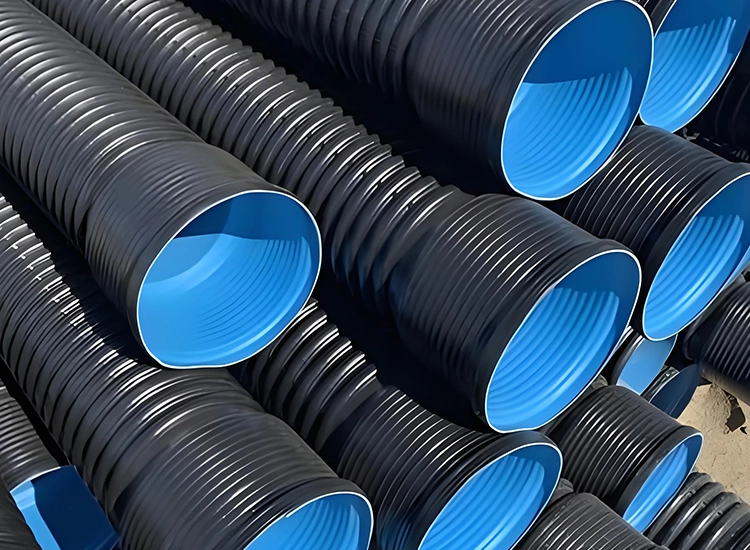
Double wall corrugated pipe (DWC pipe) is a critical infrastructure material widely used in modern engineering. Primarily manufactured through specialized extrusion processes using raw materials like high-density polyethylene (HDPE), DWC pipe features a unique structure with a smooth inner wall and corrugated outer wall, forming a lightweight hollow ring with high ring stiffness. The specialized structure of HDPE double-wall corrugated pipe endows it with outstanding corrosion resistance, impact resistance, and excellent flexibility. This makes it an indispensable component in modern infrastructure construction. It is primarily used in drainage systems and sewage treatment, and can also serve as protective casing for underground power and communication cables.
Proper connection of double-wall corrugated pipes is a critical prerequisite for ensuring long-term stable system operation. A reliable DWC pipe connection not only guarantees strict sealing within the piping system, effectively preventing leaks and protecting against environmental contamination and system pollution, but also ensures system durability. This prevents DWC drainage pipes from disconnecting or shifting when subjected to foundation settlement and external loads. The following sections will delve into the connection methods and key considerations for double-walled corrugated pipes.
The ingenuity of double wall corrugated pipe design lies in its unique dual-layer structure. The inner wall is engineered to be smooth and flat, primarily serving to minimize friction resistance. This enhances water flow efficiency and reduces head loss during fluid conveyance. In contrast, the outer wall features a corrugated design, operating on the principle of an arch structure. This geometric configuration significantly enhances the pipe’s ring stiffness, enabling it to withstand substantial external pressure and soil loads, thereby ensuring the safety of buried pipelines.

Additionally, the selection of high-density polyethylene (HDPE) as the corrugated pipe material endows the pipeline with outstanding chemical corrosion resistance, flexibility, and impact resistance. Its lightweight nature facilitates easy handling and transportation, making the pipeline more convenient to install and connect during on-site construction. This enhances the overall construction efficiency of the project.
The key to ensuring the double wall corrugated pipe system delivers its superior performance lies in the reliable connection between pipe sections. Since DWC is primarily used in applications such as buried drainage and sewage systems that demand extremely high sealing integrity, it is essential to employ connection technologies that are scientifically sound, robust, and easy to install.
Rubber ring socket connections for DWC pipes represent the most common and simplest connection method, utilizing the compressive deformation of elastic materials to achieve reliable sealing. This socket connection requires no complex fusion equipment, and the elastic sealing ring provides a dependable seal when compressed. It is resistant to damage and offers straightforward operation.
Follow these specific steps:
Heat-shrink sleeve connections for double wall corrugated pipes are a sealing method designed to enhance watertightness and meet stringent anti-leakage requirements. By heating polymer materials to shrink and fuse with the pipe surface, they form a continuous, high-strength, corrosion-resistant seal. This connection not only provides sealing but also reinforces the joint, making it suitable for underground installations, high-water-table areas, or corrosive environments where leak prevention is critical.
The specific steps are as follows:
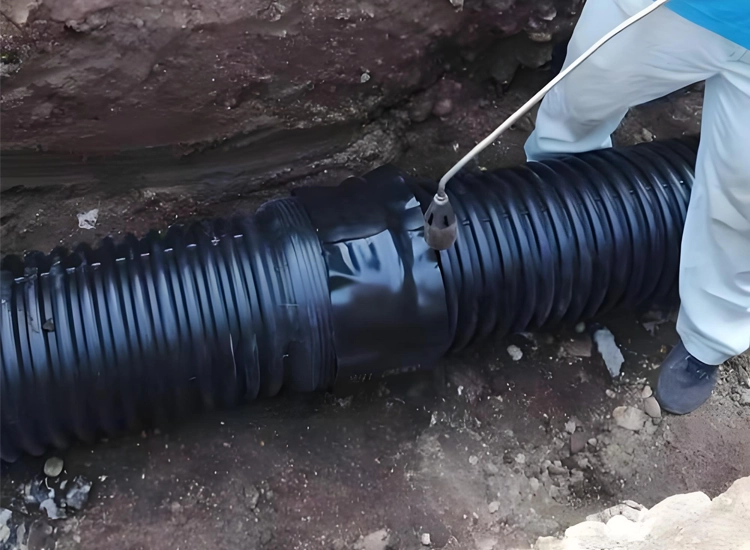
Coupler or sleeve connection is a versatile connection method primarily used to join two double wall corrugated pipes with straight ends (non-socketed). It employs a separate fitting—a coupler or sleeve—to bridge the ends of two pipes, making it a common choice for connecting large-diameter or special-type pipes.
The specific steps are as follows:
During the installation of HDPE double wall corrugated pipes, in addition to mastering the correct connection methods, attention must also be paid to the construction environment, operational details, and quality inspection procedures. Below are the general precautions and detailed construction points.
During operation, improper handling can easily cause joint leaks, pipe deformation, or disrupt the entire pipeline system’s performance. Therefore, common mistakes must be avoided.
Some common mistakes can be avoided by training operators before construction, familiarizing them with connection methods and processes, keeping interfaces clean during construction, conducting necessary pressure tests or water tests on pipes, and checking the position of sealing rings after construction.
HDPE double-wall corrugated pipe has become an ideal material for municipal drainage, underground sewage systems, and cable sheathing due to its excellent mechanical strength, corrosion resistance, and flexibility. The connection quality of DWC pipe is a critical factor determining the service life and sealing performance of the piping system. During installation, select the appropriate connection method based on the project environment and specifications, and adhere to operational standards. Proper connections effectively ensure the safety, sealing integrity, and long-term stable operation of the piping system. Jinquan supplies premium double-wall corrugated pipes for global engineering projects. We also provide HDPE pipe, delivering reliable solutions for urban infrastructure development.