Address
Zhengzhou, Henan, China
Work Hours
Monday to Friday: 7AM - 7PM
Weekend: 10AM - 5PM
Address
Zhengzhou, Henan, China
Work Hours
Monday to Friday: 7AM - 7PM
Weekend: 10AM - 5PM


HDPE pipe fittings are processed from high-density polyethylene, a material known for its excellent physical properties and chemical stability, and is a key and indispensable component of modern piping systems.The main function of HDPE pipe fittings is to connect the various parts of the HDPE pipeline to achieve the steering of the fluid, runoff, diversion, blocking, and the transition connection with the pipeline or equipment made of other materials.
HDPE fittings are fast becoming the preferred solution for many applications due to their superior durability, flexibility, excellent corrosion resistance and reliable connections compared to traditional metal, PVC or concrete fittings. Whether in municipal water supply, gas distribution, industrial fluid handling and agricultural irrigation scenarios, HDPE fittings demonstrate a wide range of applicability and superior performance. Due to its high strength-to-density ratio, HDPE fittings are not only lightweight and easy to install, but also offer excellent durability and long-term performance.
In this article, we’ll provide an in-depth analysis of the types and benefits of HDPE fittings to help engineers, contractors and HDPE pipe laying projects target the use of HDPE fittings.

Understanding the types and specifications of HDPE fittings is a prerequisite for proper selection and application.There is a wide variety of HDPE fittings that can be divided primarily based on their connection type and function. Choosing the right type of PE fittings is critical to ensuring the integrity, safety and long-term performance of your piping system.
Different connection types are suitable for different HDPE water pipe diameters, pressure levels, construction conditions and application requirements. The following are several mainstream HDPE pipe fitting connection types.


In addition to being categorized according to the connection method, HDPE fittings can also be distinguished according to their function in the piping system.
HDPE pipe fittings have widely replaced traditional pipes and become the first choice of engineers and projects, mainly due to their excellent comprehensive performance. These advantages not only greatly improve the reliability and efficiency of the piping system, but also in terms of economy and environmental protection to show significant results, to fully meet the needs of modern engineering for high-quality piping solutions.
HDPE is a chemically inert material that is extremely resistant to most acids, alkalis, salt chemicals and organic solvents. This means that HDPE fittings will not galvanically corrode or rust like metal fittings, and there is no need for expensive internal or external anti-corrosion coatings or cathodic protection. This characteristic makes it ideal for transporting corrosive media or for applications in harsh soil and marine environments.
HDPE material has good flexibility, allowing the pipe to bend to a certain extent, and can adapt to uneven settlement or slight displacement of the foundation, thus significantly reducing the risk of pipe breakage due to geological changes. Its excellent impact resistance, especially at low temperatures, is far superior to brittle materials such as PVC, making HDPE pipe fittings less susceptible to damage during handling, installation and operation. This flexibility also makes it ideal for non-excavation (e.g. directional drilling) laying techniques.
Despite being lightweight, HDPE material has a high strength-to-weight ratio. Modern, high quality PE100 grade HDPE materials have excellent creep resistance and slow crack growth (SCG) resistance. When properly designed and installed, HDPE piping systems are typically designed to last 50 years or more, far longer than many traditional piping materials.
The heat fusion connection is a highlight of HDPE piping systems. This type of connection can form a fully fused, leak-free integrated piping system. The strength of the joint is usually equal to or greater than the strength of the pipe itself, which fundamentally eliminates the joint leakage problem common to traditional piping.
HDPE pipe fittings have a very smooth inner wall (low Manning’s roughness coefficient), which offers low resistance to water flow and is less prone to scaling. This means that in the same diameter and pressure, HDPE pipes can convey a larger flow, or lower energy consumption when conveying the same flow. Long-term use is not easy to reduce the efficiency of transportation due to scaling.
The density of HDPE is much lower than that of steel, cast iron or concrete, so HDPE pipes and fittings are lightweight and easy to handle, transport and install, which can significantly reduce the investment in manpower and equipment and shorten the construction period. A variety of connection options also provide convenience for different construction conditions.
HDPE material is non-toxic and meets sanitary standards for the delivery of drinking water. The production process is relatively energy-efficient and HDPE materials are 100% recyclable, which is in line with the current requirements for sustainable development of construction materials. Waste HDPE pipes and fittings can be recycled into other plastic products, reducing the burden on the environment.
Although the initial unit cost of materials for HDPE fittings may be higher than for some conventional materials, the use of HDPE pipe and fittings is more cost-effective in terms of reduced leakage losses, lower energy consumption, given its low installation costs, lack of need for corrosion protection treatments, minimal maintenance, long service life, and excellent performance.
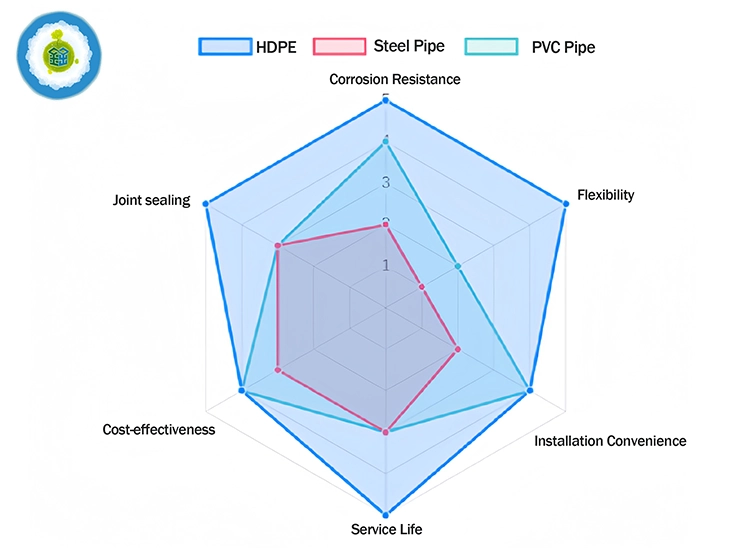
As one of the world’s trusted manufacturers of HDPE pipe and fittings, JINQUAN is committed to providing reliable, high-performance solutions for modern piping systems.HDPE pipe and fittings offer superior durability, corrosion resistance, flexibility, and cost-effectiveness. Whether for municipal water supply, gas distribution, industrial fluid handling or agricultural irrigation, HDPE pipe and fittings have proven to be the superior choice. JINQUAN offers a wide range of fittings types and sizes to meet a variety of application requirements and provides customized solutions to meet the ever-changing needs of infrastructure and sustainability.
Fill out the form and our team will contact you shortly.