Address
Zhengzhou, Henan, China
Work Hours
Monday to Friday: 7AM - 7PM
Weekend: 10AM - 5PM
Address
Zhengzhou, Henan, China
Work Hours
Monday to Friday: 7AM - 7PM
Weekend: 10AM - 5PM


HDPE pipe fusion welding requires controlled heater temperature, pressure, heating time, changeover time and cooling time. For butt fusion, heater plates are commonly operated around 200–230°C, but the exact parameters must follow the pipe material, SDR, wall thickness, welding standard and machine specifications. This guide explains the complete process, parameter selection and weld inspection requirements.
HDPE pipe fusion welding joins two polyethylene pipe ends by heating, aligning, pressing, and cooling them under controlled conditions. For butt fusion welding, the heater plate is commonly set around 200–230°C, while heating time, welding pressure, and cooling time should be adjusted based on the pipe diameter, wall thickness, SDR, material grade, and project standard. A qualified weld should have a clean, continuous, symmetrical double bead with no gap, contamination, or severe misalignment.
HDPE pipe fusion welding is a specialized technique for joining high-density polyethylene pipes. It involves simultaneously heating the ends of HDPE pipe to a molten state, rapidly aligning them, and applying pressure. After cooling and solidification, a robust, seamless weld is formed. The principle relies on the reversible melting of thermoplastic polyethylene when heated, enabling molecular chains to re-bond through butt fusion. Unlike traditional metal welding, fusion welding requires no filler material. The joint strength matches or exceeds that of the base material, offering superior corrosion resistance.
| Parameter | General Reference | Important Note |
|---|---|---|
| Heating plate temperature | Commonly around 200–230°C | Follow the selected welding standard and pipe manufacturer |
| Fusion pressure | Calculated by joint area and machine piston area | Add measured drag pressure |
| Heating time | Determined mainly by wall thickness and standard | Do not calculate from pipe diameter alone |
| Changeover time | Keep within the standard’s maximum limit | Larger wall thickness may allow a longer time |
| Cooling time | Determined by wall thickness and procedure | Maintain fusion pressure throughout initial cooling |
| Alignment | Mismatch commonly limited to 10% of wall thickness | Re-face the pipe after major adjustment |
To ensure the quality of HDPE pipe welding, scientific welding procedures must be followed and adjusted according to on-site environmental conditions. The following provides a detailed analysis of each step for the proper use of hot-melt hydraulic HDPE pipe welding machines. This approach enhances the success rate of HDPE pipe welding, guaranteeing the long-term safety and stable operation of pipeline systems.
Place PE pipes or HDPE fittings on a flat surface within the butt welding frame. Support the pipes from below using wooden or rubber rollers to prevent damage to the PE100 pipe from sharp objects on the ground. When the movable clamp of the fusion machine frame is extended to its maximum position, ensure approximately 150 mm (milling cutter width) of space remains between the inserted PE pipes to allow the electric planer to be inserted smoothly for cutting. Avoid excessive spacing to guarantee a milling allowance of 10–20 mm on the PE pipe or fitting.
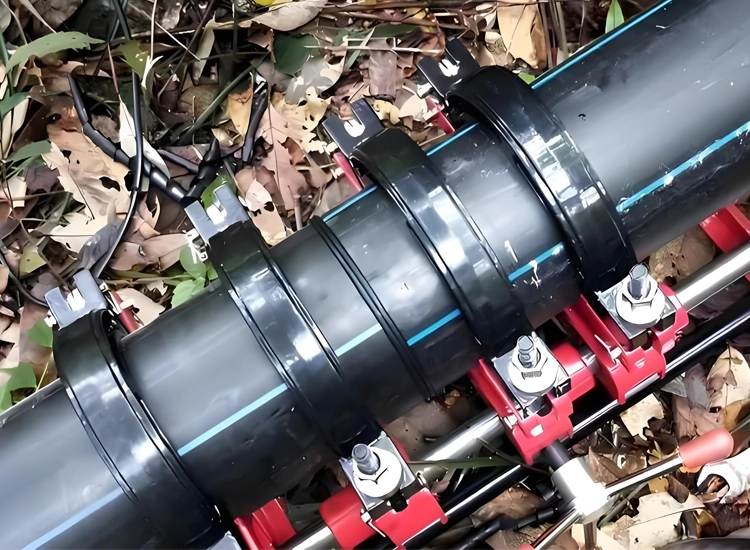
Based on the HDPE pipe diameter requiring butt fusion welding, select appropriate clamps to ensure the pipe and fittings are securely held in place, preparing for subsequent milling operations. Proper clamping prevents pipe movement or misalignment during cutting, heating, or joining processes, ensuring uniform welds. When clamping, adjust each clamp bolt individually to align the pipe centers on the same horizontal plane. This step is a critical prerequisite for successful welding.
During the clamping process, adjust the upper and lower fixing bolts of the clamping fixture to ensure the end faces of the two PE welded pipes (fittings) are perfectly aligned with their axes coinciding. The misalignment between the pipe walls of the front and rear pipes should be minimized as much as possible. The maximum misalignment must not exceed 10% of the PE pipe wall thickness; otherwise, it will compromise the quality of the pipe butt joint and its pressure-bearing capacity, resulting in a failed weld.
Clean the heating plate and milling cutter of butt fusion welding machine using a clean cotton cloth and alcohol (typically requiring one cleaning at the start of construction; if the work environment is dusty, perform continuous cleaning as needed). Clean the ends of PE pipes or fittings to prepare for butt fusion.
Mill the oxidized layer from the welded ends of HDPE pipes to ensure both butted surfaces are flat, smooth, and free of impurities. The criteria for determining adequate milling are: the milled surface should exhibit uniform glossiness with no visible cutting marks or burrs. During this process, once adequate milling is observed, the hydraulic station of the hot-melt machine should slowly release pressure. Before pressure release, the electric milling cutter must maintain continuous rotation. Only after the electric milling cutter has completely idled can the hydraulic station’s push rod retract the fixture to remove the milling cutter.
If the butt fusion welding environment is favorable with no dust on-site, the milled ends of PE pipes or fittings require no further cleaning (their cleanliness is already suitable for welding). If wind-blown dust is present, clean the pipe ends with a clean cotton cloth and alcohol to maintain a clean welding surface.
Heat the heating plate to the set temperature (approximately 200–230°C), with the specific temperature determined based on the pipe wall thickness and welding equipment performance; the heat absorption time should be calculated according to the pipe wall thickness. Then position the heating plate between the welding ends to melt the welding surfaces.
After the specified melting time, promptly remove the heating plate and quickly bring the butt fusion ends of the pipes into contact while applying pressure. To ensure fusion quality, remove the heating plate and bring the molten pipe ends together within the maximum changeover time specified by the approved welding procedure. Keep this interval as short as possible to prevent cooling or contamination of the fusion surfaces. Use the hydraulic unit to close the pipe ends smoothly and apply the specified fusion pressure. Avoid touching the molten surfaces and protect them from dust, moisture, and other contaminants.
Butt fusion is critical to the welding process. The alignment procedure must be performed under constant welding pressure. A flange height of 2 to 4 millimeters is recommended. Welding pressure should be adjusted according to pipe diameter, wall thickness, and equipment specifications to ensure full contact and fusion of the end faces while preventing deformation from excessive pressure.
Maintain constant butt pressure and allow the joint to cool slowly and naturally. The cooling time should be determined based on the pipe wall thickness. Cooling under sustained pressure is critical for the PE polymer chains to re-entangle and polymerize from their high-temperature free state, forming a new cohesive structure. Insufficient cooling time, pressure release, or loosening the clamps will result in a false weld, compromising the quality of the HDPE pipe welding.
A good HDPE butt fusion weld should show a uniform, continuous, and symmetrical double bead around the pipe circumference. The joint should have no visible gap, contamination, cracks, severe bead flattening, or obvious misalignment.
If the weld bead is uneven, too small, too large, contaminated, separated, or shows signs of poor alignment, the joint should be cut out and re-welded according to the project standard.
| Weld appearance | Possible cause | Corrective action |
|---|---|---|
| Uneven double bead | Poor alignment or unequal heating | Cut out the joint, realign, re-face and weld again |
| Very small bead | Insufficient heat or fusion pressure | Verify heater temperature, heating time and pressure |
| Excessively large bead | Excessive heat or pressure | Check the approved fusion parameters |
| Contaminated bead | Dirt, moisture, oil or delayed changeover | Remove the joint and repeat with clean surfaces |
| Visible offset | Pipe ends were not correctly aligned | Re-clamp, align and re-face before welding |
| Bead separation or gaps | Incomplete fusion | Reject and replace the joint |
Throughout the HDPE pipe welding process, particular attention must be paid to controlling temperature, pressure, and time, all of which must be strictly executed according to the specified process parameters. The construction environment should be protected from wind, rain, and dust contamination, as these factors can severely compromise weld quality. Operators must be trained and thoroughly familiar with equipment performance and safety protocols. Upon completion of welding, the appearance and dimensions of the welds should be inspected and documented for quality traceability. For critical pipeline networks, pressure testing must also be conducted to ensure joint integrity.
For butt fusion welding, the heater plate is commonly set around 200–230°C. The exact temperature should follow the pipe material, SDR, wall thickness, welding machine, and project standard.
Cooling time depends on pipe diameter and wall thickness. The joint should remain clamped under pressure until it is fully cooled and stable.
A good weld should have a clean, continuous, and symmetrical double bead with no gap, contamination, cracks, or obvious misalignment.
It should be avoided unless proper shelters and protection are used. Rain, dust, wind, and contamination can reduce welding quality.
Butt fusion joins two pipe ends directly using a heater plate and pressure, while electrofusion welding machine uses fittings with embedded heating wires to melt and connect the pipe and fitting.
Hydraulic butt fusion HDPE pipe welding is a mature and reliable joining process, offering high weld strength, excellent sealing performance, and extended service life. By following standardized procedures—including preparation, clamping, alignment, cleaning, heating, switching, welding, and cooling—welding success rates can be significantly improved, ensuring safe and stable operation of HDPE pipeline systems. As a professional fusion HDPE pipe welding machine supplier, JINQUAN provides high-performance butt welding machines and comprehensive technical support to empower customers in achieving high-quality construction.
If you need HDPE pipes, fittings, or fusion welding machines for water supply, drainage, mining, irrigation, gas, or infrastructure projects, JQ PIPE can provide factory-direct supply, technical support, and customized project solutions.
Contact JQ PIPE today to get product specifications, welding support, and a project quotation.
Fill out the form and our team will contact you shortly.