Address
Zhengzhou, Henan, China
Work Hours
Monday to Friday: 7AM - 7PM
Weekend: 10AM - 5PM
Address
Zhengzhou, Henan, China
Work Hours
Monday to Friday: 7AM - 7PM
Weekend: 10AM - 5PM

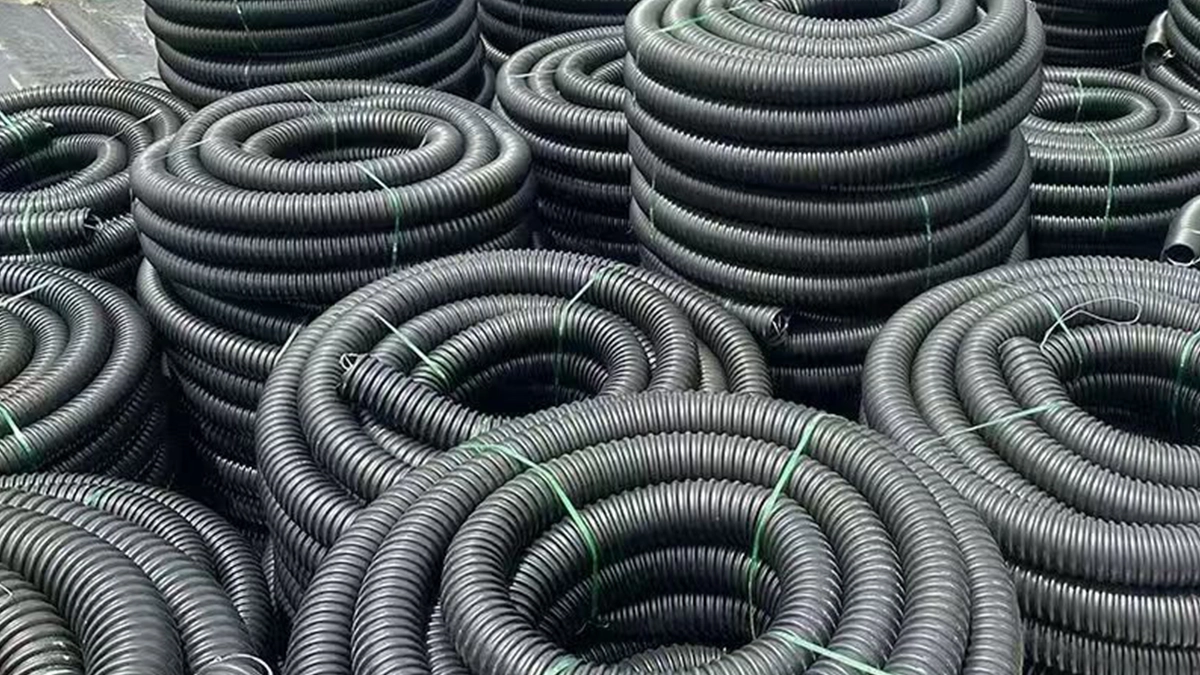
This guide explains HDPE Single Wall Corrugated Pipe applications, standard sizes, ring stiffness ratings, and selection criteria. It helps B2B buyers, engineers, and procurement teams choose the right diameter, SN class, and supplier while avoiding common specification and quality risks.
Engineered from High-Density Polyethylene, an HDPE single wall corrugated pipe acts as a highly flexible, lightweight conduit. You can easily spot it by its distinctive ribbed profile—which mirrors itself on both the inside and outside. Contractors primarily rely on these SWC pipes for gravity-flow water management, agricultural drainage, and underground cable shielding. Why? Because these applications demand rapid installation and the ability to bend without snapping.
The secret to this SWC pipe’s durability lies in that very corrugation. It fights off heavy soil loads while bending naturally around obstacles, eliminating the need for complex, specialized fittings. Manufacturers typically use industrial-grade HDPE with a material density hovering between 0.945 and 0.965 g/cm³. This isn’t a random number. That specific density strikes a precise balance between raw load-bearing strength and Environmental Stress Crack Resistance (ESCR). To guarantee underground stability for the long haul, premium SWC pipes must survive a minimum of 1,000 hours submerged in a 50°C, 10% Igepal solution, strictly following AASHTO M294 standards.
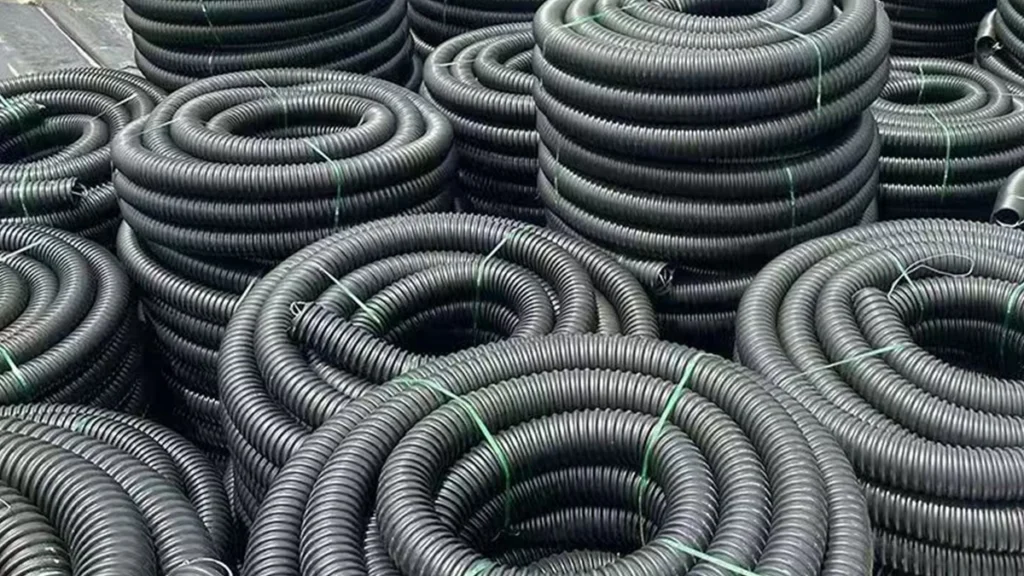
When it comes to non-pressurized drainage and utility conduits, HDPE single wall corrugated pipe brings an unmatched mix of flexibility and budget-friendly performance to the table. Think about rigid piping systems for a moment. They require precise alignment and countless directional fittings. In contrast, corrugated HDPE rolls out in continuous, undulating runs. This slashes labor hours and practically wipes out joint failure points.
Key Advantages:
Honest Limitation:
Every material has its trade-offs. For single wall corrugated pipe, that trade-off is the ribbed interior. Those internal grooves bump up flow friction (resulting in a higher Manning’s ‘n’ value) and can snag sediment over the years. If you’re designing a low-velocity sewer line, a smooth-core pipe is a much safer bet.
| Feature | Single Wall Corrugated Pipe | Double Wall Corrugated Pipe (DWC) |
|---|---|---|
| Structure | Corrugated exterior, corrugated interior | Corrugated exterior, smooth interior |
| Hydraulic Flow | Moderate (ribbed interior causes turbulence) | Excellent (smooth interior optimizes flow) |
| Flexibility | Highly flexible, easily coiled | Rigid, typically supplied in straight sticks |
| Primary Use | Agricultural drainage, flexible cable conduit | Municipal storm sewers, highway culverts |
| Cost | Lower | Higher |
You’ll find these SWC pipes deployed across a massive range of industries—anywhere that demands flexible fluid routing or tough cable shielding. The specific job dictates whether you need a solid (non-perforated) or perforated profile.
Agricultural Drainage
Managing the water table makes or breaks crop yields. In the farming sector, DN100 (4-inch) perforated single-wall pipe reigns as the gold standard for subsurface field drainage. The pipe actively pulls excess soil moisture through its perforations, channeling it safely away from vulnerable root zones. Out in the real world, massive soybean operations roll out continuous coils of this DN100 pipe. They wrap it in a geotextile sock to block silt while keeping soil drainage at peak efficiency.
Residential and Commercial Water Management
Building infrastructure heavily depends on these SWC pipes to manage both surface runoff and hidden subsurface water. You’ll routinely see them hooked up to downspout run-offs, buried as foundation perimeter drains, or installed in window well systems. Thanks to the pipe’s inherent flexibility, landscaping crews can easily route it around complex structural footings and garden beds.
Infrastructure and Cable Protection
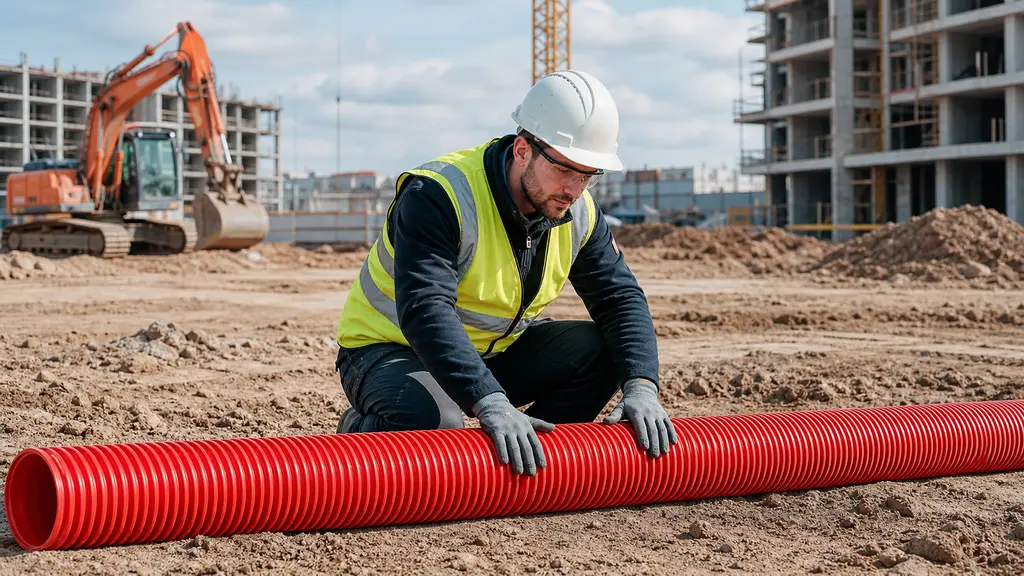
Water isn’t the only thing these SWC pipes handle. Solid single wall corrugated pipe acts as a rugged bodyguard for underground utilities. Take urban road expansions, for example. City planners frequently bury DN50 red corrugated pipe to house electrical cables. This creates a tough, brightly colored barrier that flexes with ground movement and clearly warns future excavation crews about live wires below.
Sizing for these pipes spans from a compact DN75 (3 inches) all the way up to a massive DN600 (24 inches). How the pipe gets packaged depends entirely on that nominal diameter. To guarantee structural reliability and dimensional accuracy, top-tier manufacturers strictly adhere to standards like AASHTO M252, AASHTO M294, ASTM F405, and ASTM F667.
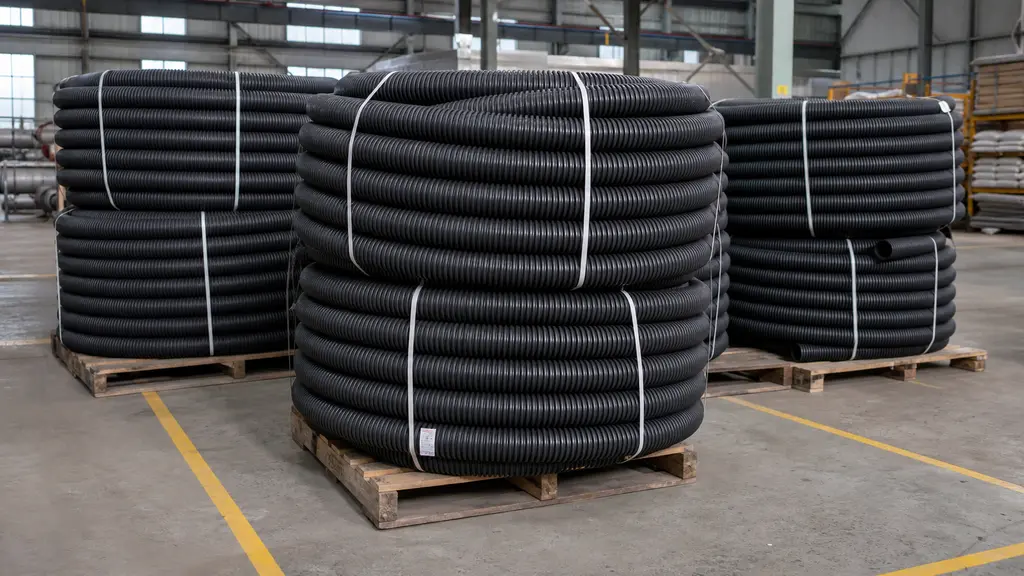
For the smaller sizes—anything up to DN100 (4 inches)—the pipe remains highly flexible. Factories typically ship these in continuous coils ranging from 30 to 600 meters. However, once you push past the DN100 mark, the thicker walls stiffen the pipe considerably. Larger diameters ship in straight 3-meter or 6-meter sticks. Smart buyers always pull the full manufacturer size chart to verify exact dimensional tolerances and packaging specs before ordering.
| Nominal Diameter (DN) | Outer Diameter (mm) | Inner Diameter (mm) | Standard Supply Format | Typical Application |
|---|---|---|---|---|
| DN75 (3″) | 89 | 75 | 50m/100m/200m Coils | Residential landscape drainage |
| DN100 (4″) | 118 | 100 | 50m/100m/200m Coils | Agricultural field drainage |
| DN150 (6″) | 175 | 150 | 6m Sticks | Highway edge drains |
| DN200 (8″) | 232 | 200 | 6m Sticks | Commercial foundation drains |
| DN250 (10″) | 288 | 250 | 6m Sticks | Temporary construction drainage |
| DN300 (12″) | 350 | 300 | 6m Sticks | Stormwater collection |
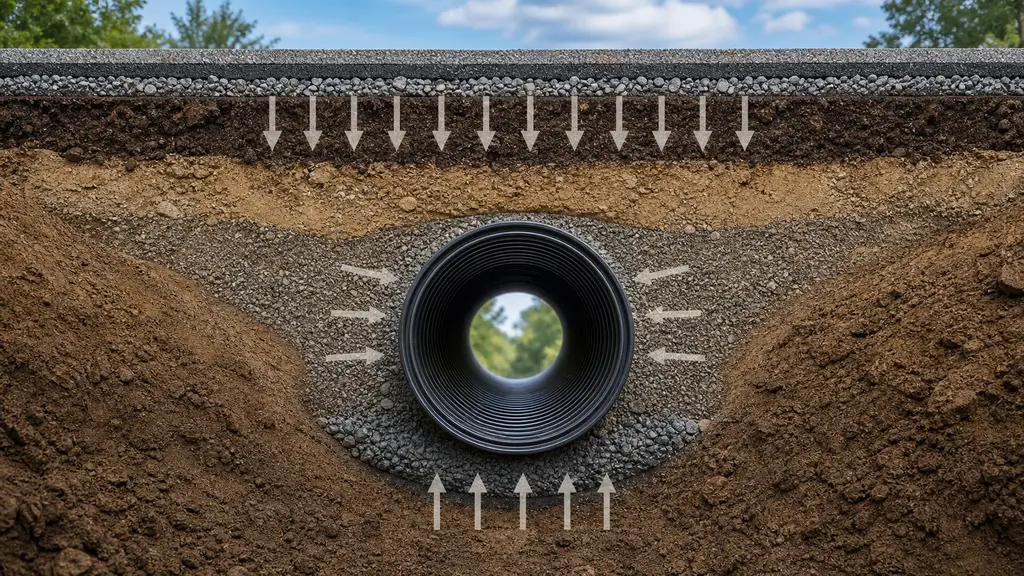
Ring stiffness (SN) is the metric that matters most here. It measures how well a corrugated pipe fights back against external radial forces—essentially, its ability to carry soil weight and surface traffic without flattening out. Because these pipes handle gravity-fed flow, they don’t carry an internal pressure rating (PN). Their structural survival entirely depends on their SN classification.
Nailing down the right SN rating and stiffness class is the only way to prevent ugly underground deformations. That stiffness class directly dictates how deep you can bury the pipe and what kind of vehicles can drive over it.
| Ring Stiffness Class | Load Capacity | Recommended Burial Depth | Typical Load Scenario |
|---|---|---|---|
| SN2 (2 kN/m²) | Light Duty | Shallow (0.5m – 1.0m) | Pedestrian traffic, residential gardens |
| SN4 (4 kN/m²) | Medium Duty | Standard (1.0m – 2.5m) | Agricultural fields, light vehicle driveways |
| SN8 (8 kN/m²) | Heavy Duty | Deep (up to 4.5m) | H-25 highway traffic, municipal infrastructure |
HDPE single wall corrugated pipe doesn’t just come in one flavor. Manufacturers produce various configurations to tackle specific environmental hazards and meet strict utility identification codes. Physically, you have two main types: solid (non-perforated) for moving fluids and shielding cables, and perforated (slotted or drilled) for soaking up subsurface water. If your job site is packed with fine sand or silt, those perforated pipes absolutely need an optional geotextile wrap (a fabric sock). Without it, soil will infiltrate and clog the line.
To stay compliant with the APWA (American Public Works Association) Uniform Color Code, utility conduits are extruded in highly specific colors. These colored variants are packed with UV stabilizers (meeting ASTM F2160) to fight off sun degradation while sitting in outdoor storage yards.
| Pipe Color | APWA Utility Designation | Typical Use Case |
|---|---|---|
| Black | Standard Drainage | Stormwater, agricultural drainage (contains carbon black for high UV resistance) |
| Red | Electrical | Underground power lines and lighting cables |
| Orange | Telecommunications | Fiber optic conduits and communication cables |
| Green | Sewer | Sanitary sewer and drain lines |
| Blue | Potable Water | Non-pressurized potable water routing |
Guesswork has no place in pipeline procurement. Selecting the exact right HDPE single wall corrugated pipe means carefully evaluating your site’s hydraulic, structural, and environmental realities. Sticking to a systematic selection process is the best way to prevent premature blowouts and maintain regulatory compliance.
Step-by-Step Selection Process:
1. Determine the Functional Type: Make the call between solid (for conduit and gravity flow) or perforated (for water collection). If you go perforated, check the soil report to see if a geotextile sock is mandatory.
2. Calculate Load Requirements: Look at your burial depth and surface traffic. Specify SN2 for simple pedestrian walkways, SN4 for standard agricultural fields, or SN8 if heavy vehicles will be driving overhead.
3. Select Diameter and Length: Figure out your required water flow rate or the total thickness of your cable bundle to pinpoint the Nominal Diameter (DN). Grab continuous coils for smaller jobs to cut down on joints, or straight sticks for the big stuff.
4. Choose the Color Code: Burying utility lines? Match the APWA color code exactly (like red for high-voltage electrical, or orange for telecom fiber).
Procurement Evaluation Checklist:
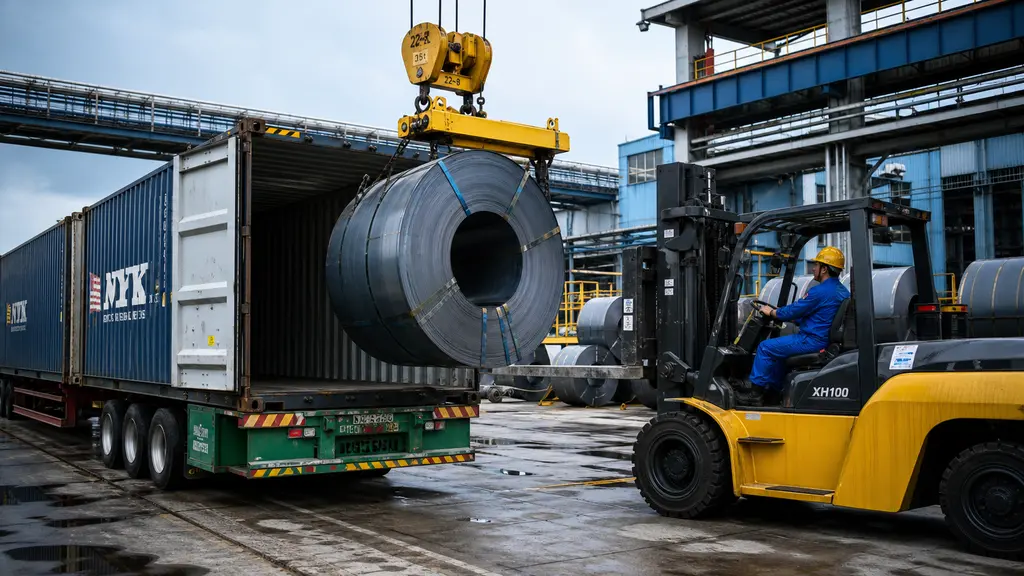
Figuring out the true price per meter for single wall corrugated pipe means looking at a few different manufacturing and logistical moving parts. The biggest cost drivers? The specific HDPE resin grade (virgin versus recycled), the wall thickness needed to hit your target SN rating, and the sheer physical volume of the freight. Corrugated coils take up a massive amount of cube space in a truck or shipping container.
While retail prices in the US for a standard 4-inch perforated pipe hover around $1.54 per foot ($5.05 per meter), securing factory-direct wholesale pricing from a massive manufacturer will drastically improve your project’s ROI.
Logistics and Supply Parameters:
Blindly purchasing corrugated drainage pipe without scrutinizing the spec sheet is a recipe for catastrophic underground failure. When a pipe collapses, the excavation and replacement costs are brutal. Stay highly vigilant and watch out for these critical red flags during sourcing.
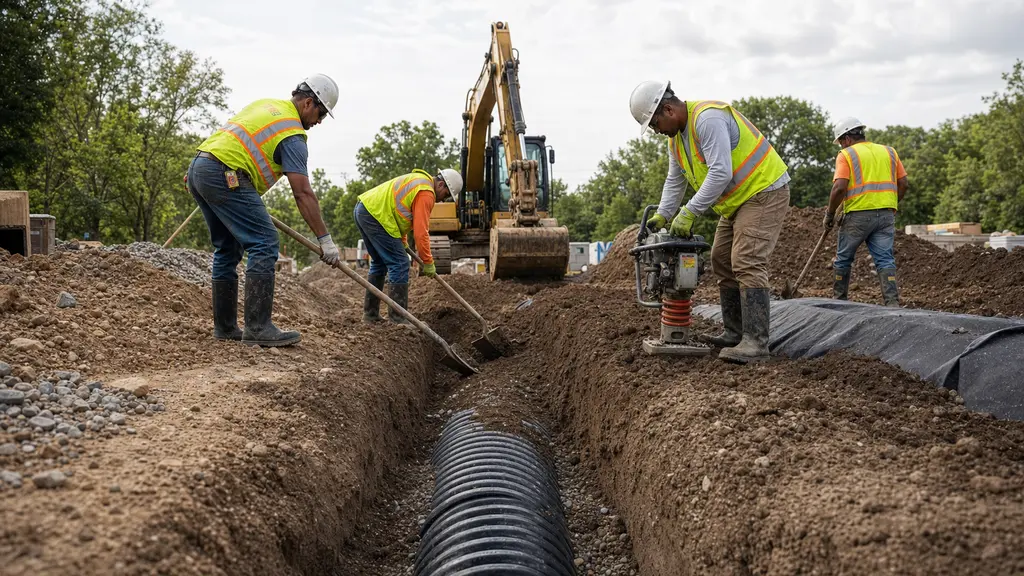
Manufacturing quality means nothing if the installation is sloppy. Proper execution according to ASTM D2321 is non-negotiable. Even a heavy-duty SN8-rated pipe will crush if the trenching and backfilling phases are botched. The entire installation philosophy revolves around achieving perfect soil compaction around the pipe so the earth shares the structural load.
Step-by-Step Installation Process:
1. Trenching: Dig the trench wide enough to allow heavy compaction equipment on the sides. Create a ‘subtrench’ no higher than 24 inches above the trench floor to embed the pipe perfectly.
2. Bedding: Put down a stable, perfectly uniform foundation using Class I or Class II granular dirt. Double-check that your trench gradient matches the hydraulic blueprints.
3. Placement and Joining: Roll out your coil or drop in the straight sticks. Lock the joints together using compatible split-couplers or snap couplers. They must be tight enough to block soil from sneaking in.
4. Backfilling: Stick to Class I, II, or III soils. You can dump Class I straight in, but Class II and III require mechanical compaction in controlled lifts to squeeze out air voids. Never let heavy compaction machinery strike the pipe directly.
5. Burial Depth: You need an absolute minimum cover of 12 inches (0.3m) before letting any H-25 vehicle drive over the trench. Maximum burial depths usually cap out between 10 to 15 feet, depending entirely on your soil class and compaction density.
Post-Installation QC Checklist:
What is the difference between single wall and double wall HDPE corrugated pipe?
Single wall corrugated pipe features a ribbed exterior and a matching ribbed interior. This makes it incredibly flexible, lightweight, and budget-friendly for things like agricultural drainage or burying cables. Double wall corrugated pipe (DWC) keeps the ribbed exterior but adds a smooth inner lining. That smooth core delivers superior hydraulic flow and much higher structural rigidity, making it the go-to for heavy-duty municipal sewer lines.
What sizes does HDPE single wall corrugated pipe come in?
You’ll generally see sizes ranging from DN75 (3 inches) up to DN600 (24 inches). The smaller diameters—up to DN100 (4 inches)—are highly flexible and ship in massive continuous coils up to 600 meters long. Once you get into the larger diameters, the pipe becomes rigid and is sold in 3-meter or 6-meter straight sticks.
Can single wall corrugated pipe be buried underground?
Yes, it is purposefully engineered for underground burial. However, its survival depends heavily on correct trenching and backfilling techniques. By matching the right Ring Stiffness (SN) class—like SN4 or SN8—to your site, the pipe will easily handle heavy soil weight and surface traffic.
Is HDPE single wall corrugated pipe suitable for cable protection?
Absolutely. Solid (non-perforated) single wall corrugated pipe serves as an excellent, highly flexible conduit for underground electrical and telecommunication lines. Manufacturers often color-code it (such as red for power lines and orange for telecom) to comply with APWA utility identification rules.
What SN rating do I need for buried drainage applications?
If you are working in shallow residential or pedestrian zones, an SN2 rating does the job. For standard agricultural fields and light residential driveways, step up to SN4. If your project involves deep burial or heavy H-25 highway traffic, an SN8 rating is non-negotiable to prevent a total pipe collapse.
How long does HDPE single wall corrugated pipe last?
When extruded from premium HDPE resin and buried strictly according to ASTM D2321 protocols, these pipes easily last anywhere from 10 to 25 years. You can push that lifespan to the absolute maximum by guaranteeing perfect soil compaction and keeping the pipe out of direct sunlight before burial.
What is the MOQ for wholesale HDPE corrugated pipe orders?
For factory-direct international wholesale, the Minimum Order Quantity (MOQ) usually sits at 1,000 meters, or whatever volume is required to pack out one standard 20-foot shipping container. This threshold ensures you get the best possible freight rates and production pricing.
How do I identify a high-quality HDPE corrugated pipe supplier?
Start by checking for ISO 9001 and ISO 14001 certifications. Next, ask them to hand over their Environmental Stress Crack Resistance (ESCR) test data. Verify that they actually comply with AASHTO or ASTM standards, and confirm they have the massive manufacturing footprint required to deliver consistent quality on tight deadlines.
Picking the correct HDPE single wall corrugated pipe isn’t just about grabbing the cheapest coil off the shelf; it demands a thorough read of your project’s environmental conditions, structural loads, and material specs. Whether you’re draining a commercial soybean field or shielding high-voltage urban power lines, the pipeline’s success comes down to a few critical choices. You must nail the nominal diameter (DN), match the ring stiffness (SN) to your specific burial depth, and verify that the resin quality passes brutal ESCR testing.
Dodging common procurement traps—like buying cheap, unverified recycled resin blends or forgetting to order a geotextile sock for sandy soils—will save you from catastrophic system failures down the road. By holding your suppliers to strict AASHTO and ASTM manufacturing standards, and forcing your installation crews to follow ASTM D2321 protocols to the letter, you guarantee an underground infrastructure system that is resilient, cost-effective, and built to last.