Address
Zhengzhou, Henan, China
Work Hours
Monday to Friday: 7AM - 7PM
Weekend: 10AM - 5PM
Address
Zhengzhou, Henan, China
Work Hours
Monday to Friday: 7AM - 7PM
Weekend: 10AM - 5PM


High-density polyethylene (HDPE) pipes are widely used in municipal water supply, gas transmission, agricultural irrigation, and industrial applications due to their exceptional corrosion resistance, durability, high water flow capacity, flexibility, and ease of installation. HDPE pipes and fittings are integral components of HDPE piping systems. To ensure the long-term safety and stable operation of these systems, mastering critical and standardized installation methods is paramount. The lifespan and performance of HDPE piping systems largely depend on the accuracy of the installation process.
HDPE pipe and fittings are widely used plastic pipes and accessories in modern pipeline engineering. Made primarily from high-density polyethylene, HDPE pipes are lighter and more durable than traditional metal pipes. They offer superior corrosion resistance, impact resistance, flexibility, and extended service life, making them ideal for urban water supply, gas transmission, drainage and sewage systems, agricultural irrigation, and industrial fluid transportation. The complex installation of HDPE pipelines necessitates the use of matching HDPE fittings for connections, thereby achieving a complete piping system.
HDPE pipe fittings primarily serve to connect, divert, redirect, or seal off sections. Common key types include elbow, tee, cross, flange, and reducer. Connections between HDPE pipes and fittings can be achieved through methods such as butt fusion, electrofusion, socket fusion, PP compression fittings, or flange connections, ensuring the safety and integrity of the PE piping system.
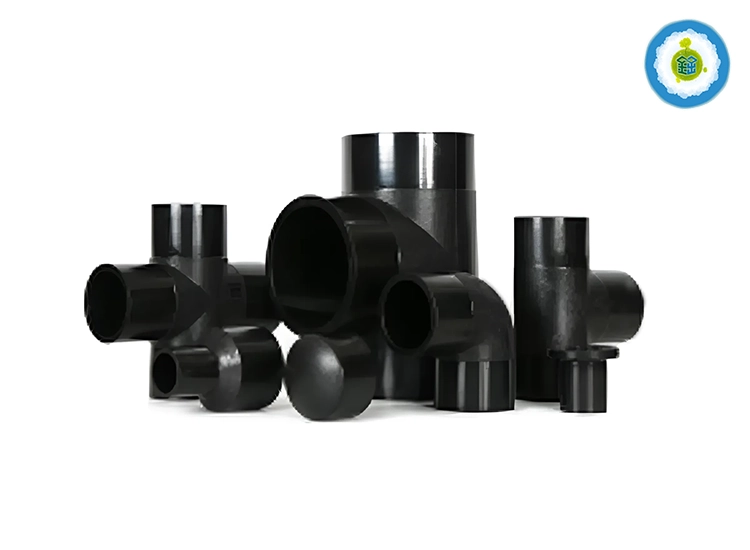
To ensure the long-term safe and stable operation of HDPE piping systems, the following 10 essential installation techniques and additional precautions will help construction personnel improve work efficiency and enhance pipeline reliability.
Before construction begins, it is essential to develop a well-planned layout for the installation of HDPE pipes and create comprehensive engineering design drawings. These drawings should clearly define the pipeline route, slope, joint locations, and the relationship between the pipeline and surrounding facilities to ensure smooth water flow and balanced pressure distribution. Additionally, maintenance access points or inspection chambers should be incorporated at critical junctions based on the construction environment to facilitate future maintenance and troubleshooting. Thorough preliminary planning not only significantly reduces construction complexity and costs but also minimizes future maintenance frequency, extends pipeline service life, and ensures long-term system stability and safety.
Based on the designed drawings, select appropriate HDPE pipes and fittings. Performance requirements for PE pipes and fittings vary depending on different application scenarios, operating pressures, and conveyed substances. Therefore, we should reasonably choose the SDR, pressure rating, and pipe diameter according to actual needs to ensure compliance with design standards. Additionally, the selected fittings’ specifications and dimensions must perfectly match the pipes; otherwise, loose connections or leaks may occur during installation.
Before installing HDPE pipe and fittings, thorough preparation is essential to ensure smooth subsequent installation. First, inspect all pipes and fittings for cracks, scratches, deformation, or other defects. Second, store all HDPE pipes and fittings appropriately. Clear the construction site in advance to avoid obstructions during work. Additionally, prepare necessary tools such as welding machines and cutters beforehand. Ensure on-site personnel are familiar with construction procedures and safety protocols to minimize risks and hazards during installation.
Trench excavation and foundation preparation are critical steps in HDPE water pipe installation, directly impacting pipeline stability and service life. Trench depth and width must meet design specifications, ensuring sufficient burial depth to prevent frost heave or external damage while avoiding excessive width that complicates backfilling. The trench bottom should be leveled and lined with fine sand or soft soil to prevent sharp stones or hard objects from puncturing the pipe. Simultaneously, the trench slope must be reasonably designed to ensure unimpeded drainage and prevent water accumulation from exerting additional pressure on the pipes. Proper trench excavation and foundation preparation not only enhance construction quality but also provide reliable assurance for subsequent pipeline operation.
During the installation of HDPE pipes and fittings, pipe cutting is a critical operation. Using specialized HDPE pipe cutting tools ensures clean, level, and smooth cut surfaces. Post-cutting treatment is essential to prevent burrs from compromising joint sealing integrity. Irregular cuts may cause uneven stress distribution on the welded surface, increasing the risk of leakage. Adhering to standardized cutting procedures guarantees joint sealing performance and subsequent welding quality.
HDPE pipe connections come in various methods, including butt fusion welding, socket fusion welding, electrofusion welding, and compression fittings connection for smaller diameters. Different connection methods suit distinct scenarios and requirements: butt fusion welding provides robust connections across multiple diameters; electrofusion welding is better suited for confined spaces; while PP compression fittings are ideal for temporary pipelines or PE pipe systems requiring frequent disassembly. Regardless of the chosen method, connections must strictly adhere to the operating manual to ensure reliable, long-term performance of the pipeline system.
HDPE pipe and fittings exhibit significant thermal expansion and contraction under temperature changes. If improperly managed, this can lead to pipe bending, joint loosening, or even rupture. During design and installation, this characteristic must be fully accounted for by allowing sufficient expansion space. For instance, in long straight pipe runs, thermal stress can be mitigated by strategically placing elbows, expansion joints, or fixed support points. Additionally, during construction, avoid over-tightening pipe restraints to ensure adequate free displacement space. This enhances the operational reliability of the entire HDPE piping system.
Welding quality determines the sealing integrity and reliability of HDPE piping systems. During welding, heating plate temperature, heating duration, and butt pressure must be strictly controlled to ensure uniform and robust welds. After welding, a period of natural cooling is required without moving the joint or applying external forces that could compromise overall strength. Proper monitoring of the welding and cooling processes significantly enhances joint reliability and reduces leakage risks.
Before the pipeline system is put into formal operation, rigorous pressure testing must be conducted to verify its sealing integrity and pressure-bearing capacity. The pressure test consists of three stages: gradual pressurization, pressure stabilization, and depressurization. During gradual pressurization, pressure should be increased slowly. During the stabilization phase, the specified pressure must be maintained for a defined period while monitoring for any pressure leaks. This prevents potential hazards from causing severe failures during subsequent operation.
Backfilling is a critical step in ensuring the safe operation of HDPE pipes. Backfill material should consist of fine soil or sandy soil, avoiding direct contact between sharp stones and the pipe walls to prevent scratches or stress concentration. Backfill should be compacted in layers to ensure even stress distribution on the pipeline while preventing excessive compaction that could cause deformation. In areas subject to vehicular loads or potential heavy object passage, a protective layer or casing may be installed above the pipeline to enhance compressive strength. Protective measures should be implemented for exposed sections. Scientific and reasonable backfilling and protective measures not only enhance pipeline safety but also effectively extend its service life.
In addition to the above 10 installation tips, take care to avoid collisions and crushing during transportation. When installing, consider ground temperature, geological conditions, groundwater levels, and drainage to prevent pipes from deforming or experiencing uneven stress due to prolonged exposure to external environmental factors. When installing HDPE pipes and fittings, wear appropriate protective gear and adhere to construction safety regulations to ensure safe operations.
The proper installation of HDPE pipe and fittings is fundamental to ensuring the long-term stable operation of the system. By following the 10 installation tips outlined in this article—covering every stage from pre-installation planning to post-installation testing—HDPE pipes can fully leverage their durability, environmental friendliness, and efficiency through scientific design and standardized construction. This enables the entire HDPE piping system to operate reliably over the long term, providing lasting assurance for municipal engineering, agricultural irrigation, and industrial conveyance.
Fill out the form and our team will contact you shortly.